QUESTION IMAGE
Question
similarity and transformations
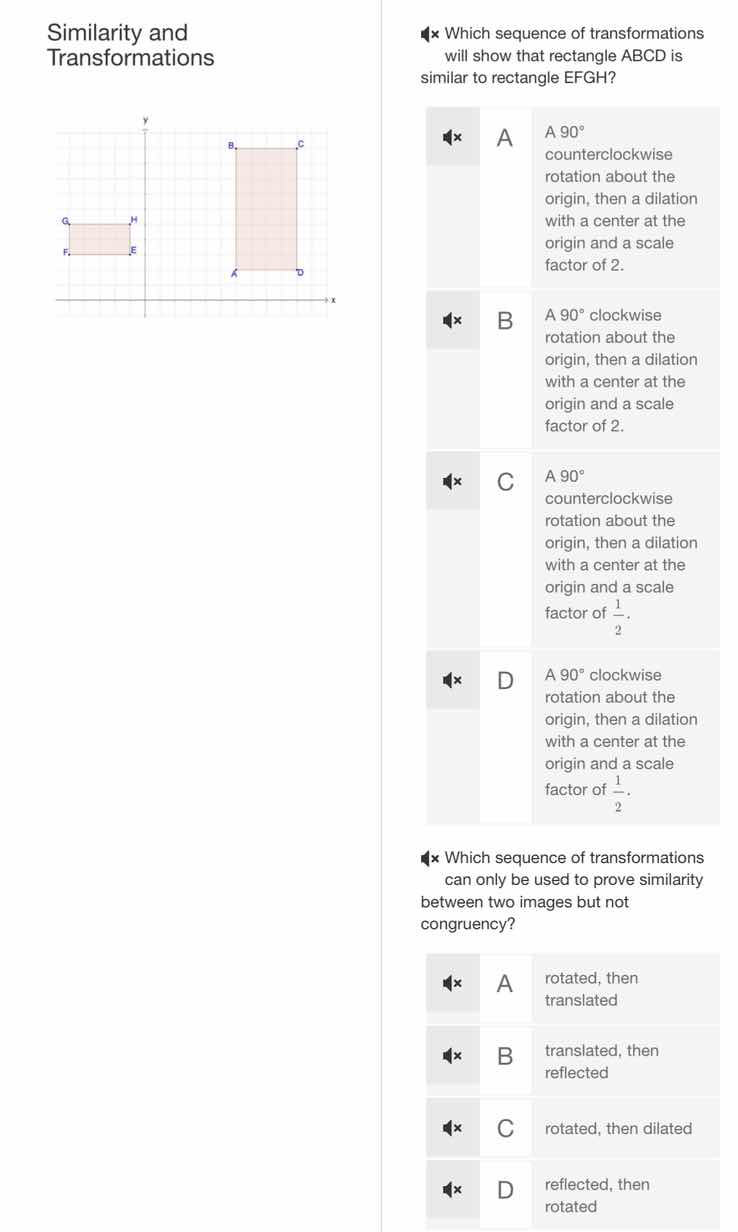
which sequence of transformations will show that rectangle abcd is similar to rectangle efgh?
a a 90° counterclockwise rotation about the origin, then a dilation with a center at the origin and a scale factor of 2.
b a 90° clockwise rotation about the origin, then a dilation with a center at the origin and a scale factor of 2.
c a 90° counterclockwise rotation about the origin, then a dilation with a center at the origin and a scale factor of \\(\frac{1}{2}\\).
d a 90° clockwise rotation about the origin, then a dilation with a center at the origin and a scale factor of \\(\frac{1}{2}\\).
which sequence of transformations can only be used to prove similarity between two images but not congruency?
a rotated, then translated
b translated, then reflected
c rotated, then dilated
d reflected, then rotated
First Question (Rectangle Similarity Transformations)
Step1: Analyze Rotation Direction
To map rectangle EFGH to ABCD, a 90° clockwise rotation (or 270° counterclockwise) aligns the orientation. A 90° counterclockwise rotation would not align them correctly.
Step2: Analyze Dilation Scale Factor
Rectangle ABCD is larger than EFGH. The scale factor for dilation (to make EFGH match ABCD) should be 2 (since ABCD appears twice as big). A scale factor of \( \frac{1}{2} \) would shrink, not expand. So a 90° clockwise rotation followed by dilation with scale factor 2 (option B) works.
- Rotation, translation, reflection are rigid transformations (preserve size/shape, so congruent).
- Dilation changes size (scales), so combining rotation (rigid) with dilation (non - rigid) proves similarity (same shape, different size) but not congruence (needs same size/shape). Options A, B, D use only rigid transformations (rotation/translation/reflection), which preserve congruence. Option C (rotated, then dilated) includes dilation, so it can only prove similarity.

Snap & solve any problem in the app
Get step-by-step solutions on Sovi AI
Photo-based solutions with guided steps
Explore more problems and detailed explanations
B. A 90° clockwise rotation about the origin, then a dilation with a center at the origin and a scale factor of 2.