QUESTION IMAGE
Question
similarity & transformations
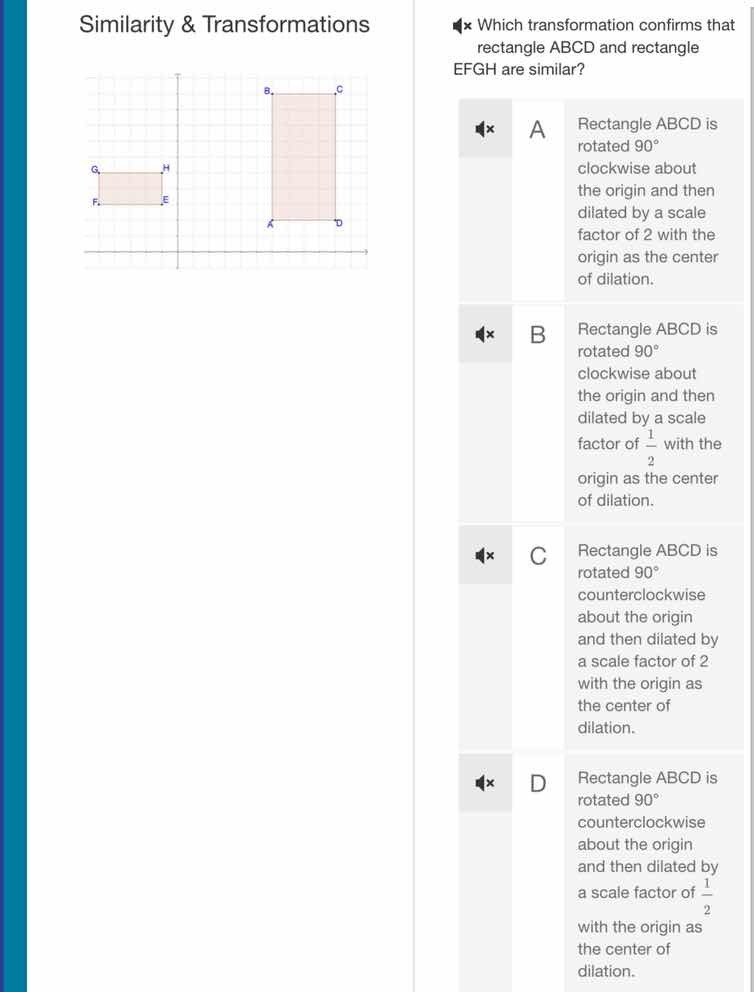
which transformation confirms that rectangle abcd and rectangle efgh are similar?
a rectangle abcd is rotated 90° clockwise about the origin and then dilated by a scale factor of 2 with the origin as the center of dilation.
b rectangle abcd is rotated 90° clockwise about the origin and then dilated by a scale factor of \\(\frac{1}{2}\\) with the origin as the center of dilation.
c rectangle abcd is rotated 90° counterclockwise about the origin and then dilated by a scale factor of 2 with the origin as the center of dilation.
d rectangle abcd is rotated 90° counterclockwise about the origin and then dilated by a scale factor of \\(\frac{1}{2}\\) with the origin as the center of dilation.
Step1: Analyze Rotation Direction
First, observe the orientation of the rectangles. To map ABCD to EFGH's orientation, a 90° clockwise rotation (or 270° counterclockwise) is needed? Wait, no—wait, ABCD is a taller rectangle, EFGH is shorter and wider. Wait, when we rotate 90° clockwise, the height and width swap. Then, dilation: EFGH is smaller than ABCD? Wait, no, looking at the grid, ABCD is taller, EFGH is shorter. Wait, if we rotate ABCD 90° clockwise, its length and width swap, then dilate by 1/2 to get EFGH's size. Wait, let's check the options. Option B: rotate 90° clockwise, then dilate by 1/2. Let's verify: Rotating 90° clockwise changes the orientation, then dilating by 1/2 (scaling down) would make it the size of EFGH. Option D is counterclockwise, which would not match the orientation. So first, rotation direction: clockwise (option A or B). Then dilation factor: EFGH is smaller, so scale factor less than 1, so 1/2. So option B.
Step2: Confirm Dilation and Rotation
- Rotation: 90° clockwise aligns the sides (since ABCD is vertical, rotating 90° clockwise makes it horizontal, like EFGH).
- Dilation: Scale factor 1/2 reduces the size of the rotated ABCD to match EFGH's dimensions.

Snap & solve any problem in the app
Get step-by-step solutions on Sovi AI
Photo-based solutions with guided steps
Explore more problems and detailed explanations
B. Rectangle ABCD is rotated \( 90^\circ \) clockwise about the origin and then dilated by a scale factor of \( \frac{1}{2} \) with the origin as the center of dilation.