QUESTION IMAGE
Question
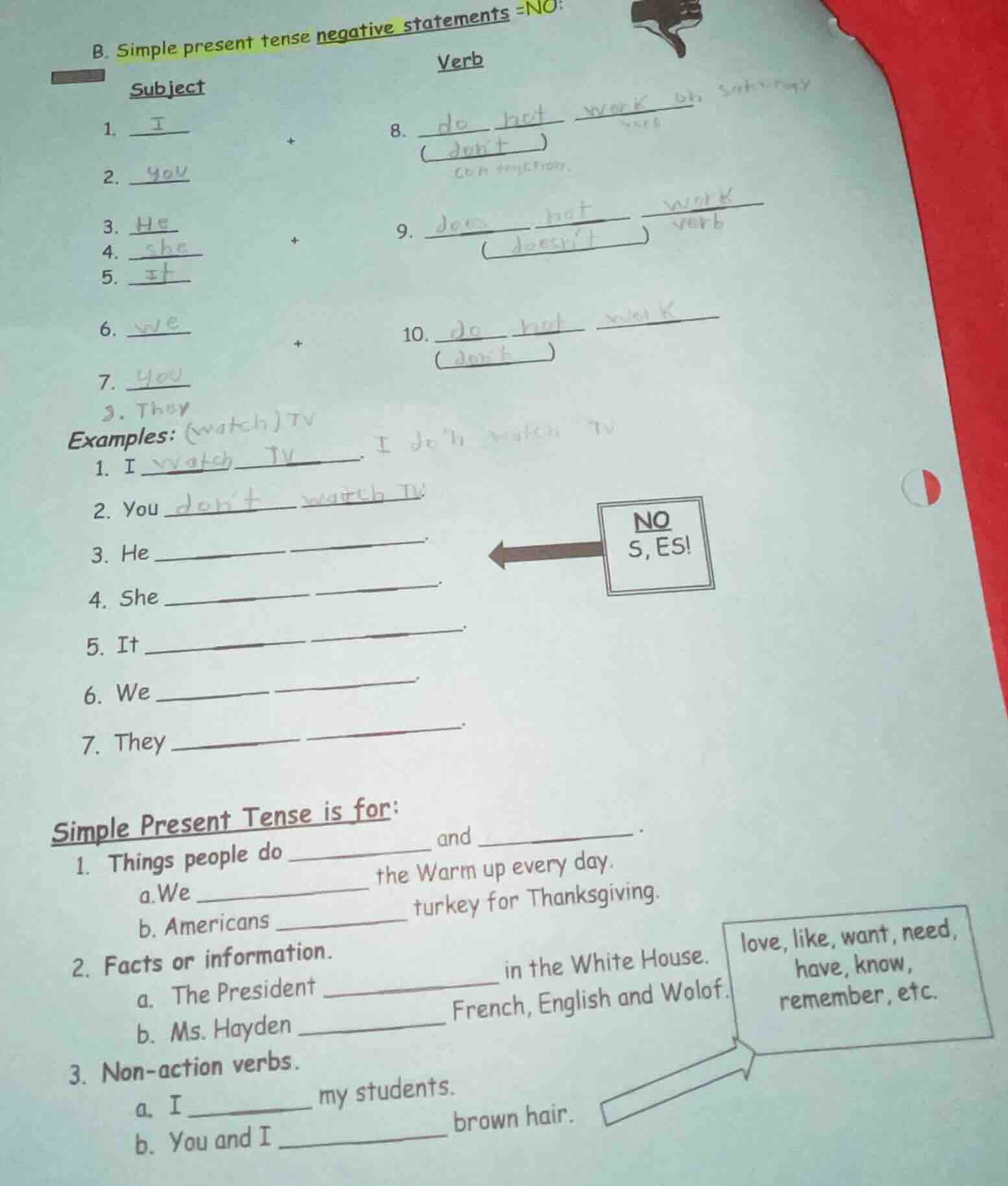
b. simple present tense negative statements =no:
subject verb
1.
2.
3.
4.
5.
6.
7.
8.
( )
9.
( )
examples: (watch) tv
- i
- you
- he
- she
- it
- we
- they
simple present tense is for:
- things people do and .
a.we the warm up every day.
b. americans turkey for thanksgiving.
- facts or information.
a. the president in the white house.
b. ms. hayden french, english and wolof.
- non - action verbs.
a. i my students.
b. you and i brown hair.
no s, es!
love, like, want, need, have, know, remember, etc.
To solve the simple present tense negative statements and fill - in - the - blank questions about the use of simple present tense, we analyze them as follows:
Part 1: Simple present tense negative statements
For subject "I", "you", "we", "they" (non - third - person singular)
The negative form of the simple present tense is formed by using "do not" (contracted as "don't") followed by the base form of the verb. For example, for the sentence pattern "Subject + do not + verb", when the subject is "I", "you", "we", or "they", we use "don't" + verb.
For subject "he", "she", "it" (third - person singular)
The negative form is formed by using "does not" (contracted as "doesn't") followed by the base form of the verb.
Let's take the example of the verb "watch" (the example given in the problem):
- 3. For "He", since it is a third - person singular subject, the negative form is "doesn't watch".
- 4. For "She", as a third - person singular subject, the negative form is "doesn't watch".
- 5. For "It", as a third - person singular subject, the negative form is "doesn't watch".
- 6. For "We", as a non - third - person singular subject, the negative form is "don't watch".
- 7. For "They", as a non - third - person singular subject, the negative form is "don't watch".
Part 2: Fill - in - the - blank questions about the use of simple present tense
1. Things people do (routines and habits)
The simple present tense is used to express routines and habits. For example:
- a. "We do the Warm up every day." (Here, "do" is used to express the routine of doing warm - up exercises.)
- b. "Americans eat turkey for Thanksgiving." (Eating turkey on Thanksgiving is a habit/routine, so we use the simple present tense "eat".)
2. Facts or information
The simple present tense is used to state facts. For example:
- a. "The President lives in the White House." (It is a fact that the President of the United States lives in the White House, so we use "lives".)
- b. "Ms. Hayden speaks French, English and Wolof." (Stating the fact of what languages Ms. Hayden knows how to speak, so we use "speaks".)
3. Non - action verbs
Non - action verbs (such as "love", "like", "want", "need", "have", "know", "remember" etc.) are used in the simple present tense to express states. For example:
- a. "I love my students." ( "love" is a non - action verb, expressing a state of emotion, so we use "love".)
- b. "You and I have brown hair." ( "have" is a non - action verb, expressing the state of possessing brown hair, so we use "have".)

Snap & solve any problem in the app
Get step-by-step solutions on Sovi AI
Photo-based solutions with guided steps
Explore more problems and detailed explanations
s to the blanks:
Simple present tense negative statements (taking "watch" as the verb example):
- He $\boldsymbol{doesn't}$ $\boldsymbol{watch}$
- She $\boldsymbol{doesn't}$ $\boldsymbol{watch}$
- It $\boldsymbol{doesn't}$ $\boldsymbol{watch}$
- We $\boldsymbol{don't}$ $\boldsymbol{watch}$
- They $\boldsymbol{don't}$ $\boldsymbol{watch}$
Fill - in - the - blank questions about the use of simple present tense:
- a. We $\boldsymbol{do}$ the Warm up every day.
b. Americans $\boldsymbol{eat}$ turkey for Thanksgiving.
- a. The President $\boldsymbol{lives}$ in the White House.
b. Ms. Hayden $\boldsymbol{speaks}$ French, English and Wolof.
- a. I $\boldsymbol{love}$ (or other non - action verbs like "like", "know" etc. according to the context) my students.
b. You and I $\boldsymbol{have}$ brown hair.