QUESTION IMAGE
Question
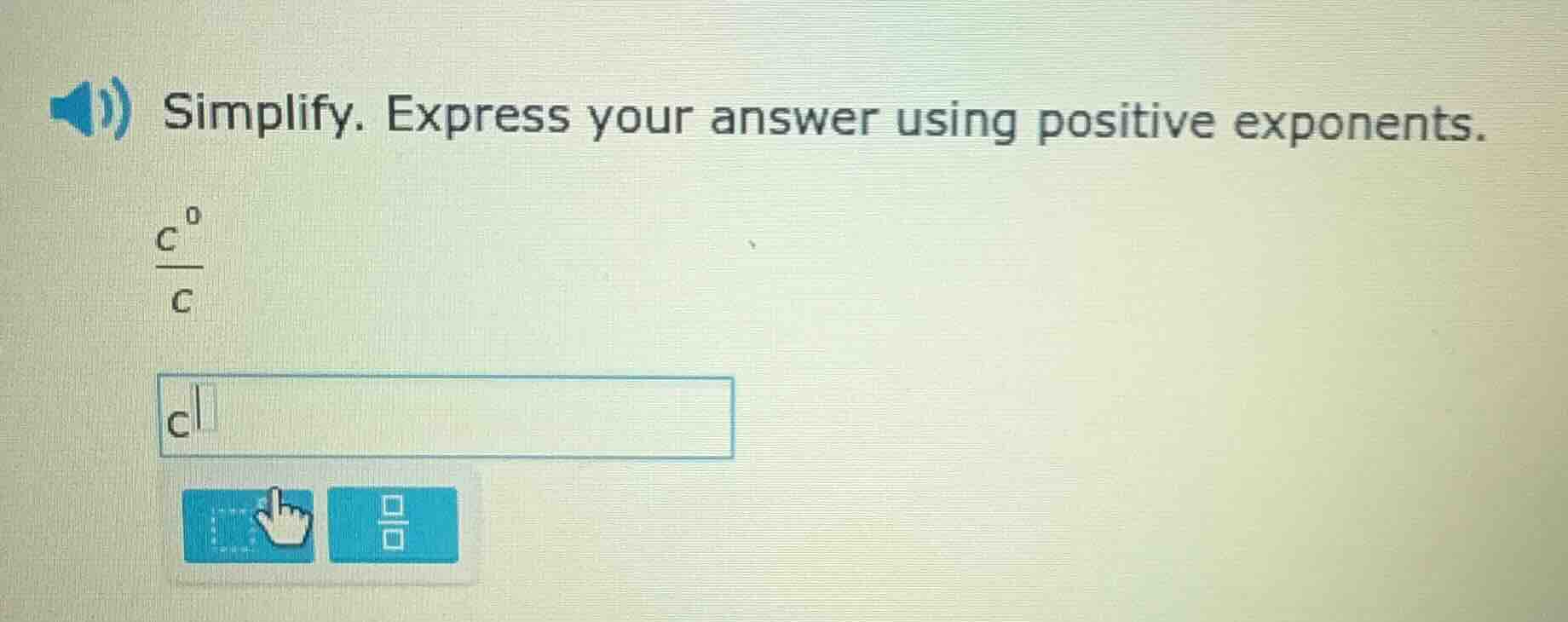
simplify. express your answer using positive exponents. \\(\frac{c^{0}}{c}\\)
Step1: Apply zero - exponent rule
Recall the zero - exponent rule: for any non - zero number \(a\), \(a^{0}=1\). Here, assuming \(c
eq0\), we have \(c^{0} = 1\). So the expression \(\frac{c^{0}}{c}\) becomes \(\frac{1}{c}\).
Step2: Express with positive exponent
We can rewrite \(\frac{1}{c}\) using the negative - exponent rule. The negative - exponent rule states that \(a^{-n}=\frac{1}{a^{n}}\) (or \(\frac{1}{a^{n}}=a^{-n}\) is not what we want here, wait, no: we want positive exponents? Wait, no, \(\frac{1}{c}=c^{- 1}\)? Wait, no, the problem says "express your answer using positive exponents". Wait, \(\frac{1}{c}\) is already with a positive exponent in the denominator? Wait, no, let's re - examine.
Wait, the original expression is \(\frac{c^{0}}{c}\). Since \(c^{0}=1\) (for \(c
eq0\)), then \(\frac{c^{0}}{c}=\frac{1}{c}\). But \(\frac{1}{c}\) can be written as \(c^{-1}\), but that has a negative exponent. Wait, no, maybe I made a mistake. Wait, the exponent rules: when dividing with the same base, \(a^{m}\div a^{n}=a^{m - n}\). So \(c^{0}\div c^{1}=c^{0 - 1}=c^{-1}=\frac{1}{c}\). But the problem says "express your answer using positive exponents". So \(\frac{1}{c}\) is in terms of positive exponents (the exponent of \(c\) in the denominator is \(1\), which is positive).
Wait, let's start over.
Step1: Simplify \(c^{0}\)
By the zero - exponent property, for any non - zero real number \(c\), \(c^{0}=1\). So the numerator \(c^{0}\) is equal to \(1\). So the expression \(\frac{c^{0}}{c}\) becomes \(\frac{1}{c}\).
Step2: Rewrite with positive exponents (if needed)
The expression \(\frac{1}{c}\) can be written as \(c^{-1}\), but that has a negative exponent. Wait, no, the problem says "express your answer using positive exponents". But \(\frac{1}{c}\) has \(c\) with a positive exponent (\(1\)) in the denominator. So the simplified form with positive exponents is \(\frac{1}{c}\) or \(c^{-1}\) is not positive. Wait, maybe I messed up the exponent rule.
Wait, the rule for dividing exponents with the same base: \(a^{m}\div a^{n}=a^{m - n}\). So \(c^{0}\div c^{1}=c^{0 - 1}=c^{-1}=\frac{1}{c}\). Since the problem asks for positive exponents, we can leave it as \(\frac{1}{c}\) (because the exponent of \(c\) in the denominator is \(1\), which is positive) or we can recognize that \(\frac{1}{c}\) is the simplest form with positive exponents (the exponent of \(c\) is \(1\) in the denominator, which is positive).

Snap & solve any problem in the app
Get step-by-step solutions on Sovi AI
Photo-based solutions with guided steps
Explore more problems and detailed explanations
\(\frac{1}{c}\) (or \(c^{-1}\) is incorrect for positive exponents, so the correct form with positive exponents is \(\frac{1}{c}\))