QUESTION IMAGE
Question
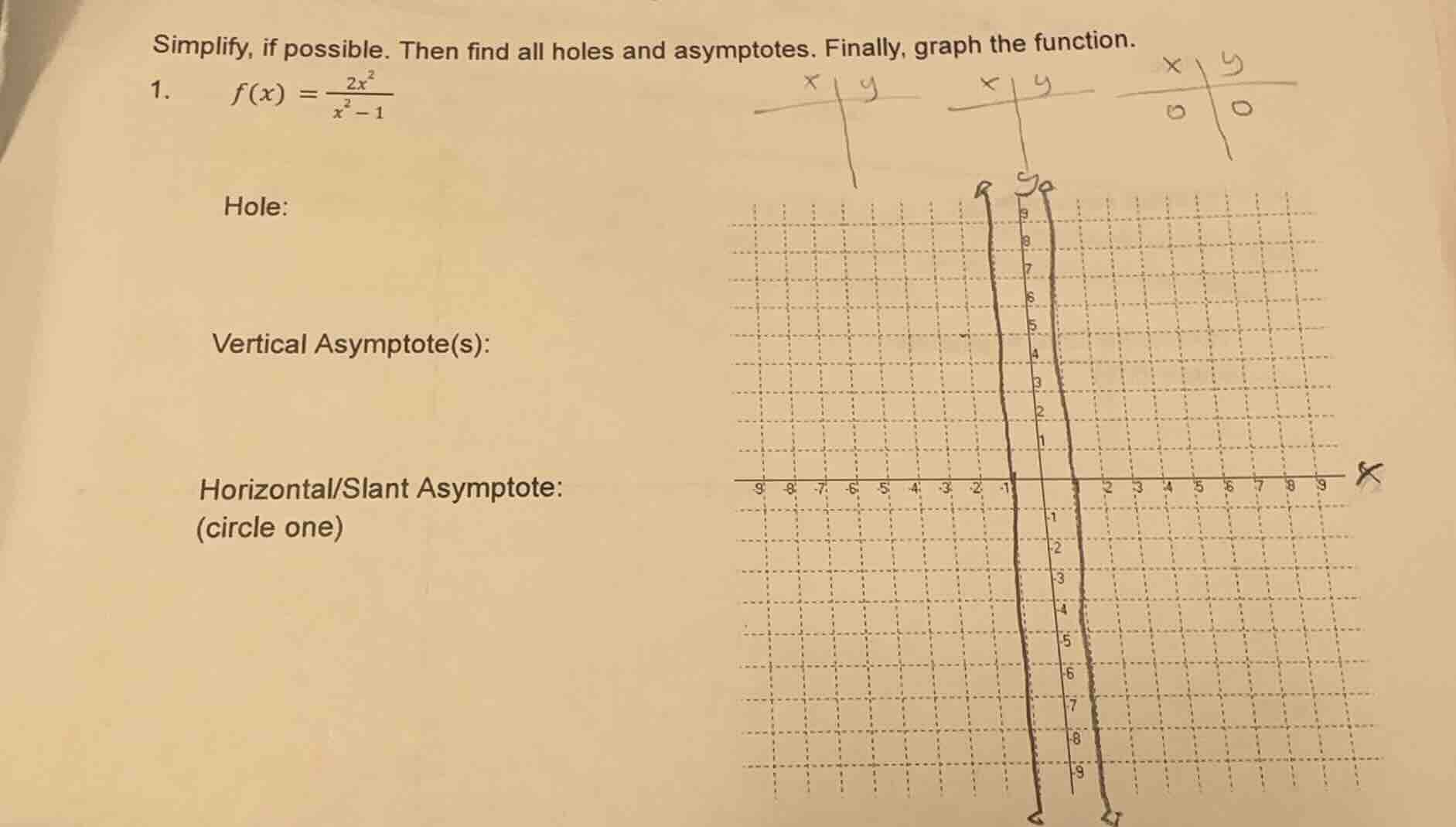
simplify, if possible. then find all holes and asymptotes. finally, graph the function.
- ( f(x) = \frac{2x^2}{x^2 - 1} )
hole:
vertical asymptote(s):
horizontal/slant asymptote:
(circle one)
Step1: Simplify the rational function
Factor the denominator: $x^2 - 1 = (x+1)(x-1)$. The numerator $2x^2$ has no common factors with the denominator, so the function cannot be simplified further:
$$f(x)=\frac{2x^2}{(x+1)(x-1)}$$
Step2: Identify holes
Holes occur when common factors cancel. Since there are no common factors between numerator and denominator, there are no holes.
Step3: Find vertical asymptotes
Vertical asymptotes occur where the denominator is 0 (and numerator is not 0):
Set $(x+1)(x-1)=0$, solve for $x$:
$x+1=0 \implies x=-1$; $x-1=0 \implies x=1$
Step4: Find horizontal asymptote
Compare degrees of numerator and denominator. Both are degree 2. The horizontal asymptote is the ratio of leading coefficients:
$$y=\frac{2}{1}=2$$

Snap & solve any problem in the app
Get step-by-step solutions on Sovi AI
Photo-based solutions with guided steps
Explore more problems and detailed explanations
Hole: None
Vertical Asymptote(s): $x=-1$, $x=1$
Horizontal/Slant Asymptote: Horizontal, $y=2$
(Note: The graph should include the horizontal asymptote $y=2$, vertical asymptotes $x=-1$ and $x=1$, pass through the origin $(0,0)$, and approach the asymptotes as $x$ approaches $\pm1$ and $\pm\infty$.)