QUESTION IMAGE
Question
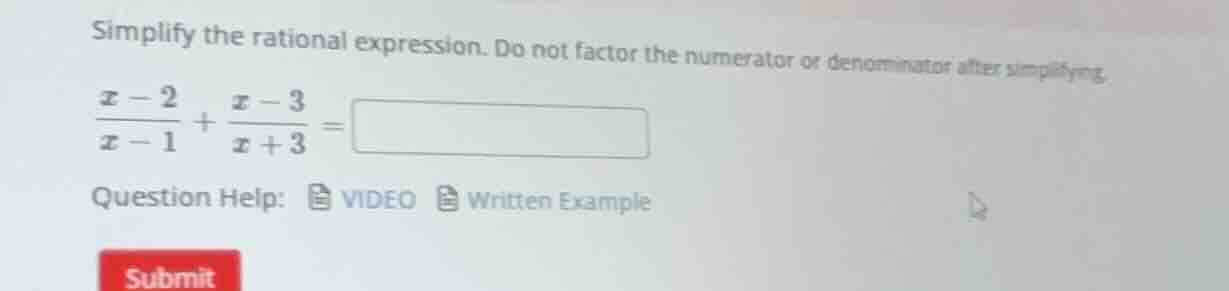
simplify the rational expression. do not factor the numerator or denominator after simplifying.
$\frac{x - 2}{x - 1} + \frac{x - 3}{x + 3} = $
question help: video written example
submit
Step1: Find common denominator
The common denominator is $(x-1)(x+3)$.
Rewrite each fraction:
$\frac{(x-2)(x+3)}{(x-1)(x+3)} + \frac{(x-3)(x-1)}{(x-1)(x+3)}$
Step2: Expand numerators
Expand each product in numerator:
First term: $(x-2)(x+3) = x^2 + 3x - 2x - 6 = x^2 + x - 6$
Second term: $(x-3)(x-1) = x^2 - x - 3x + 3 = x^2 - 4x + 3$
Step3: Add numerators
Combine the expanded numerators over common denominator:
$\frac{(x^2 + x - 6) + (x^2 - 4x + 3)}{(x-1)(x+3)}$
Step4: Simplify numerator
Combine like terms in numerator:
$x^2 + x^2 + x - 4x - 6 + 3 = 2x^2 - 3x - 3$
Step5: Final expression
Write simplified expression:
$\frac{2x^2 - 3x - 3}{(x-1)(x+3)}$
Expand denominator (per instruction not to factor after simplifying):
$(x-1)(x+3) = x^2 + 3x - x - 3 = x^2 + 2x - 3$
So the expression becomes $\frac{2x^2 - 3x - 3}{x^2 + 2x - 3}$

Snap & solve any problem in the app
Get step-by-step solutions on Sovi AI
Photo-based solutions with guided steps
Explore more problems and detailed explanations
$\frac{2x^2 - 3x - 3}{x^2 + 2x - 3}$