QUESTION IMAGE
Question
sinusoidal graphs
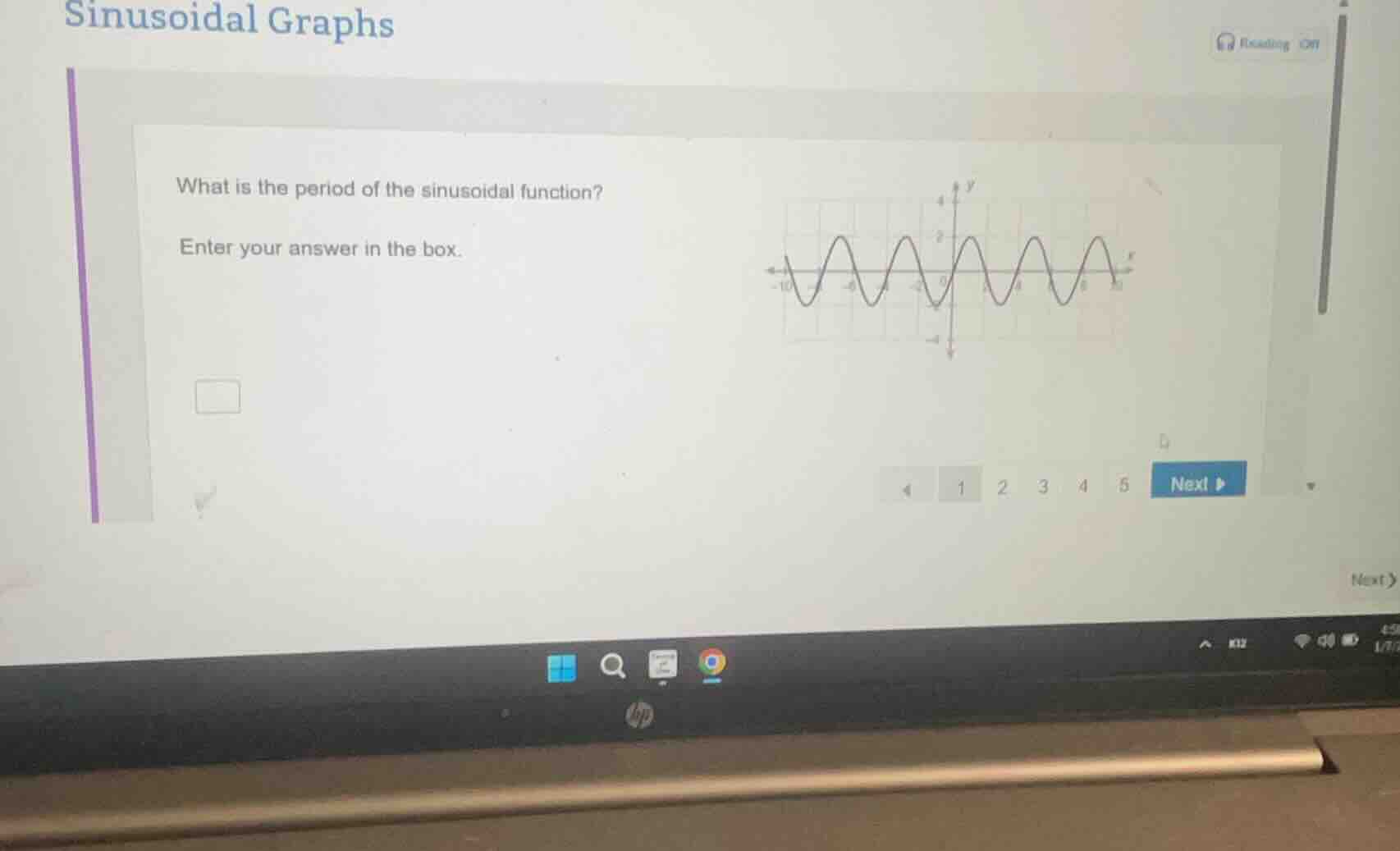
what is the period of the sinusoidal function?
enter your answer in the box.
(there is a sinusoidal graph with x - axis labeled from -10 to 10 and y - axis labeled from -4 to 4)
Step1: Identify period definition
The period of a sinusoidal function is the horizontal length of one complete cycle (from peak to peak, trough to trough, or any corresponding points).
Step2: Analyze the graph's x - axis
Looking at the x - axis, we can observe the distance between two consecutive corresponding points (e.g., from one peak to the next peak or one trough to the next trough). By looking at the grid, we can see that the distance between two consecutive cycles (for example, from \(x=- 8\) to \(x = - 4\), or from \(x = 0\) to \(x=4\)) is 4 units? Wait, no, let's re - examine. Wait, looking at the graph, let's take two consecutive troughs or peaks. Let's see the x - values. From the graph, if we look at the distance between two consecutive peaks (or troughs), let's check the x - axis markings. The graph has a cycle that repeats every 4 units? Wait, no, wait, let's count the units. Wait, the x - axis has markings at - 10, - 8, - 6, - 4, - 2, 0, 2, 4, 6, 8, 10. Let's take a peak at \(x=-6\) and the next peak at \(x=-2\), the distance between them is \(\vert-2-(-6)\vert = 4\)? Wait, no, wait, maybe I made a mistake. Wait, no, let's look again. Wait, the period is the length of one full cycle. Let's take two consecutive points where the graph repeats. Let's take the trough at \(x=-9\) and the next trough at \(x=-5\), the distance is \(\vert-5 - (-9)\vert=4\)? Wait, no, maybe the correct way is to see the distance between two identical points. Wait, looking at the graph, from \(x = - 8\) to \(x = 0\), how many cycles? Wait, no, let's look at the graph's pattern. Wait, the graph seems to have a period of 4? Wait, no, wait, maybe I misread. Wait, let's check the x - axis. The distance between two consecutive "same" points (like from one peak to the next peak) is 4? Wait, no, wait, let's count the number of units between two consecutive cycles. Wait, if we look at the graph, from \(x=-8\) to \(x = 0\), that's 8 units, but how many cycles? Wait, no, the period is the length of one cycle. Wait, maybe the correct period is 4? Wait, no, wait, let's look at the graph again. Wait, the key is that the period is the horizontal distance between two consecutive peaks (or troughs or any two corresponding points). Looking at the graph, let's take a peak at \(x=-6\) and the next peak at \(x=-2\), the difference is \(-2-(-6)=4\). Similarly, a peak at \(x = 2\) and the next at \(x = 6\), difference is \(6 - 2=4\). So the period is 4? Wait, no, wait, maybe I made a mistake. Wait, no, let's check the x - axis. Wait, the graph has a cycle that repeats every 4 units. Wait, but let's confirm. The period of a sinusoidal function \(y = A\sin(Bx + C)+D\) or \(y = A\cos(Bx + C)+D\) is given by \(T=\frac{2\pi}{\vert B\vert}\), but from the graph, we can visually determine the period. By looking at the graph, the distance between two consecutive peaks (or troughs) is 4 units. Wait, no, wait, maybe the period is 4? Wait, no, let's look at the x - axis again. The graph at \(x=-8\) and \(x = 0\): the shape from \(x=-8\) to \(x = 0\) – no, wait, maybe the period is 4. Wait, I think the correct period is 4? Wait, no, wait, maybe I messed up. Wait, let's take two points where the function starts repeating. Let's take the point \((-8,0)\) and the next point \((0,0)\), the distance is 8, but that's two periods? So one period would be 4. Yes, because from \((-8,0)\) to \((-4,0)\) is one period? No, wait, \((-8,0)\) to \((-4,0)\): the distance is 4, and the graph from \(-8\) to \(-4\) is one cycle, then from \(-4\) to \(0\) is another cycle. So the period is 4.

Snap & solve any problem in the app
Get step-by-step solutions on Sovi AI
Photo-based solutions with guided steps
Explore more problems and detailed explanations
4