QUESTION IMAGE
Question
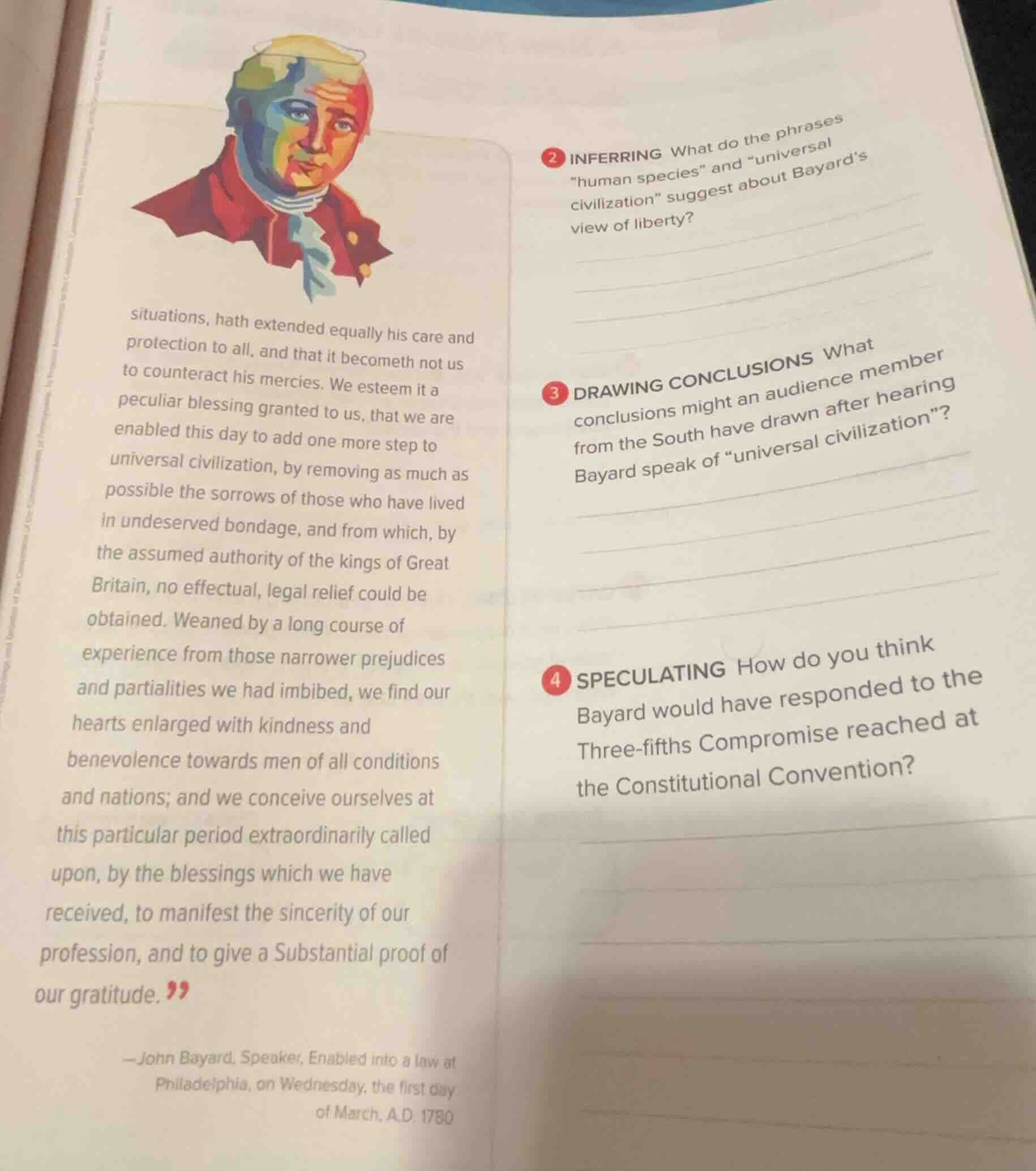
situations, hath extended equally his care and protection to all, and that it becometh not us to counteract his mercies. we esteem it a peculiar blessing granted to us, that we are enabled this day to add one more step to universal civilization, by removing as much as possible the sorrows of those who have lived in undeserved bondage, and from which, by the assumed authority of the kings of great britain, no effectual, legal relief could be obtained. weaned by a long course of experience from those narrower prejudices and partialities we had imbibed, we find our hearts enlarged with kindness and benevolence towards men of all conditions and nations; and we conceive ourselves at this particular period extraordinarily called upon, by the blessings which we have received, to manifest the sincerity of our profession, and to give a substantial proof of our gratitude.\ —john bayard, speaker, enabled into a law at philadelphia, on wednesday, the first day of march, a.d. 1780 2 inferring what do the phrases \human species\ and \universal civilization\ suggest about bayard’s view of liberty? 3 drawing conclusions what conclusions might an audience member from the south have drawn after hearing bayard speak of \universal civilization\? 4 speculating how do you think bayard would have responded to the three - fifths compromise reached at the constitutional convention?
- For question 2: The phrases show Bayard frames liberty as a right for all humans, not just a select group, tied to advancing a civilization that includes and uplifts every person, regardless of their background or former bondage.
- For question 3: A Southern audience member might have felt threatened, concluding Bayard's words challenged the institution of slavery (the bondage referenced) that was central to their economy and society, and seen his call for universal civilization as an attack on their way of life.
- For question 4: Bayard would have opposed the Three-fifths Compromise, since his words emphasize equal care for all humans and reject the idea that some people should be counted as less than full persons; he viewed liberty and dignity as universal, so reducing enslaved people's status for political representation would contradict his beliefs.

Snap & solve any problem in the app
Get step-by-step solutions on Sovi AI
Photo-based solutions with guided steps
Explore more problems and detailed explanations
- Bayard viewed liberty as a universal right belonging to all members of the human species, tied to building an inclusive civilization that frees people from undeserved bondage.
- A Southern audience member likely would have concluded Bayard's message threatened the system of slavery, which was foundational to their region's society and economy, and seen his call for universal civilization as a direct challenge to their interests.
- Bayard would have strongly opposed the Three-fifths Compromise, as his statements emphasize the equal worth of all humans; counting enslaved people as only three-fifths of a person would contradict his belief in universal liberty and dignity for all members of the human species.