QUESTION IMAGE
Question
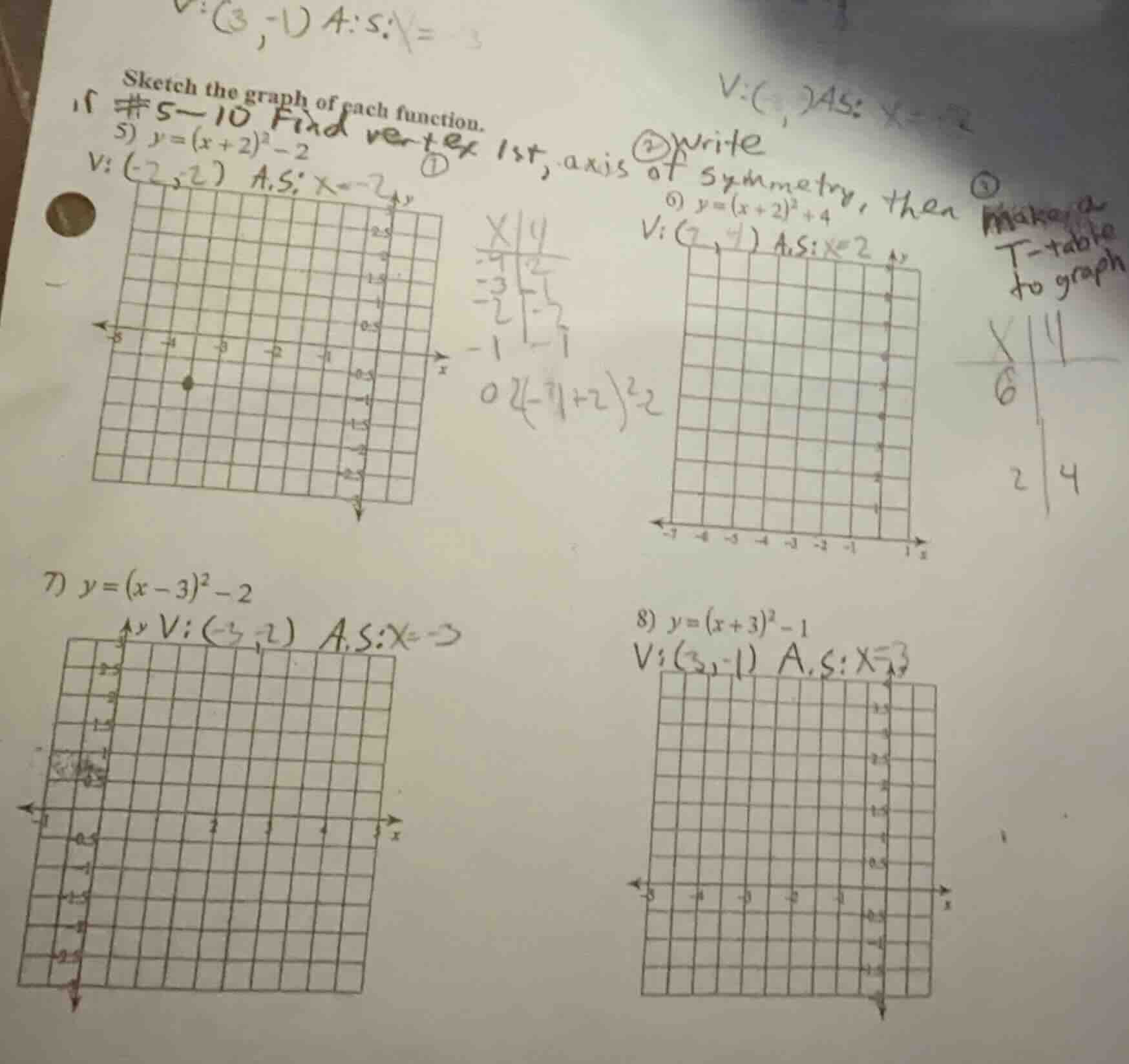
sketch the graph of each function.
- $y=(x + 2)^2 - 2$
- $y=(x + 2)^2 + 4$
- $y=(x - 3)^2 - 2$
- $y=(x + 3)^2 - 1$
#5 - 10 find vertex 1st, axis of symmetry, then make a t - table to graph
① write vertex, axis of symmetry, then ③ make a t - table to graph
Let's take problem 5: \( y=(x + 2)^2-2 \) to find the vertex and axis of symmetry, then sketch the graph. We can also do the same for other problems following the vertex - form of a parabola \( y=a(x - h)^2+k \), where \((h,k)\) is the vertex and the axis of symmetry is \( x = h \).
For problem 5: \( y=(x + 2)^2-2 \)
Step 1: Identify the vertex
The vertex - form of a parabola is \( y=a(x - h)^2+k \), where the vertex is \((h,k)\). In the equation \( y=(x + 2)^2-2 \), we can rewrite \( x + 2\) as \( x-(-2) \). So, comparing with \( y=a(x - h)^2+k \), we have \( h=-2 \) and \( k = - 2 \). So the vertex \( V=(-2,-2) \).
Step 2: Find the axis of symmetry
For a parabola in the form \( y=a(x - h)^2+k \), the axis of symmetry is the vertical line \( x = h \). Since \( h=-2 \), the axis of symmetry (A.S) is \( x=-2 \).
Step 3: Create a table of values
We can choose values of \( x \) around \( x=-2 \) (the \( x \) - coordinate of the vertex) to find corresponding \( y \) - values.
- When \( x=-3 \):
\( y=(-3 + 2)^2-2=(-1)^2-2=1 - 2=-1 \)
- When \( x=-2 \):
\( y=(-2 + 2)^2-2=0^2-2=-2 \)
- When \( x=-1 \):
\( y=(-1 + 2)^2-2=(1)^2-2=1 - 2=-1 \)
- When \( x = 0\):
\( y=(0 + 2)^2-2=4-2 = 2 \)
- When \( x=-4\):
\( y=(-4 + 2)^2-2=(-2)^2-2=4 - 2=2 \)
We can then plot the points \((-4,2),(-3,-1),(-2,-2),(-1,-1),(0,2)\) and draw a parabola (opening upwards since \( a = 1>0 \)) with the vertex at \((-2,-2)\) and axis of symmetry \( x=-2 \).
For problem 6: \( y=(x + 2)^2+4 \)
Step 1: Identify the vertex
Using the vertex - form \( y=a(x - h)^2+k \), rewrite \( x + 2\) as \( x-(-2) \). So \( h=-2 \) and \( k = 4 \). The vertex \( V=(-2,4) \).
Step 2: Find the axis of symmetry
The axis of symmetry is \( x=h=-2 \).
Step 3: Create a table of values
- When \( x=-3 \):
\( y=(-3 + 2)^2+4=(-1)^2+4=1 + 4=5 \)
- When \( x=-2 \):
\( y=(-2 + 2)^2+4=0^2+4=4 \)
- When \( x=-1 \):
\( y=(-1 + 2)^2+4=(1)^2+4=1 + 4=5 \)
- When \( x = 0\):
\( y=(0 + 2)^2+4=4 + 4=8 \)
- When \( x=-4\):
\( y=(-4 + 2)^2+4=(-2)^2+4=4 + 4=8 \)
Plot the points \((-4,8),(-3,5),(-2,4),(-1,5),(0,8)\) and draw a parabola (opening upwards since \( a = 1>0 \)) with vertex \((-2,4)\) and axis of symmetry \( x=-2 \).
For problem 7: \( y=(x - 3)^2-2 \)
Step 1: Identify the vertex
Using the vertex - form \( y=a(x - h)^2+k \), here \( h = 3\) and \( k=-2 \). So the vertex \( V=(3,-2) \).
Step 2: Find the axis of symmetry
The axis of symmetry is \( x = h=3 \).
Step 3: Create a table of values
- When \( x=2 \):
\( y=(2 - 3)^2-2=(-1)^2-2=1 - 2=-1 \)
- When \( x=3 \):
\( y=(3 - 3)^2-2=0^2-2=-2 \)
- When \( x=4 \):
\( y=(4 - 3)^2-2=(1)^2-2=1 - 2=-1 \)
- When \( x = 1\):
\( y=(1 - 3)^2-2=(-2)^2-2=4 - 2=2 \)
- When \( x=5\):
\( y=(5 - 3)^2-2=(2)^2-2=4 - 2=2 \)
Plot the points \((1,2),(2,-1),(3,-2),(4,-1),(5,2)\) and draw a parabola (opening upwards since \( a = 1>0 \)) with vertex \((3,-2)\) and axis of symmetry \( x = 3 \).
For problem 8: \( y=(x + 3)^2-1 \)
Step 1: Identify the vertex
Using the vertex - form \( y=a(x - h)^2+k \), rewrite \( x + 3\) as \( x-(-3) \). So \( h=-3 \) and \( k=-1 \). The vertex \( V=(-3,-1) \).
Step 2: Find the axis of symmetry
The axis of symmetry is \( x=h=-3 \).
Step 3: Create a table of values
- When \( x=-4 \):
\( y=(-4 + 3)^2-1=(-1)^2-1=1 - 1=0 \)
- When \( x=-3 \):
\( y=(-3 + 3)^2-1=0^2-1=-1 \)
- When \( x=-2 \):
\( y=(-2 + 3)^2-1=(1)^2-1=1 - 1=0 \)
- When \( x = 0\):
\( y=(0 + 3)^2-1=9 - 1=8 \)
- When \( x=-6\):
\( y=(-6 + 3)^2-1=(-3)^2-1=9 - 1=8 \)
Plot the points \((-6,8),(-4,0),(-3,-1),(-2,0…

Snap & solve any problem in the app
Get step-by-step solutions on Sovi AI
Photo-based solutions with guided steps
Explore more problems and detailed explanations
Let's take problem 5: \( y=(x + 2)^2-2 \) to find the vertex and axis of symmetry, then sketch the graph. We can also do the same for other problems following the vertex - form of a parabola \( y=a(x - h)^2+k \), where \((h,k)\) is the vertex and the axis of symmetry is \( x = h \).
For problem 5: \( y=(x + 2)^2-2 \)
Step 1: Identify the vertex
The vertex - form of a parabola is \( y=a(x - h)^2+k \), where the vertex is \((h,k)\). In the equation \( y=(x + 2)^2-2 \), we can rewrite \( x + 2\) as \( x-(-2) \). So, comparing with \( y=a(x - h)^2+k \), we have \( h=-2 \) and \( k = - 2 \). So the vertex \( V=(-2,-2) \).
Step 2: Find the axis of symmetry
For a parabola in the form \( y=a(x - h)^2+k \), the axis of symmetry is the vertical line \( x = h \). Since \( h=-2 \), the axis of symmetry (A.S) is \( x=-2 \).
Step 3: Create a table of values
We can choose values of \( x \) around \( x=-2 \) (the \( x \) - coordinate of the vertex) to find corresponding \( y \) - values.
- When \( x=-3 \):
\( y=(-3 + 2)^2-2=(-1)^2-2=1 - 2=-1 \)
- When \( x=-2 \):
\( y=(-2 + 2)^2-2=0^2-2=-2 \)
- When \( x=-1 \):
\( y=(-1 + 2)^2-2=(1)^2-2=1 - 2=-1 \)
- When \( x = 0\):
\( y=(0 + 2)^2-2=4-2 = 2 \)
- When \( x=-4\):
\( y=(-4 + 2)^2-2=(-2)^2-2=4 - 2=2 \)
We can then plot the points \((-4,2),(-3,-1),(-2,-2),(-1,-1),(0,2)\) and draw a parabola (opening upwards since \( a = 1>0 \)) with the vertex at \((-2,-2)\) and axis of symmetry \( x=-2 \).
For problem 6: \( y=(x + 2)^2+4 \)
Step 1: Identify the vertex
Using the vertex - form \( y=a(x - h)^2+k \), rewrite \( x + 2\) as \( x-(-2) \). So \( h=-2 \) and \( k = 4 \). The vertex \( V=(-2,4) \).
Step 2: Find the axis of symmetry
The axis of symmetry is \( x=h=-2 \).
Step 3: Create a table of values
- When \( x=-3 \):
\( y=(-3 + 2)^2+4=(-1)^2+4=1 + 4=5 \)
- When \( x=-2 \):
\( y=(-2 + 2)^2+4=0^2+4=4 \)
- When \( x=-1 \):
\( y=(-1 + 2)^2+4=(1)^2+4=1 + 4=5 \)
- When \( x = 0\):
\( y=(0 + 2)^2+4=4 + 4=8 \)
- When \( x=-4\):
\( y=(-4 + 2)^2+4=(-2)^2+4=4 + 4=8 \)
Plot the points \((-4,8),(-3,5),(-2,4),(-1,5),(0,8)\) and draw a parabola (opening upwards since \( a = 1>0 \)) with vertex \((-2,4)\) and axis of symmetry \( x=-2 \).
For problem 7: \( y=(x - 3)^2-2 \)
Step 1: Identify the vertex
Using the vertex - form \( y=a(x - h)^2+k \), here \( h = 3\) and \( k=-2 \). So the vertex \( V=(3,-2) \).
Step 2: Find the axis of symmetry
The axis of symmetry is \( x = h=3 \).
Step 3: Create a table of values
- When \( x=2 \):
\( y=(2 - 3)^2-2=(-1)^2-2=1 - 2=-1 \)
- When \( x=3 \):
\( y=(3 - 3)^2-2=0^2-2=-2 \)
- When \( x=4 \):
\( y=(4 - 3)^2-2=(1)^2-2=1 - 2=-1 \)
- When \( x = 1\):
\( y=(1 - 3)^2-2=(-2)^2-2=4 - 2=2 \)
- When \( x=5\):
\( y=(5 - 3)^2-2=(2)^2-2=4 - 2=2 \)
Plot the points \((1,2),(2,-1),(3,-2),(4,-1),(5,2)\) and draw a parabola (opening upwards since \( a = 1>0 \)) with vertex \((3,-2)\) and axis of symmetry \( x = 3 \).
For problem 8: \( y=(x + 3)^2-1 \)
Step 1: Identify the vertex
Using the vertex - form \( y=a(x - h)^2+k \), rewrite \( x + 3\) as \( x-(-3) \). So \( h=-3 \) and \( k=-1 \). The vertex \( V=(-3,-1) \).
Step 2: Find the axis of symmetry
The axis of symmetry is \( x=h=-3 \).
Step 3: Create a table of values
- When \( x=-4 \):
\( y=(-4 + 3)^2-1=(-1)^2-1=1 - 1=0 \)
- When \( x=-3 \):
\( y=(-3 + 3)^2-1=0^2-1=-1 \)
- When \( x=-2 \):
\( y=(-2 + 3)^2-1=(1)^2-1=1 - 1=0 \)
- When \( x = 0\):
\( y=(0 + 3)^2-1=9 - 1=8 \)
- When \( x=-6\):
\( y=(-6 + 3)^2-1=(-3)^2-1=9 - 1=8 \)
Plot the points \((-6,8),(-4,0),(-3,-1),(-2,0),(0,8)\) and draw a parabola (opening upwards since \( a = 1>0 \)) with vertex \((-3,-1)\) and axis of symmetry \( x=-3 \).
Summary of vertices and axes of symmetry:
- Problem 5: Vertex \((-2,-2)\), Axis of Symmetry \( x=-2 \)
- Problem 6: Vertex \((-2,4)\), Axis of Symmetry \( x=-2 \)
- Problem 7: Vertex \((3,-2)\), Axis of Symmetry \( x = 3 \)
- Problem 8: Vertex \((-3,-1)\), Axis of Symmetry \( x=-3 \)
If you want to sketch the graphs, use the table of values to plot the points and draw the parabolas (all opening upwards since \( a = 1>0 \) in each case).