QUESTION IMAGE
Question
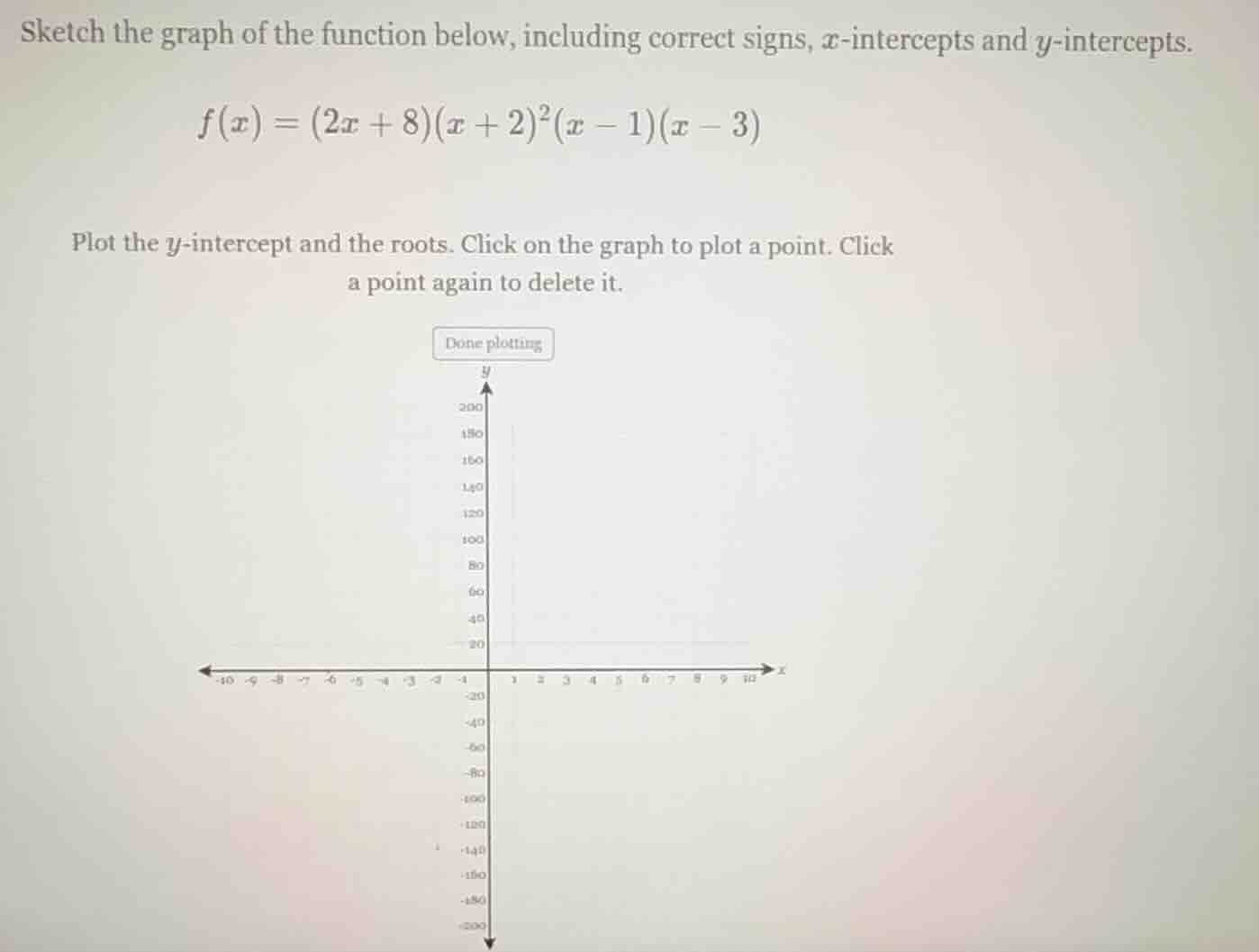
sketch the graph of the function below, including correct signs, ( x )-intercepts and ( y )-intercepts.
( f(x) = (2x + 8)(x + 2)^2(x - 1)(x - 3) )
plot the ( y )-intercept and the roots. click on the graph to plot a point. click
a point again to delete it.
Step1: Find x-intercepts (roots)
To find the x-intercepts, set \( f(x) = 0 \). So, \( (2x + 8)(x + 2)^2(x - 1)(x - 3)=0 \).
- For \( 2x + 8 = 0 \), solve for \( x \): \( 2x=-8\Rightarrow x = - 4 \).
- For \( (x + 2)^2 = 0 \), solve for \( x \): \( x=-2 \) (double root, multiplicity 2).
- For \( x - 1 = 0 \), solve for \( x \): \( x = 1 \).
- For \( x - 3 = 0 \), solve for \( x \): \( x = 3 \).
Step2: Find y-intercept
To find the y-intercept, set \( x = 0 \) in \( f(x) \).
\( f(0)=(2(0)+8)(0 + 2)^2(0 - 1)(0 - 3)=(8)(4)(-1)(-3) \).
Calculate the value: \( 8\times4 = 32 \), \( - 1\times-3=3 \), then \( 32\times3 = 96 \). So the y-intercept is at \( (0,96) \).
Step3: Analyze the sign of the function in intervals
The critical points (roots) divide the number line into intervals: \( (-\infty,-4) \), \( (-4,-2) \), \( (-2,1) \), \( (1,3) \), \( (3,\infty) \).
- Choose a test point in \( (-\infty,-4) \), say \( x=-5 \):
\( f(-5)=(2(-5)+8)((-5)+2)^2((-5)-1)((-5)-3)=(-10 + 8)(-3)^2(-6)(-8)=(-2)(9)(48)=-864<0 \).
- Choose a test point in \( (-4,-2) \), say \( x=-3 \):
\( f(-3)=(2(-3)+8)((-3)+2)^2((-3)-1)((-3)-3)=(-6 + 8)(-1)^2(-4)(-6)=(2)(1)(24)=48>0 \).
- Choose a test point in \( (-2,1) \), say \( x = 0 \) (we already know \( f(0)=96>0 \)).
- Choose a test point in \( (1,3) \), say \( x = 2 \):
\( f(2)=(2(2)+8)((2)+2)^2((2)-1)((2)-3)=(4 + 8)(4)^2(1)(-1)=(12)(16)(-1)=-192<0 \).
- Choose a test point in \( (3,\infty) \), say \( x = 4 \):
\( f(4)=(2(4)+8)((4)+2)^2((4)-1)((4)-3)=(8 + 8)(6)^2(3)(1)=(16)(36)(3)=1728>0 \).
Step4: Analyze the behavior at roots (multiplicity)
- At \( x=-4 \) (multiplicity 1, odd), the graph crosses the x-axis.
- At \( x=-2 \) (multiplicity 2, even), the graph touches the x-axis and turns around.
- At \( x = 1 \) (multiplicity 1, odd), the graph crosses the x-axis.
- At \( x = 3 \) (multiplicity 1, odd), the graph crosses the x-axis.

Snap & solve any problem in the app
Get step-by-step solutions on Sovi AI
Photo-based solutions with guided steps
Explore more problems and detailed explanations
- x-intercepts: \( (-4,0) \), \( (-2,0) \), \( (1,0) \), \( (3,0) \) (note: \( (-2,0) \) is a touch - point, \( (-4,0) \), \( (1,0) \), \( (3,0) \) are cross - points)
- y-intercept: \( (0,96) \)
- Sign of \( f(x) \):
- \( (-\infty,-4) \): Negative
- \( (-4,-2) \): Positive
- \( (-2,1) \): Positive
- \( (1,3) \): Negative
- \( (3,\infty) \): Positive
To sketch the graph:
- Plot the x-intercepts \( (-4,0) \), \( (-2,0) \), \( (1,0) \), \( (3,0) \) and y-intercept \( (0,96) \).
- For the interval \( (-\infty,-4) \), the graph is below the x-axis (negative), coming from \( -\infty \) and crossing the x-axis at \( x = - 4 \).
- For \( (-4,-2) \), the graph is above the x-axis (positive), moving from \( (-4,0) \) to touch the x-axis at \( x=-2 \) (since multiplicity of \( x=-2 \) is 2, the graph touches and turns around).
- For \( (-2,1) \), the graph is above the x-axis (positive), moving from \( (-2,0) \) to \( (1,0) \) (crossing the x-axis at \( x = 1 \) as multiplicity is 1).
- For \( (1,3) \), the graph is below the x-axis (negative), moving from \( (1,0) \) to \( (3,0) \) (crossing the x-axis at \( x = 3 \) as multiplicity is 1).
- For \( (3,\infty) \), the graph is above the x-axis (positive), moving to \( +\infty \) as \( x
ightarrow\infty \).