QUESTION IMAGE
Question
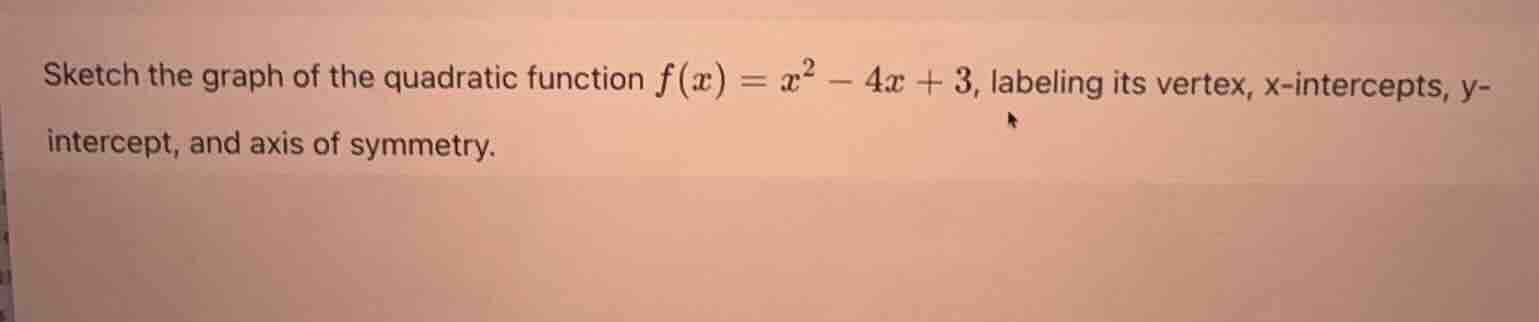
sketch the graph of the quadratic function $f(x) = x^2 - 4x + 3$, labeling its vertex, x-intercepts, y-intercept, and axis of symmetry.
Step1: Find the vertex form (completing the square)
To find the vertex form of \( f(x) = x^2 - 4x + 3 \), we complete the square.
The coefficient of \( x^2 \) is 1. For the \( x \)-terms \( x^2 - 4x \), we take half of -4, which is -2, square it to get 4.
So, \( f(x)=x^{2}-4x + 4-4 + 3=(x - 2)^{2}-1 \).
The vertex form of a quadratic function is \( f(x)=a(x - h)^{2}+k \), where \((h,k)\) is the vertex. So here, the vertex is \((2,-1)\).
Step2: Find the axis of symmetry
For a quadratic function in the form \( f(x)=a(x - h)^{2}+k \) or \( f(x)=ax^{2}+bx + c \), the axis of symmetry is the vertical line \( x = h \) (from vertex form) or \( x=-\frac{b}{2a} \) (from standard form).
From the vertex form, we know \( h = 2 \), so the axis of symmetry is \( x = 2 \).
Using the standard form \( f(x)=x^{2}-4x + 3 \), where \( a = 1 \), \( b=-4 \), then \( x=-\frac{-4}{2\times1}=2 \), which confirms the axis of symmetry is \( x = 2 \).
Step3: Find the x - intercepts
To find the x - intercepts, we set \( f(x)=0 \), so we solve the equation \( x^{2}-4x + 3=0 \).
We can factor the quadratic: \( x^{2}-4x + 3=(x - 1)(x - 3)=0 \).
Setting each factor equal to zero: \( x - 1=0\) gives \( x = 1 \), and \( x - 3=0\) gives \( x = 3 \). So the x - intercepts are \((1,0)\) and \((3,0)\).
Step4: Find the y - intercept
To find the y - intercept, we set \( x = 0 \) in the function \( f(x)=x^{2}-4x + 3 \).
Then \( f(0)=0^{2}-4\times0 + 3=3 \). So the y - intercept is \((0,3)\).
Step5: Sketch the graph
- The parabola opens upward because the coefficient of \( x^{2} \) ( \( a = 1 \)) is positive.
- Plot the vertex \((2,-1)\), the x - intercepts \((1,0)\) and \((3,0)\), the y - intercept \((0,3)\).
- Draw the axis of symmetry \( x = 2 \).
- Connect the points with a smooth curve, making sure the parabola is symmetric about \( x = 2 \).

Snap & solve any problem in the app
Get step-by-step solutions on Sovi AI
Photo-based solutions with guided steps
Explore more problems and detailed explanations
- Vertex: \((2, - 1)\)
- Axis of symmetry: \(x = 2\)
- x - intercepts: \((1,0)\) and \((3,0)\)
- y - intercept: \((0,3)\)
- The graph is a parabola opening upward with the above - mentioned features labeled.