QUESTION IMAGE
Question
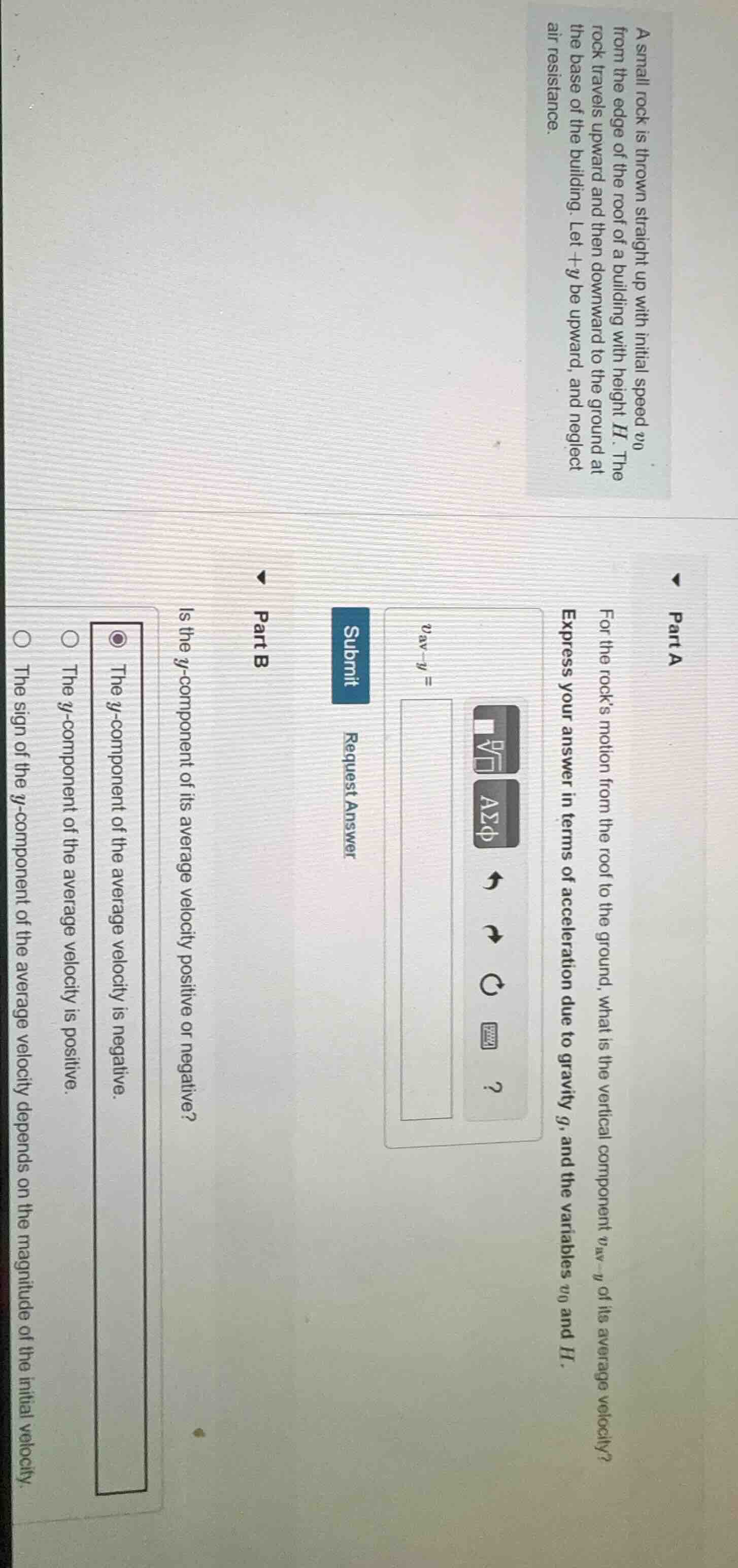
a small rock is thrown straight up with initial speed $v_0$ from the edge of the roof of a building with height $h$. the rock travels upward and then downward to the ground at the base of the building. let $+y$ be upward, and neglect air resistance.
part a
for the rocks motion from the roof to the ground, what is the vertical component $v_{av-y}$ of its average velocity?
express your answer in terms of acceleration due to gravity $g$, and the variables $v_0$ and $h$.
$v_{av-y} = $
submit request answer
part b
is the $y$-component of its average velocity positive or negative?
○ the $y$-component of the average velocity is negative.
○ the $y$-component of the average velocity is positive.
○ the sign of the $y$-component of the average velocity depends on the magnitude of the initial velocity.
Step1: Define displacement and avg velocity
Average velocity is total displacement over total time: $v_{\text{av}-y} = \frac{\Delta y}{t_{\text{total}}}$, where $\Delta y = -H$ (final position - initial position, downward is negative for +y upward).
Step2: Find final velocity $v_f$
Use kinematic equation: $v_f^2 = v_0^2 + 2g(-H) = v_0^2 - 2gH$, so $v_f = -\sqrt{v_0^2 + 2gH}$ (negative since downward).
Step3: Calculate total time $t_{\text{total}}$
From $v_f = v_0 - gt_{\text{total}}$, solve for $t$:
$t_{\text{total}} = \frac{v_0 - v_f}{g} = \frac{v_0 + \sqrt{v_0^2 + 2gH}}{g}$
Step4: Compute average velocity
Substitute $\Delta y$ and $t_{\text{total}}$:
$v_{\text{av}-y} = \frac{-H}{\frac{v_0 + \sqrt{v_0^2 + 2gH}}{g}} = \frac{-gH}{v_0 + \sqrt{v_0^2 + 2gH}}$
Simplify using $v_f = -\sqrt{v_0^2 + 2gH}$:
$v_{\text{av}-y} = \frac{v_0 + v_f}{2} = \frac{v_0 - \sqrt{v_0^2 + 2gH}}{2}$
The total displacement of the rock is downward (from roof to ground), with $\Delta y = -H$ (negative for +y upward). Average velocity is displacement over time, so its y-component must be negative.

Snap & solve any problem in the app
Get step-by-step solutions on Sovi AI
Photo-based solutions with guided steps
Explore more problems and detailed explanations
(Part A):
$\frac{v_0 - \sqrt{v_0^2 + 2gH}}{2}$
---