QUESTION IMAGE
Question
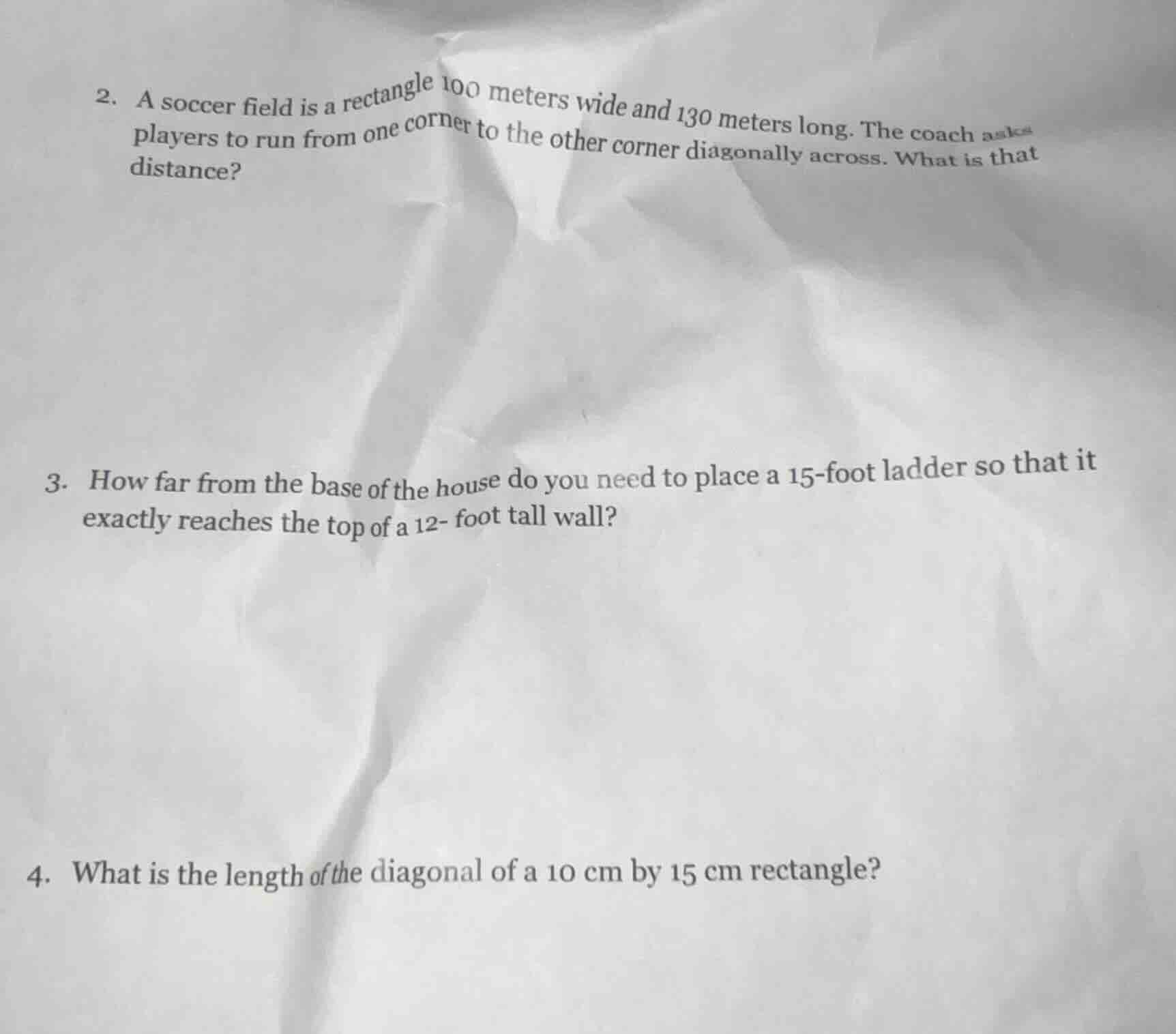
- a soccer field is a rectangle 100 meters wide and 130 meters long. the coach asks players to run from one corner to the other corner diagonally across. what is that distance?
- how far from the base of the house do you need to place a 15 - foot ladder so that it exactly reaches the top of a 12 - foot tall wall?
- what is the length of the diagonal of a 10 cm by 15 cm rectangle?
Problem 2
Step1: Identify the problem type
This is a right - triangle problem where the length and width of the rectangle are the two legs of a right triangle, and the diagonal is the hypotenuse. We can use the Pythagorean theorem, which states that for a right triangle with legs of length \(a\) and \(b\) and hypotenuse of length \(c\), \(c^{2}=a^{2}+b^{2}\), or \(c = \sqrt{a^{2}+b^{2}}\). Here, \(a = 100\) meters and \(b=130\) meters.
Step2: Apply the Pythagorean theorem
First, calculate \(a^{2}\) and \(b^{2}\):
\(a^{2}=100^{2}=10000\)
\(b^{2}=130^{2}=16900\)
Then, find the sum of \(a^{2}\) and \(b^{2}\):
\(a^{2}+b^{2}=10000 + 16900=26900\)
Finally, find the square root of the sum to get the length of the diagonal \(c\):
\(c=\sqrt{26900}\approx164.01\) meters (rounded to two decimal places)
Step1: Identify the problem type
This is a right - triangle problem. The ladder is the hypotenuse (\(c = 15\) feet) of the right triangle, the height of the wall is one leg (\(a = 12\) feet), and the distance from the base of the house to the base of the ladder is the other leg (\(b\)) that we need to find. We use the Pythagorean theorem \(a^{2}+b^{2}=c^{2}\), and we can re - arrange it to solve for \(b\): \(b=\sqrt{c^{2}-a^{2}}\).
Step2: Apply the formula
First, calculate \(c^{2}\) and \(a^{2}\):
\(c^{2}=15^{2}=225\)
\(a^{2}=12^{2}=144\)
Then, find the difference between \(c^{2}\) and \(a^{2}\):
\(c^{2}-a^{2}=225 - 144 = 81\)
Finally, find the square root of the difference to get the value of \(b\):
\(b=\sqrt{81}=9\) feet
Step1: Identify the problem type
This is a right - triangle problem. The length and width of the rectangle are the two legs of a right triangle, and the diagonal is the hypotenuse. We use the Pythagorean theorem \(c=\sqrt{a^{2}+b^{2}}\), where \(a = 10\) cm and \(b = 15\) cm.
Step2: Apply the Pythagorean theorem
First, calculate \(a^{2}\) and \(b^{2}\):
\(a^{2}=10^{2}=100\)
\(b^{2}=15^{2}=225\)
Then, find the sum of \(a^{2}\) and \(b^{2}\):
\(a^{2}+b^{2}=100 + 225=325\)
Finally, find the square root of the sum to get the length of the diagonal \(c\):
\(c=\sqrt{325}\approx18.03\) cm (rounded to two decimal places)

Snap & solve any problem in the app
Get step-by-step solutions on Sovi AI
Photo-based solutions with guided steps
Explore more problems and detailed explanations
The diagonal distance is approximately \(\boldsymbol{164.01}\) meters.