QUESTION IMAGE
Question
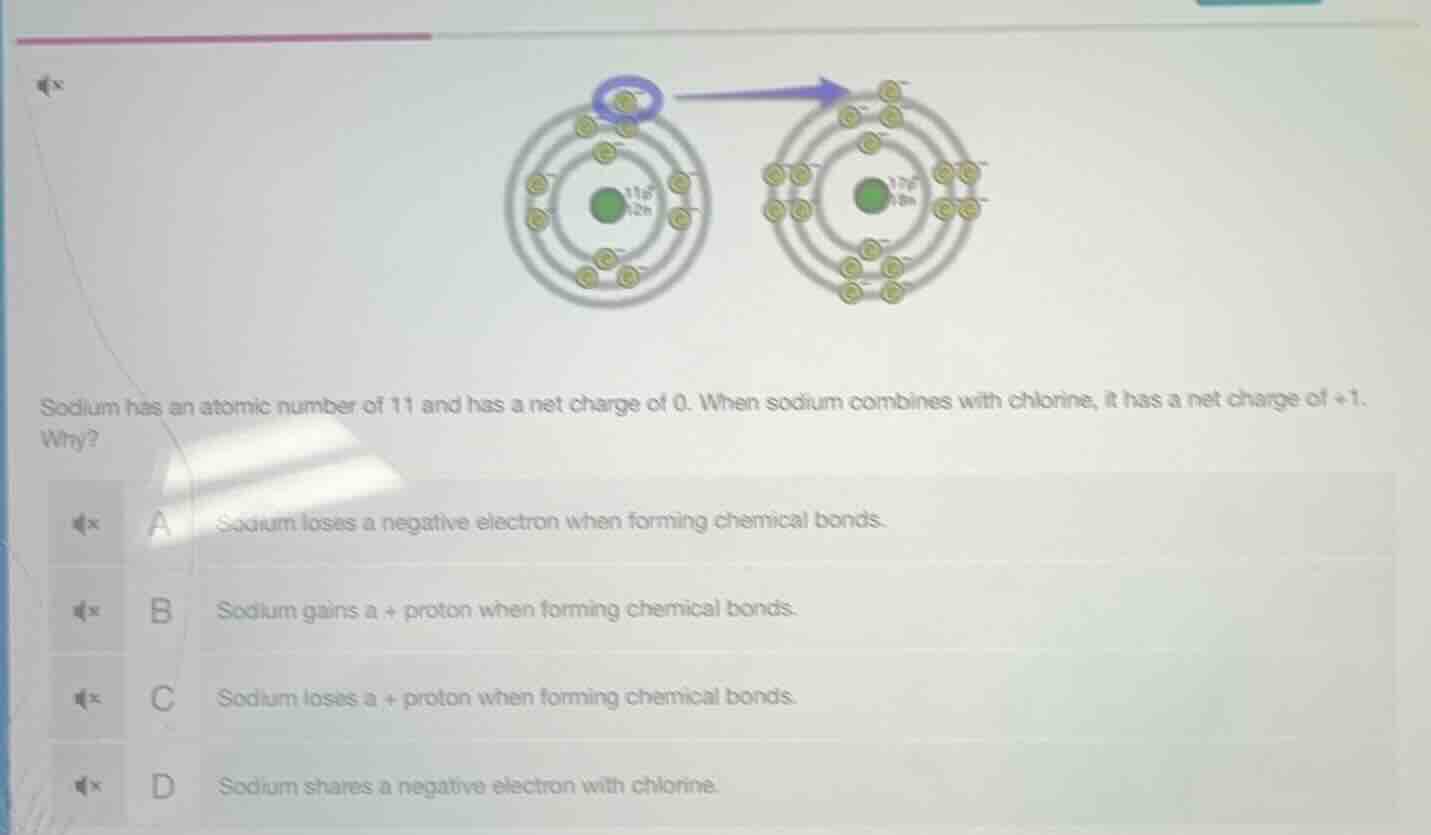
sodium has an atomic number of 11 and has a net charge of 0. when sodium combines with chlorine, it has a net charge of +1. why? a sodium loses a negative electron when forming chemical bonds. b sodium gains a + proton when forming chemical bonds. c sodium loses a + proton when forming chemical bonds. d sodium shares a negative electron with chlorine.
Brief Explanations
To determine why sodium has a net charge of +1 when combining with chlorine, we analyze each option:
- Option A: Sodium (atomic number 11, neutral with 11 protons and 11 electrons) loses one electron (negative charge) when forming an ionic bond with chlorine. This leaves 11 protons and 10 electrons, resulting in a net charge of +1. This matches the scenario.
- Option B: Protons are in the nucleus and do not participate in chemical bonding (electrons do). Gaining a proton would change the element (to magnesium), so this is incorrect.
- Option C: Losing a proton would also change the element (to neon), and protons are not lost in chemical reactions, so this is incorrect.
- Option D: Sodium and chlorine form an ionic bond, not a covalent bond (where electrons are shared). Sodium transfers an electron to chlorine, so sharing is incorrect.

Snap & solve any problem in the app
Get step-by-step solutions on Sovi AI
Photo-based solutions with guided steps
Explore more problems and detailed explanations
A. Sodium loses a negative electron when forming chemical bonds.