QUESTION IMAGE
Question
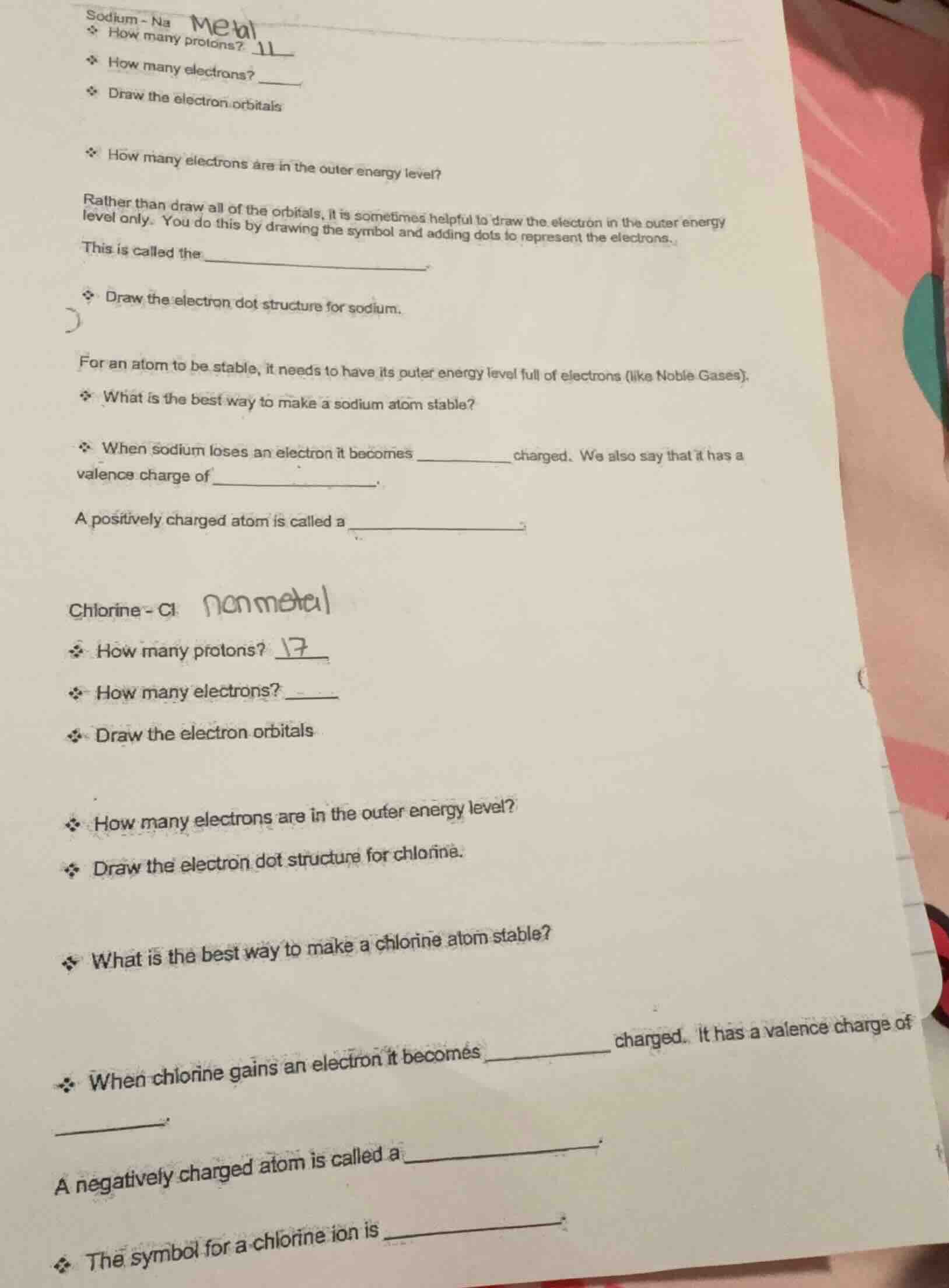
sodium - na
how many protons?
how many electrons?
draw the electron orbitals
how many electrons are in the outer energy level?
rather than draw all of the orbitals, it is sometimes helpful to draw the electron in the outer energy level only. you do this by drawing the symbol and adding dots to represent the electrons.
this is called the
draw the electron dot structure for sodium.
for an atom to be stable, it needs to have its outer energy level full of electrons (like noble gases).
what is the best way to make a sodium atom stable?
when sodium loses an electron it becomes charged. we also say that it has a valence charge of
a positively charged atom is called a
chlorine - cl
how many protons?
how many electrons?
draw the electron orbitals
how many electrons are in the outer energy level?
draw the electron dot structure for chlorine.
what is the best way to make a chlorine atom stable?
when chlorine gains an electron it becomes charged. it has a valence charge of
a negatively charged atom is called a
the symbol for a chlorine ion is
Step1: Sodium electron count (neutral)
Neutral atoms have equal protons/electrons. Sodium has 11 protons, so electrons = 11.
Step2: Sodium outer electrons
Sodium electron config: $1s^22s^22p^63s^1$. Outer level (3rd) has 1 electron.
Step3: Name outer electron diagram
The dot structure is Lewis dot structure.
Step4: Sodium stability method
Lose 1 outer electron to match noble gas config.
Step5: Sodium ion charge
Losing 1 electron gives +1 charge; positive ion = cation.
Step6: Chlorine electron count (neutral)
Neutral chlorine has 17 protons, so electrons = 17.
Step7: Chlorine outer electrons
Chlorine electron config: $1s^22s^22p^63s^23p^5$. Outer level (3rd) has 7 electrons.
Step8: Chlorine stability method
Gain 1 electron to fill outer level (8 electrons).
Step9: Chlorine ion charge
Gaining 1 electron gives -1 charge; negative ion = anion.
Step10: Chlorine ion symbol
Symbol with charge: $\text{Cl}^-$

Snap & solve any problem in the app
Get step-by-step solutions on Sovi AI
Photo-based solutions with guided steps
Explore more problems and detailed explanations
Sodium (Na) section:
- How many electrons? $\boldsymbol{11}$
- How many electrons are in the outer energy level? $\boldsymbol{1}$
- This is called the $\boldsymbol{\text{Lewis dot structure}}$
- Draw the electron dot structure for sodium: $\text{Na} \cdot$ (one dot next to the Na symbol)
- What is the best way to make a sodium atom stable? $\boldsymbol{\text{Lose 1 outer electron}}$
- When sodium loses an electron it becomes $\boldsymbol{\text{positively}}$ charged. We also say that it has a valence charge of $\boldsymbol{+1}$
- A positively charged atom is called a $\boldsymbol{\text{cation}}$
Chlorine (Cl) section:
- How many electrons? $\boldsymbol{17}$
- How many electrons are in the outer energy level? $\boldsymbol{7}$
- Draw the electron dot structure for chlorine: $\boldsymbol{:\!\underset{\cdot \cdot}{\overset{\cdot \cdot}{\text{Cl}}}\!\cdot}$ (seven dots surrounding the Cl symbol)
- What is the best way to make a chlorine atom stable? $\boldsymbol{\text{Gain 1 electron}}$
- When chlorine gains an electron it becomes $\boldsymbol{\text{negatively}}$ charged. It has a valence charge of $\boldsymbol{-1}$
- A negatively charged atom is called a $\boldsymbol{\text{anion}}$
- The symbol for a chlorine ion is $\boldsymbol{\text{Cl}^-}$