QUESTION IMAGE
Question
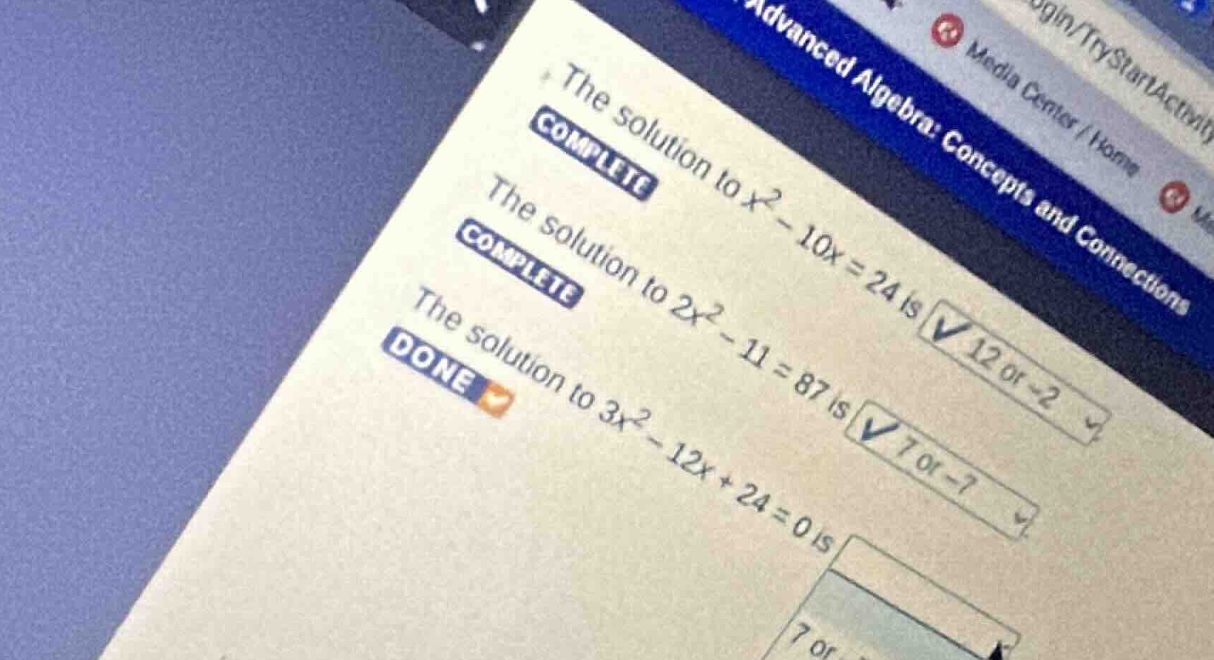
the solution to $x^2 - 10x = 24$ is 12 or -2 (complete)
the solution to $2x^2 - 11 = 87$ is 7 or -7 (complete)
the solution to $3x^2 - 12x + 24 = 0$ is (done)
Let's solve the equation \(3x^2 - 12x + 24 = 0\).
Step 1: Simplify the equation
First, we can divide the entire equation by 3 to simplify it.
\(\frac{3x^2 - 12x + 24}{3} = \frac{0}{3}\)
\(x^2 - 4x + 8 = 0\)
Step 2: Use the quadratic formula
For a quadratic equation \(ax^2 + bx + c = 0\), the quadratic formula is \(x = \frac{-b \pm \sqrt{b^2 - 4ac}}{2a}\).
Here, \(a = 1\), \(b = -4\), and \(c = 8\).
First, calculate the discriminant \(D = b^2 - 4ac\).
\(D = (-4)^2 - 4(1)(8)\)
\(D = 16 - 32\)
\(D = -16\)
Since the discriminant is negative, the solutions are complex numbers.
\(x = \frac{-(-4) \pm \sqrt{-16}}{2(1)}\)
\(x = \frac{4 \pm 4i}{2}\)
\(x = 2 \pm 2i\)
Wait, but let's check if we made a mistake in simplifying. Wait, the original equation is \(3x^2 - 12x + 24 = 0\). Let's factor out 3 first: \(3(x^2 - 4x + 8) = 0\), which implies \(x^2 - 4x + 8 = 0\) (since 3 ≠ 0). So the discriminant is indeed \( (-4)^2 - 4(1)(8) = 16 - 32 = -16\), so the solutions are \(x = \frac{4 \pm \sqrt{-16}}{2} = \frac{4 \pm 4i}{2} = 2 \pm 2i\).
But maybe there was a typo in the problem? Or maybe I misread it. Wait, let's check again. The equation is \(3x^2 - 12x + 24 = 0\). Let's divide by 3: \(x^2 - 4x + 8 = 0\). Yes, that's correct. So the solutions are complex: \(2 + 2i\) and \(2 - 2i\).
Alternatively, if the equation was \(3x^2 - 12x - 24 = 0\) (with a minus sign), then it would be different. But as per the given equation, it's \(+24\). So the solutions are \(2 + 2i\) and \(2 - 2i\).

Snap & solve any problem in the app
Get step-by-step solutions on Sovi AI
Photo-based solutions with guided steps
Explore more problems and detailed explanations
The solutions are \(2 + 2i\) and \(2 - 2i\) (or in boxed form, \(\boxed{2 + 2i}\) and \(\boxed{2 - 2i}\))