QUESTION IMAGE
Question
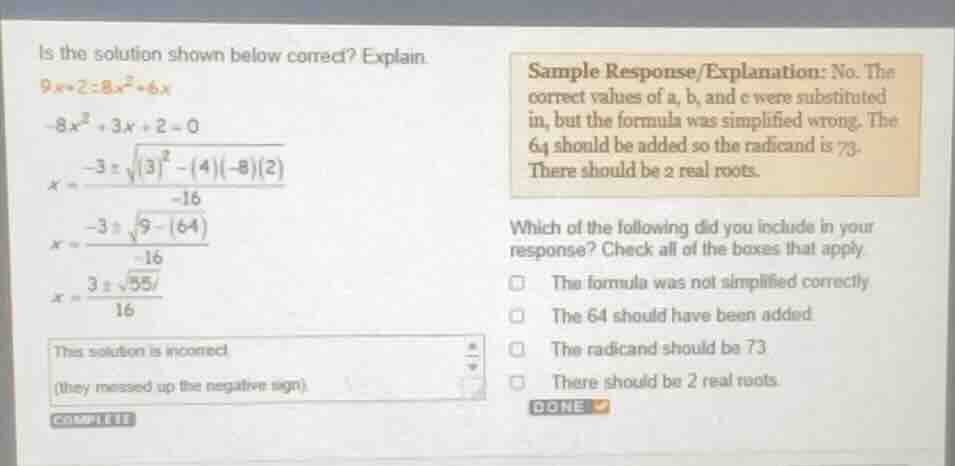
is the solution shown below correct? explain
$9x + 2 = 8x^2 + 6x$
$-8x^2 + 3x + 2 = 0$
$x = \frac{-3 \pm \sqrt{(3)^2 - (4)(-8)(2)}}{-16}$
$x = \frac{-3 \pm \sqrt{9 - (64)}}{-16}$
$x = \frac{3 \pm \sqrt{55}}{16}$
this solution is incorrect
(they messed up the negative sign)
complete
sample response/explanation: no. the correct values of a, b, and c were substituted in, but the formula was simplified wrong. the 64 should be added so the radicand is 73. there should be 2 real roots.
which of the following did you include in your response? check all of the boxes that apply.
☐ the formula was not simplified correctly.
☐ the 64 should have been added.
☐ the radicand should be 73
☐ there should be 2 real roots.
done
- When substituting into the quadratic formula $x=\frac{-b\pm\sqrt{b^2-4ac}}{2a}$ for the equation $-8x^2+3x+2=0$, $a=-8$, $b=3$, $c=2$.
- The discriminant calculation has an error: $b^2-4ac = 3^2 - 4(-8)(2) = 9 + 64$, not $9 - 64$, because multiplying two negative numbers ($-4 \times -8$) gives a positive result.
- This means 64 should be added, making the radicand (discriminant) $9+64=73$, not $-55$.
- A positive discriminant (73) means there are 2 real roots, and the formula was simplified incorrectly due to the sign mistake.

Snap & solve any problem in the app
Get step-by-step solutions on Sovi AI
Photo-based solutions with guided steps
Explore more problems and detailed explanations
- The formula was not simplified correctly
- The 64 should have been added
- The radicand should be 73
- There should be 2 real roots