QUESTION IMAGE
Question
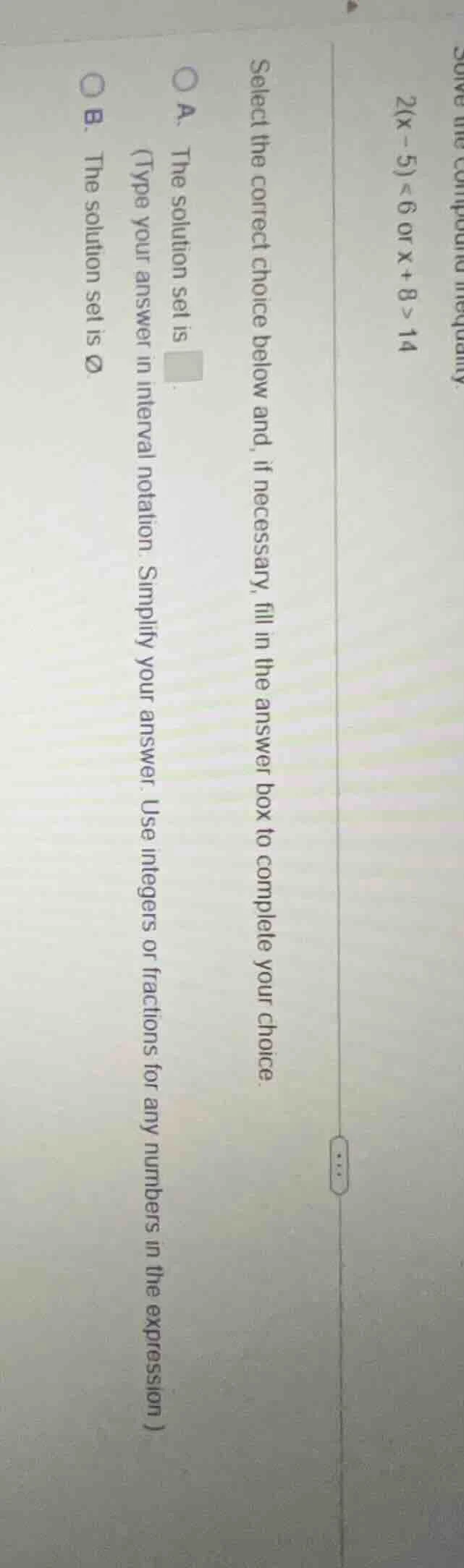
solve the compound inequality. (2(x - 5) < 6) or (x + 8 > 14) select the correct choice below and, if necessary, fill in the answer box to complete your choice. a. the solution set is (square). (type your answer in interval notation. simplify your answer. use integers or fractions for any numbers in the expression) b. the solution set is (varnothing).
Step1: Solve the first inequality \(2(x - 5) < 6\)
First, distribute the 2 on the left side: \(2x - 10 < 6\). Then, add 10 to both sides: \(2x < 6 + 10\), which simplifies to \(2x < 16\). Divide both sides by 2: \(x < 8\).
Step2: Solve the second inequality \(x + 8 > 14\)
Subtract 8 from both sides: \(x > 14 - 8\), so \(x > 6\).
Step3: Find the union of the two solution sets
The first solution is \(x < 8\) and the second is \(x > 6\). The union of these two sets (since it's an "or" compound inequality) is all real numbers except maybe none, but let's check. The solution to \(x < 8\) or \(x > 6\) is all real numbers? Wait, no, wait. Wait, let's re - evaluate. Wait, the first inequality: \(2(x - 5)<6\) gives \(x < 8\), the second \(x + 8>14\) gives \(x > 6\). So the compound inequality is \(x < 8\) or \(x > 6\). The union of \( (-\infty, 8)\) and \( (6, \infty)\) is \( (-\infty, \infty)\)? Wait, no, that can't be. Wait, no, actually, every real number is either less than 8 or greater than 6 (because if a number is between 6 and 8, it is less than 8, and if it's less than or equal to 6, it's less than 8, and if it's greater than or equal to 8, it's greater than 6? Wait, no, 7 is between 6 and 8, and 7 < 8, so it satisfies the first inequality. 5 is less than 6, and 5 < 8, so it satisfies the first. 9 is greater than 8, and 9>6, so it satisfies the second. So actually, the solution set is all real numbers. But wait, maybe I made a mistake. Wait, let's check the original inequalities again. The compound inequality is \(2(x - 5)<6\) or \(x + 8>14\). So we solve each and take the union. The first solution: \(x < 8\), the second: \(x > 6\). The union of \( (-\infty, 8)\) and \( (6, \infty)\) is \( (-\infty, \infty)\) because every real number is in at least one of the intervals. But let's check the options. Option A says the solution set is (in interval notation) \((-\infty, \infty)\), and option B says it's empty. But that's not possible. Wait, maybe I made a mistake in solving. Wait, no, let's re - solve the first inequality: \(2(x - 5)<6\). Divide both sides by 2: \(x - 5 < 3\), then add 5: \(x < 8\). Second inequality: \(x + 8>14\), subtract 8: \(x > 6\). So the solution is \(x < 8\) or \(x > 6\). So any real number is either less than 8 or greater than 6 (because if a number is between 6 and 8, it's less than 8; if it's ≤6, it's less than 8; if it's ≥8, it's greater than 6). So the solution set is all real numbers, which in interval notation is \((-\infty, \infty)\). But maybe the problem was written incorrectly? Wait, no, maybe I misread. Wait, the original problem: "Solve the compound inequality \(2(x - 5)<6\) or \(x + 8>14\)". So the solution is the union of \(x < 8\) and \(x > 6\), which is \((-\infty, \infty)\). But let's check the options. Option A says "The solution set is (type your answer in interval notation...)" and option B says the solution set is empty. But that's not correct. Wait, maybe there's a mistake in my reasoning. Wait, no, let's take a number, say 7: 7 < 8, so it satisfies the first inequality. 5: 5 < 8, satisfies the first. 9: 9>6, satisfies the second. 6.5: 6.5 < 8, satisfies the first. So all real numbers are in the solution set. So the solution set in interval notation is \((-\infty, \infty)\).

Snap & solve any problem in the app
Get step-by-step solutions on Sovi AI
Photo-based solutions with guided steps
Explore more problems and detailed explanations
\((-\infty, \infty)\)