QUESTION IMAGE
Question
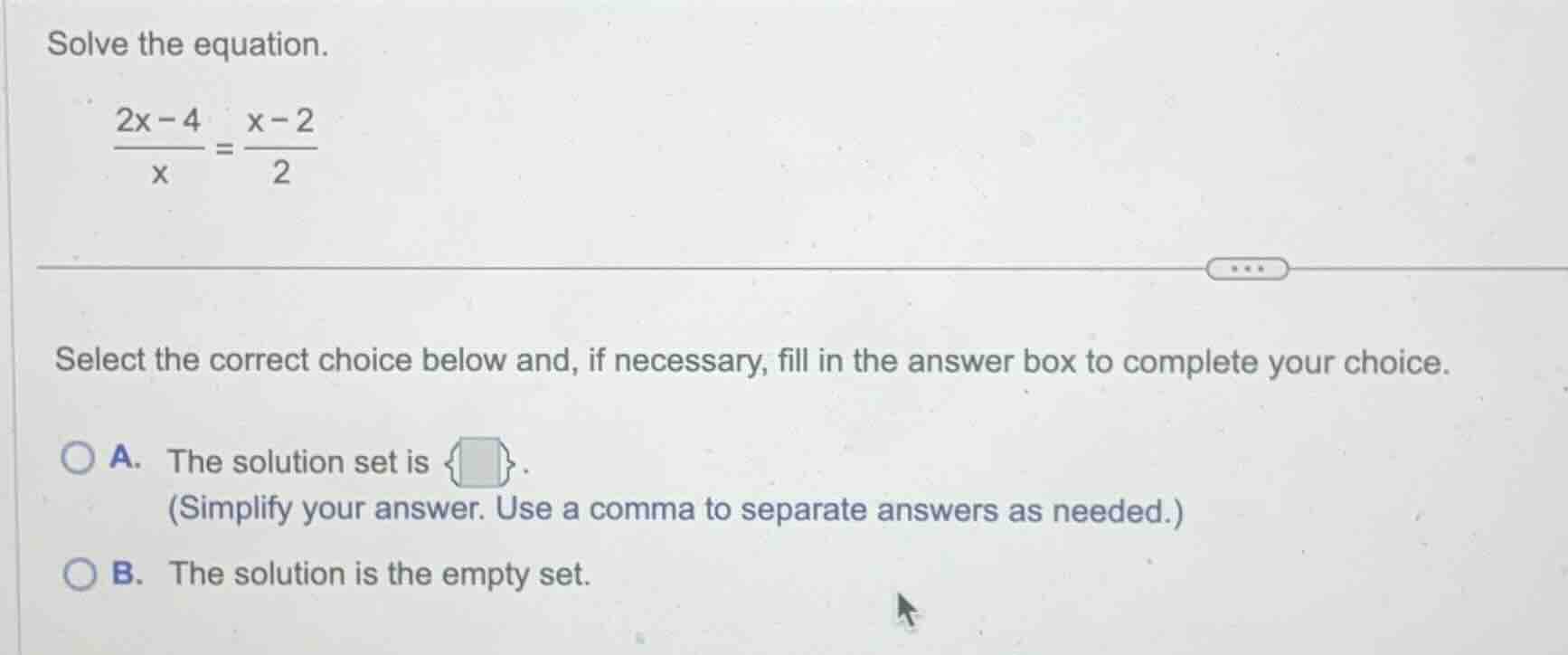
solve the equation.\\(\frac{2x - 4}{x}=\frac{x - 2}{2}\\)\\(\\)select the correct choice below and, if necessary, fill in the answer box to complete your choice.\\(\\)\\(\\)a. the solution set is \\(\\{\\}\\).\\(\\)(simplify your answer. use a comma to separate answers as needed.)\\(\\)\\(\\)b. the solution is the empty set.
Step1: Cross - multiply to eliminate fractions
Given the equation \(\frac{2x - 4}{x}=\frac{x - 2}{2}\), cross - multiplying (which is valid when \(x
eq0\) and \(2
eq0\), and \(x
eq0\) is already a restriction for the original left - hand side fraction) gives us \(2(2x - 4)=x(x - 2)\).
Step2: Expand both sides of the equation
Expand the left - hand side: \(2\times2x-2\times4 = 4x-8\).
Expand the right - hand side: \(x\times x-x\times2=x^{2}-2x\).
So the equation becomes \(4x - 8=x^{2}-2x\).
Step3: Rearrange the equation into standard quadratic form
Bring all terms to one side: \(x^{2}-2x-(4x - 8)=0\), which simplifies to \(x^{2}-2x - 4x + 8 = 0\), and further to \(x^{2}-6x + 8 = 0\).
Step4: Factor the quadratic equation
We need to find two numbers that multiply to \(8\) and add up to \(-6\). The numbers are \(-2\) and \(-4\). So, \(x^{2}-6x + 8=(x - 2)(x - 4)=0\).
Step5: Solve for \(x\)
Set each factor equal to zero:
- If \(x - 2 = 0\), then \(x = 2\).
- If \(x - 4 = 0\), then \(x = 4\).
Step6: Check for extraneous solutions
We need to check if these solutions make the original equation's denominators zero.
For \(x = 2\): The original equation is \(\frac{2(2)-4}{2}=\frac{2 - 2}{2}\), \(\frac{4 - 4}{2}=\frac{0}{2}\), \(0 = 0\), which is true.
For \(x = 4\): The original equation is \(\frac{2(4)-4}{4}=\frac{4 - 2}{2}\), \(\frac{8 - 4}{4}=\frac{2}{2}\), \(\frac{4}{4}=1\) and \(1 = 1\), which is true.
Also, we need to check the restriction \(x
eq0\), and both \(2\) and \(4\) are not equal to \(0\).

Snap & solve any problem in the app
Get step-by-step solutions on Sovi AI
Photo-based solutions with guided steps
Explore more problems and detailed explanations
The solution set is \(\{2,4\}\)