QUESTION IMAGE
Question
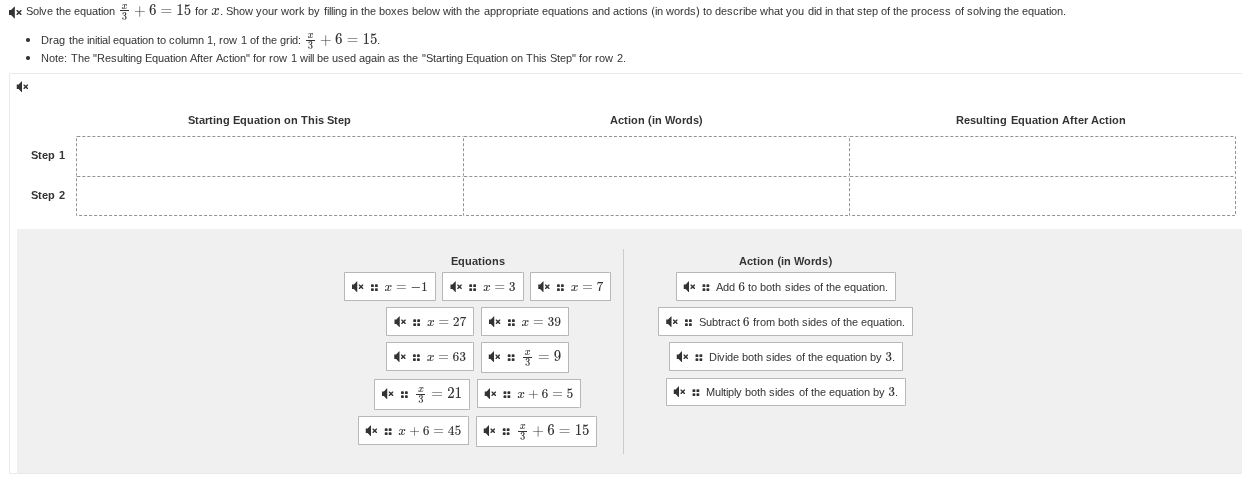
solve the equation \\(\frac{x}{3} + 6 = 15\\) for \\(x\\). show your work by filling in the boxes below with the appropriate equations and actions (in words) to describe what you did in that step of the process of solving the equation. - drag the initial equation to column 1, row 1 of the grid: \\(\frac{x}{3} + 6 = 15\\) - note: the
esulting equation after action\ for row 1 will be used again as the \starting equation on this step\ for row 2. step 1 step 2 equations \\(x = -1\\) \\(x = 3\\) \\(x = 7\\) \\(x = 27\\) \\(x = 39\\) \\(x = 63\\) \\(\frac{x}{3} = 9\\) \\(\frac{x}{3} = 21\\) \\(x + 6 = 5\\) \\(x + 6 = 45\\) \\(\frac{x}{3} + 6 = 15\\) action (in words) add 6 to both sides of the equation. subtract 6 from both sides of the equation. divide both sides of the equation by 3. multiply both sides of the equation by 3.
Step 1:
Starting Equation: $\frac{x}{3} + 6 = 15$
Action: Subtract 6 from both sides
To isolate the term with \( x \), we subtract 6 from both sides of the equation. This is based on the subtraction property of equality, which states that if we subtract the same number from both sides of an equation, the equation remains balanced.
\[
\frac{x}{3} + 6 - 6 = 15 - 6
\]
Resulting Equation: $\frac{x}{3} = 9$
Step 2:
Starting Equation: $\frac{x}{3} = 9$
Action: Multiply both sides by 3
To solve for \( x \), we multiply both sides of the equation by 3. This is based on the multiplication property of equality, which states that if we multiply both sides of an equation by the same non - zero number, the equation remains balanced.
\[
\frac{x}{3}\times3 = 9\times3
\]
Resulting Equation: $x = 27$

Snap & solve any problem in the app
Get step-by-step solutions on Sovi AI
Photo-based solutions with guided steps
Explore more problems and detailed explanations
The solution to the equation \(\frac{x}{3}+6 = 15\) is \(x = 27\).