QUESTION IMAGE
Question
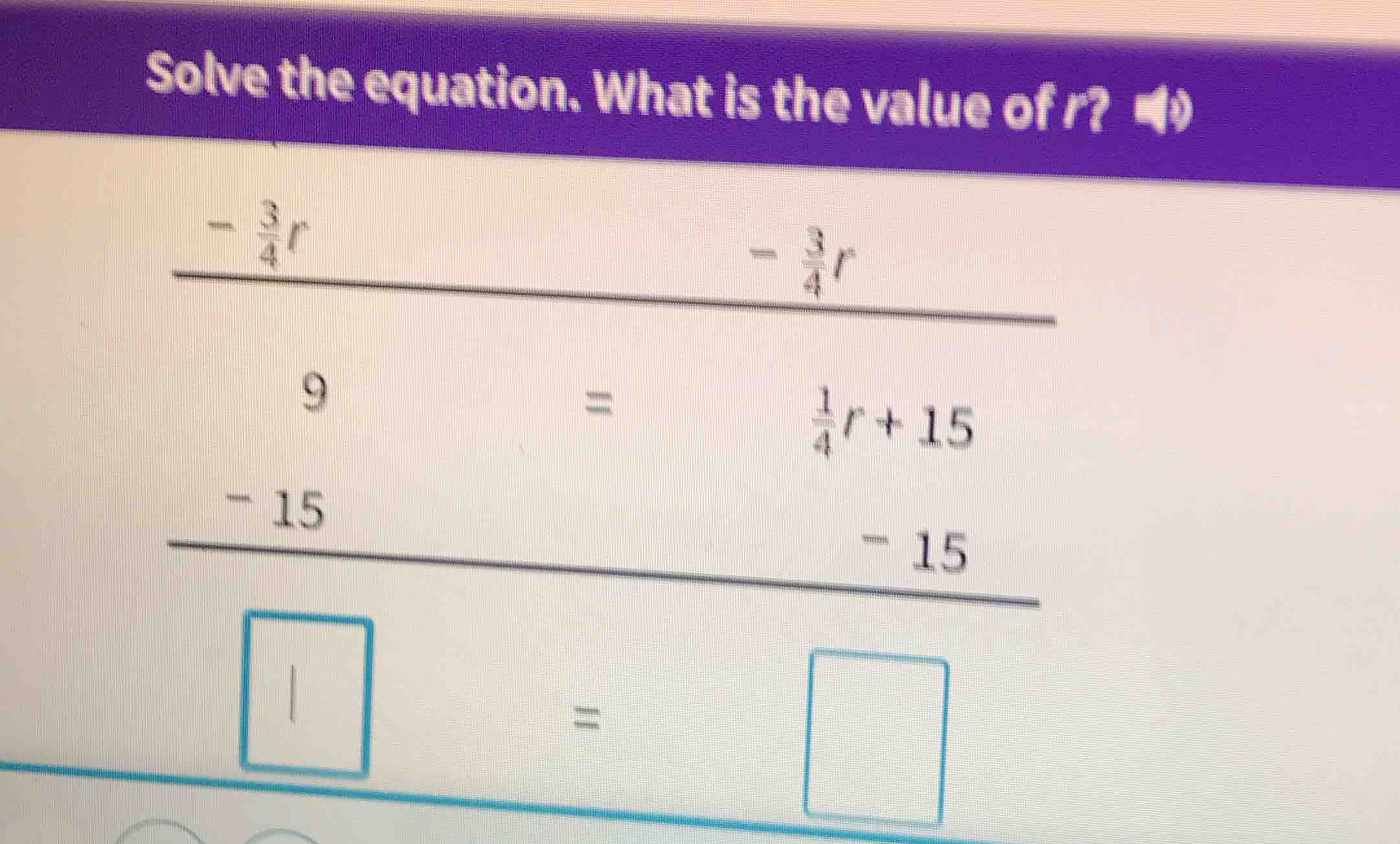
solve the equation. what is the value of r?
\\(-\frac{3}{4}r\\) \\(-\frac{3}{4}r\\)
\\(\overline{\quad\quad\quad\quad\quad\quad\quad\quad\quad\quad\quad\quad}\\)
\\(9 = \frac{1}{4}r + 15\\)
\\(-15\\) \\(-15\\)
\\(\overline{\quad\quad\quad\quad\quad\quad\quad\quad\quad\quad\quad\quad}\\)
\\(\square = \square\\)
Step1: Calculate left - hand side after subtraction
We have the left - hand side as \(9 - 15\). According to the subtraction operation of integers, \(9-15=- 6\).
Step2: Calculate right - hand side after subtraction
The right - hand side is \(\frac{1}{4}r + 15-15\). The \(+ 15\) and \(-15\) cancel out, so we are left with \(\frac{1}{4}r\). But wait, actually, in the original equation - modification step (the first step of subtracting \(\frac{3}{4}r\) is not fully shown in the final box - filling part, but the second step is subtracting 15 from both sides). Wait, let's re - express the original equation solving process.
The original equation (after the first step of subtracting \(\frac{3}{4}r\) from both sides) is \(9=\frac{1}{4}r + 15\). Then we subtract 15 from both sides:
Left - hand side: \(9-15=-6\)
Right - hand side: \(\frac{1}{4}r+15 - 15=\frac{1}{4}r\)
So the equation after subtracting 15 from both sides is \(-6=\frac{1}{4}r\)
But wait, maybe the problem is just about the step of subtracting 15 from both sides. Let's focus on the subtraction step.
When we subtract 15 from the left - hand side (\(9-15\)) and subtract 15 from the right - hand side (\(\frac{1}{4}r + 15-15\)):
For the left - hand side: \(9-15=-6\)
For the right - hand side: \(\frac{1}{4}r+15 - 15=\frac{1}{4}r\)
But maybe the problem is in the middle of solving the equation \(9=\frac{1}{4}r + 15\) by subtracting 15 from both sides. So the left - hand side result of \(9 - 15\) is \(-6\), and the right - hand side result of \(\frac{1}{4}r+15 - 15\) is \(\frac{1}{4}r\)
Wait, perhaps the first box is for the left - hand side after \(9-15\) and the second box is for the right - hand side after \(\frac{1}{4}r + 15-15\)
So:
Left - hand side: \(9-15=-6\)
Right - hand side: \(\frac{1}{4}r+15 - 15=\frac{1}{4}r\)
But if we continue to solve for \(r\), we can multiply both sides by 4:
\(r=-6\times4=-24\)
But let's first complete the subtraction step.

Snap & solve any problem in the app
Get step-by-step solutions on Sovi AI
Photo-based solutions with guided steps
Explore more problems and detailed explanations
The left - hand box (after \(9 - 15\)) is \(-6\), and the right - hand box (after \(\frac{1}{4}r+15 - 15\)) is \(\frac{1}{4}r\)
If we are to solve for \(r\) completely:
After getting \(-6=\frac{1}{4}r\), multiply both sides by 4: \(r=-6\times4 = - 24\)
But based on the subtraction step (the step of subtracting 15 from both sides), the left - hand side result is \(-6\) and the right - hand side result is \(\frac{1}{4}r\)
If the question is about the subtraction step (the two boxes), the answers are \(-6\) (left) and \(\frac{1}{4}r\) (right). If it's about the final value of \(r\), the answer is \(-24\)
Assuming the question is about the subtraction step (the two boxes in the image), the left box is \(-6\) and the right box is \(\frac{1}{4}r\). But if we solve for \(r\) completely:
Step3: Solve for \(r\)
We have \(-6=\frac{1}{4}r\). Multiply both sides by 4: \(r=-6\times4=-24\)
If we consider the final value of \(r\), the answer is \(-24\)