QUESTION IMAGE
Question
solve for x. figures are not necessarily drawn to scale.
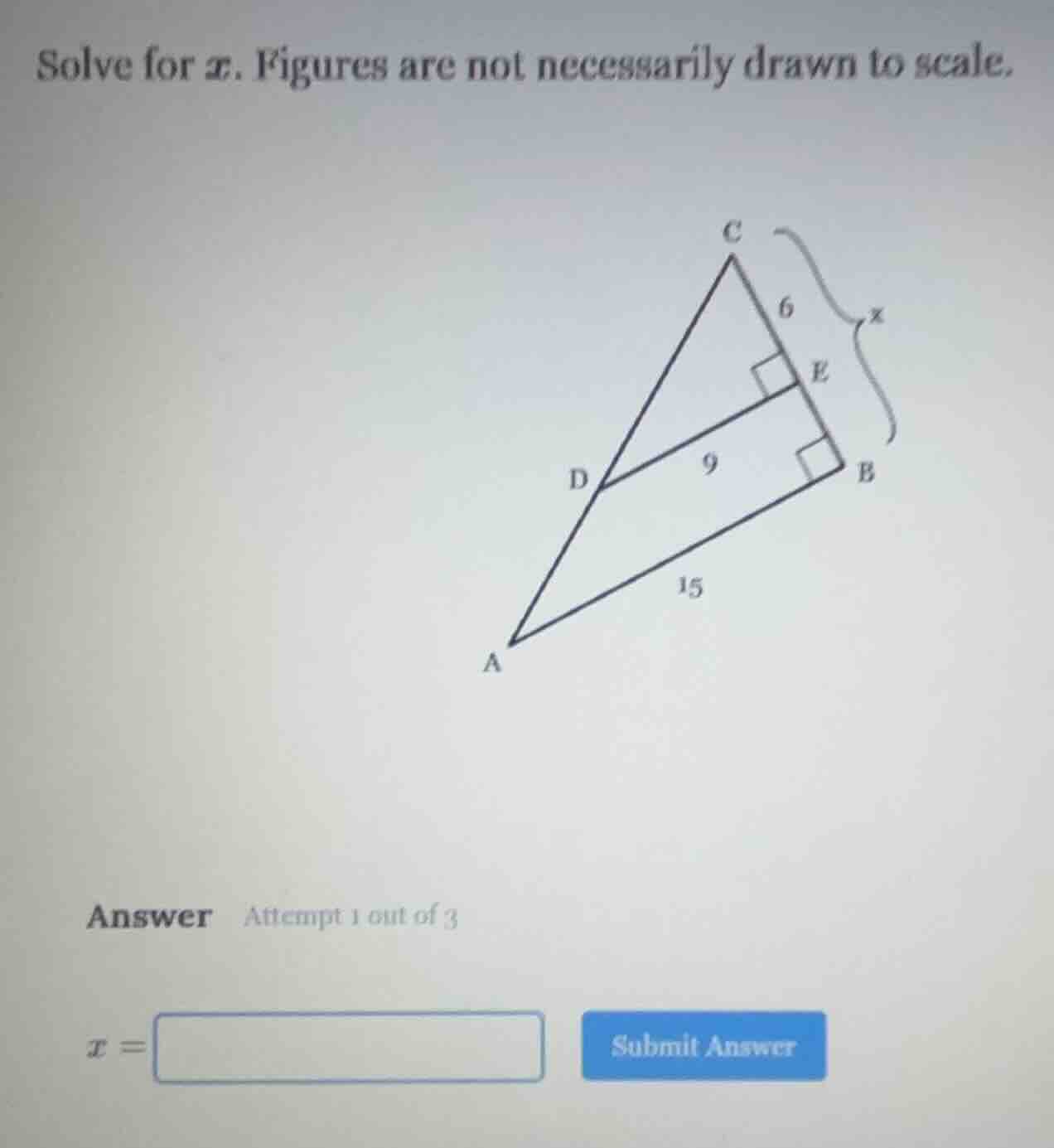
(image of a triangle with right angles at e and b, segment ce = 6, segment db = 9, segment ab = 15, and x is the length from c to b)
answer attempt 1 out of 3
x = blank submit answer
Step1: Identify similar triangles
Triangles \( \triangle ADE \) and \( \triangle ACB \) are similar (by AA similarity, as both have a right angle and share \( \angle A \)).
Step2: Set up proportion
For similar triangles, the ratios of corresponding sides are equal. Let \( AE = 6 + x \), \( DE = 9 \), \( AB = 15 \), \( CB = 6 + x \)? Wait, no, let's correct. Wait, \( CE = 6 \), \( EB \) is part of \( CB \)? Wait, actually, \( DE = 9 \), \( AB = 15 \), and \( CE = 6 \), \( AE \) is from \( A \) to \( E \), but maybe the sides are \( DE \) and \( AB \), and \( CE \) and \( CB \)? Wait, no, let's re-express. Let \( AD \) and \( AC \) be the hypotenuses, \( DE \) and \( AB \) be the legs, and \( CE \) and \( CB \) be the other legs? Wait, no, the right angles are at \( E \) and \( B \), so \( DE \perp AB \)? Wait, no, the figure: \( E \) is on \( CB \), \( D \) is on \( AC \), \( DE \) is parallel to \( AB \)? Wait, no, \( DE \) and \( AB \) are both right angles, so \( DE \parallel AB \), so triangles \( CDE \) and \( CAB \) are similar? Wait, maybe I mixed up. Let's see: \( \angle C \) is common, \( \angle CED = \angle CBA = 90^\circ \), so \( \triangle CED \sim \triangle CBA \) (AA similarity). Therefore, the ratio of \( CE \) to \( CB \) is equal to the ratio of \( DE \) to \( AB \). Wait, \( CE = 6 \), \( CB = 6 + x \)? No, \( x \) is the length from \( E \) to \( B \)? Wait, the problem says "x" is the length from \( E \) to \( B \) plus \( CE \)? Wait, the diagram: \( CE = 6 \), \( EB \) is some length, and \( x \) is \( CE + EB \)? No, the curly bracket is around \( CE = 6 \) and \( EB \), so \( x = 6 + EB \)? Wait, no, maybe \( x \) is the length of \( CB \), and \( CE = 6 \), \( EB \) is part of \( CB \). Wait, let's look at the sides: \( DE = 9 \), \( AB = 15 \), \( CE = 6 \), and we need to find \( x \) (which is \( CB \), so \( CB = 6 + EB \), but maybe \( \triangle CDE \sim \triangle CAB \), so \( \frac{CE}{CB} = \frac{DE}{AB} \). Wait, \( CE = 6 \), \( CB = x \), \( DE = 9 \), \( AB = 15 \). So \( \frac{6}{x} = \frac{9}{15} \)? Wait, no, that would be if \( \triangle CDE \sim \triangle CAB \), but \( DE \) corresponds to \( AB \), and \( CE \) corresponds to \( CB \). Wait, but \( DE = 9 \), \( AB = 15 \), \( CE = 6 \), \( CB = x \). So the proportion is \( \frac{CE}{CB} = \frac{DE}{AB} \), so \( \frac{6}{x} = \frac{9}{15} \). Wait, solving for \( x \): cross-multiplying, \( 9x = 6 \times 15 \), \( 9x = 90 \), \( x = 10 \)? Wait, no, that can't be, because \( CE = 6 \), and \( x \) is \( CB \), so \( CB = 10 \), so \( EB = 10 - 6 = 4 \)? Wait, but maybe the triangles are \( \triangle ADE \) and \( \triangle ACB \). Let's try again. \( DE = 9 \), \( AB = 15 \), \( AE = 6 + x \)? No, maybe \( AD \) and \( AC \): \( AD = AC - CD \), but maybe the correct proportion is \( \frac{DE}{AB} = \frac{CE}{CB} \). Wait, \( DE = 9 \), \( AB = 15 \), \( CE = 6 \), \( CB = x \). So \( \frac{9}{15} = \frac{6}{x} \)? Wait, no, that would be \( 9x = 90 \), \( x = 10 \). Wait, but let's check: if \( \triangle CDE \sim \triangle CAB \), then corresponding sides: \( CD/CA = DE/AB = CE/CB \). So \( DE/AB = 9/15 = 3/5 \), so \( CE/CB = 6/x = 3/5 \), so \( 3x = 30 \), \( x = 10 \). Wait, that makes sense. So \( x = 10 \).
Wait, maybe I had the proportion reversed. Let's confirm: similar triangles, so the ratio of the smaller triangle to the larger triangle. \( \triangle CED \) is smaller, \( \triangle CAB \) is larger. So \( CE \) (side of smaller) over \( CB \) (side of larger) equals \( DE \) (side of smaller) over \( AB \) (side of larger…

Snap & solve any problem in the app
Get step-by-step solutions on Sovi AI
Photo-based solutions with guided steps
Explore more problems and detailed explanations
\( x = 10 \)