QUESTION IMAGE
Question
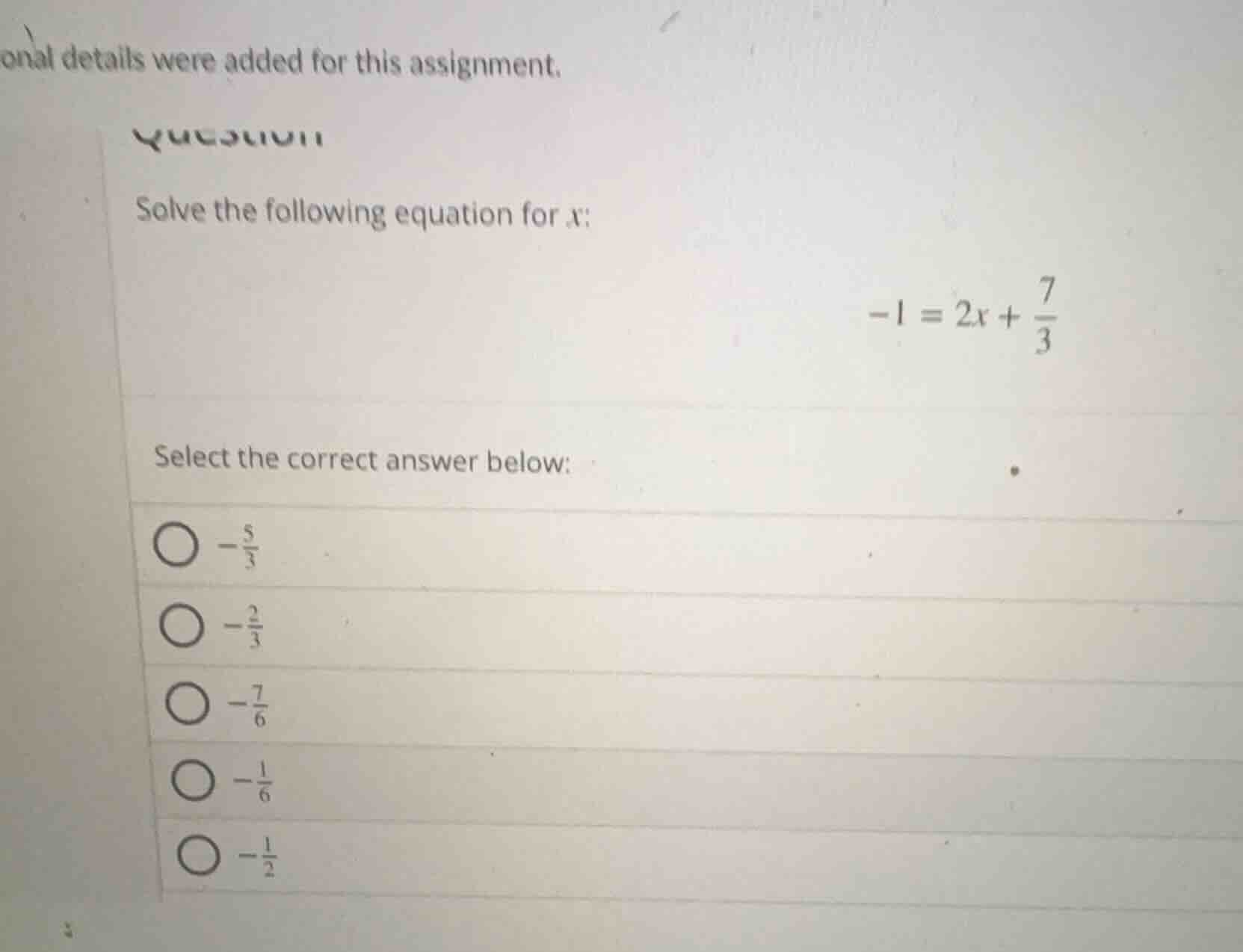
solve the following equation for x:
$-1 = 2x + \frac{7}{3}$
select the correct answer below:
$\boldsymbol{\circ} -\frac{5}{3}$
$\boldsymbol{\circ} -\frac{2}{3}$
$\boldsymbol{\circ} -\frac{7}{6}$
$\boldsymbol{\circ} -\frac{1}{6}$
$\boldsymbol{\circ} -\frac{1}{2}$
Step1: Subtract $\frac{7}{3}$ from both sides
To isolate the term with \(x\), we subtract \(\frac{7}{3}\) from both sides of the equation \(-1 = 2x+\frac{7}{3}\).
First, rewrite \(-1\) as \(-\frac{3}{3}\) to have a common denominator.
So, \(-\frac{3}{3}-\frac{7}{3}=2x+\frac{7}{3}-\frac{7}{3}\).
Simplifying the left side: \(-\frac{3 + 7}{3}=2x\), which is \(-\frac{10}{3}=2x\).
Step2: Divide both sides by 2
To solve for \(x\), we divide both sides of the equation \(-\frac{10}{3}=2x\) by 2.
Dividing a fraction by 2 is the same as multiplying by \(\frac{1}{2}\), so \(x = -\frac{10}{3}\times\frac{1}{2}\).
Simplifying the right side: \(x=-\frac{10\times1}{3\times2}=-\frac{5}{3}\)? Wait, no, wait. Wait, let's check again. Wait, in step 1, if the equation is \(-1 = 2x+\frac{7}{3}\), then subtract \(\frac{7}{3}\) from both sides: \(-1-\frac{7}{3}=2x\). \(-1\) is \(-\frac{3}{3}\), so \(-\frac{3}{3}-\frac{7}{3}=-\frac{10}{3}\), so \(2x = -\frac{10}{3}\)? Wait, no, that can't be. Wait, maybe I made a mistake. Wait, the original equation is \(-1 = 2x+\frac{7}{3}\). Let's do it again.
Wait, let's start over. Equation: \(-1 = 2x+\frac{7}{3}\).
Subtract \(\frac{7}{3}\) from both sides: \(-1-\frac{7}{3}=2x\).
Convert \(-1\) to thirds: \(-\frac{3}{3}-\frac{7}{3}=2x\).
Combine numerators: \(\frac{-3 - 7}{3}=2x\) → \(-\frac{10}{3}=2x\)? Wait, but the options don't have \(-\frac{5}{3}\) as correct? Wait, no, wait the options do have \(-\frac{5}{3}\) as the first option. Wait, but let's check the calculation again. Wait, maybe I messed up the sign. Wait, the equation is \(-1 = 2x+\frac{7}{3}\). So, subtract \(\frac{7}{3}\) from both sides: \(-1-\frac{7}{3}=2x\). \(-1\) is \(-\frac{3}{3}\), so \(-\frac{3}{3}-\frac{7}{3}=-\frac{10}{3}\). Then divide both sides by 2: \(x = -\frac{10}{3}\div2 = -\frac{10}{3}\times\frac{1}{2}=-\frac{5}{3}\). Wait, but let's check with the options. The first option is \(-\frac{5}{3}\). But wait, maybe I made a mistake in the equation. Wait, maybe the equation is \(-1 = 2x+\frac{7}{3}\), let's plug \(x = -\frac{5}{3}\) back into the equation. Left side: \(-1\). Right side: \(2\times(-\frac{5}{3})+\frac{7}{3}=-\frac{10}{3}+\frac{7}{3}=-\frac{3}{3}=-1\). So that works. So the correct answer is \(-\frac{5}{3}\).
Wait, but let's check the options again. The first option is \(-\frac{5}{3}\), so that's the correct one.
Wait, but maybe I made a mistake in the initial step. Let's confirm:
Equation: \(-1 = 2x + \frac{7}{3}\)
Subtract \(\frac{7}{3}\) from both sides:
\(-1 - \frac{7}{3} = 2x\)
\(-\frac{3}{3} - \frac{7}{3} = 2x\)
\(-\frac{10}{3} = 2x\)
Divide both sides by 2:
\(x = -\frac{10}{3} \div 2 = -\frac{10}{3} \times \frac{1}{2} = -\frac{5}{3}\)
Yes, that's correct. So the answer is \(-\frac{5}{3}\), which is the first option.

Snap & solve any problem in the app
Get step-by-step solutions on Sovi AI
Photo-based solutions with guided steps
Explore more problems and detailed explanations
\(\boxed{-\dfrac{5}{3}}\) (corresponding to the option: \(\boldsymbol{-\dfrac{5}{3}}\))