QUESTION IMAGE
Question
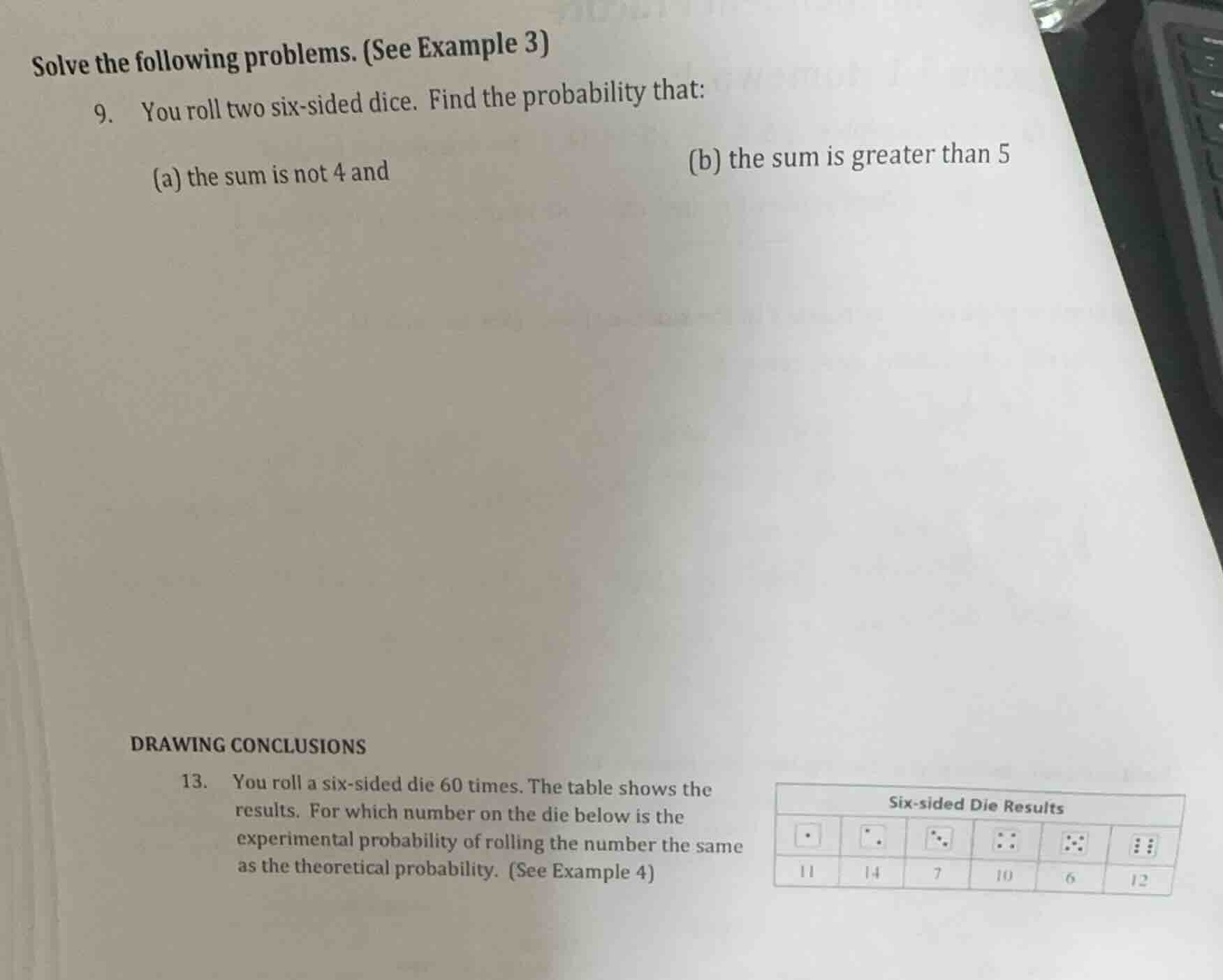
solve the following problems. (see example 3)
- you roll two six - sided dice. find the probability that:
(a) the sum is not 4 and
(b) the sum is greater than 5
drawing conclusions
- you roll a six - sided die 60 times. the table shows the
results. for which number on the die below is the
experimental probability of rolling the number the same
as the theoretical probability. (see example 4)
six - sided die results
11 14 7 10 6 12
Part (a)
Step1: Find total outcomes
When rolling two six - sided dice, the total number of possible outcomes is \(n(S)=6\times6 = 36\) since each die has 6 faces.
Step2: Find number of outcomes with sum 4
The pairs \((x,y)\) where \(x + y=4\) are \((1,3)\), \((2,2)\), \((3,1)\). So the number of outcomes with sum 4, \(n(A) = 3\).
Step3: Find probability of sum not 4
The probability of an event \(A\) not occurring is \(P(\text{not }A)=1 - P(A)\). Here \(P(A)=\frac{n(A)}{n(S)}=\frac{3}{36}=\frac{1}{12}\). So \(P(\text{sum is not }4)=1-\frac{1}{12}=\frac{12 - 1}{12}=\frac{11}{12}\).
Step1: Find total outcomes
As before, \(n(S) = 36\).
Step2: Find number of outcomes with sum \(\leq5\)
The pairs \((x,y)\) with \(x + y\leq5\) are:
- Sum = 2: \((1,1)\) (1 outcome)
- Sum = 3: \((1,2)\), \((2,1)\) (2 outcomes)
- Sum = 4: \((1,3)\), \((2,2)\), \((3,1)\) (3 outcomes)
- Sum = 5: \((1,4)\), \((2,3)\), \((3,2)\), \((4,1)\) (4 outcomes)
The total number of outcomes with sum \(\leq5\) is \(1 + 2+3 + 4=10\).
Step3: Find probability of sum > 5
The probability of sum > 5 is \(P = 1-\frac{\text{number of outcomes with sum}\leq5}{n(S)}=1-\frac{10}{36}=1 - \frac{5}{18}=\frac{18 - 5}{18}=\frac{13}{18}\).
Step1: Theoretical probability for a die
For a fair six - sided die, the theoretical probability of rolling any particular number \(k\) (where \(k = 1,2,\cdots,6\)) is \(P_{theoretical}=\frac{1}{6}\). When rolling the die \(n = 60\) times, the expected number of times we roll a particular number is \(E=n\times P_{theoretical}=60\times\frac{1}{6}=10\).
Step2: Check experimental frequencies
We are given the experimental frequencies: 11, 14, 7, 10, 6, 12 for the numbers 1 - 6 respectively. We see that the frequency 10 matches the expected number of 10. The number corresponding to the frequency 10 is the number with 4 dots (since the fourth column in the table has a frequency of 10).

Snap & solve any problem in the app
Get step-by-step solutions on Sovi AI
Photo-based solutions with guided steps
Explore more problems and detailed explanations
\(\frac{11}{12}\)