QUESTION IMAGE
Question
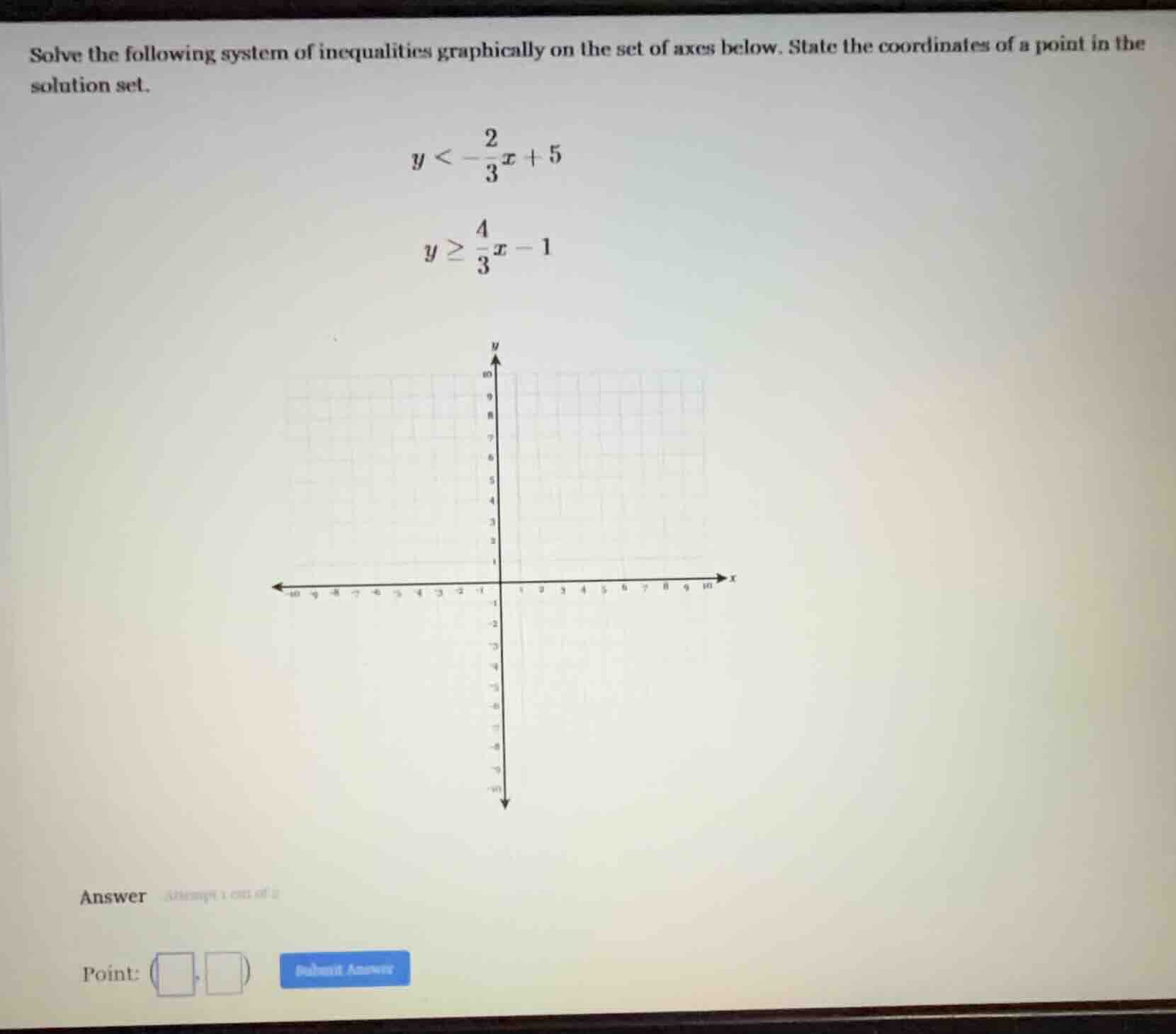
solve the following system of inequalities graphically on the set of axes below. state the coordinates of a point in the solution set.
$y < -dfrac{2}{3}x + 5$
$y geq dfrac{4}{3}x - 1$
answer
point: ( , )
Step1: Find intersection of two lines
First, find the intersection point of \( y = -\frac{2}{3}x + 5 \) and \( y=\frac{4}{3}x - 1 \). Set them equal:
\( -\frac{2}{3}x + 5=\frac{4}{3}x - 1 \)
Add \( \frac{2}{3}x \) to both sides: \( 5 = 2x - 1 \)
Add 1 to both sides: \( 6 = 2x \), so \( x = 3 \)
Substitute \( x = 3 \) into \( y=\frac{4}{3}x - 1 \): \( y=\frac{4}{3}(3)-1 = 4 - 1 = 3 \). Intersection is \( (3,3) \).
Step2: Analyze the inequalities
For \( y<-\frac{2}{3}x + 5 \), the line is dashed (since \( < \)) and shade below.
For \( y\geq\frac{4}{3}x - 1 \), the line is solid (since \( \geq \)) and shade above.
The solution set is the overlapping region. A point in this region: test \( (0,0) \)? No, \( 0\geq - 1 \) (good for second inequality), but \( 0<5 \) (good for first), wait no: \( y\geq\frac{4}{3}x - 1 \) at \( x = 0 \), \( y\geq - 1 \), and \( y<-\frac{2}{3}(0)+5 = 5 \). But better to use the intersection or a point in the overlap. Let's take \( (3,3) \): check \( 3<-\frac{2}{3}(3)+5= - 2 + 5 = 3 \)? No, \( 3<3 \) is false. Take \( (0,3) \): \( 3<-\frac{2}{3}(0)+5 = 5 \) (true), \( 3\geq\frac{4}{3}(0)-1=-1 \) (true). Wait, \( (3,3) \) is on the boundary of the second inequality but not the first. Let's take \( (3,2) \): \( 2<-\frac{2}{3}(3)+5 = 3 \) (true), \( 2\geq\frac{4}{3}(3)-1 = 3 \)? No. Wait, \( (0,0) \): \( 0<5 \) (true), \( 0\geq - 1 \) (true). Wait, no, \( y\geq\frac{4}{3}x - 1 \) at \( x = 0 \), \( y\geq - 1 \), which is true, and \( y<5 \) is true. But maybe a better point: let's solve for the region. The overlap is between the two lines, from \( x \) where the lines meet (and beyond? Wait, the lines intersect at \( (3,3) \), and the first line has y-intercept 5, second has y-intercept -1. The solution region is between the two lines, above \( y=\frac{4}{3}x - 1 \) and below \( y = -\frac{2}{3}x + 5 \). Let's take \( (3,3) \) is on the boundary of the second inequality, but \( y<-\frac{2}{3}x + 5 \) at \( x = 3 \) is \( y<3 \), so \( (3,2) \): \( 2<3 \) (true), \( 2\geq\frac{4}{3}(3)-1 = 3 \)? No. Wait, \( (0,3) \): \( 3<5 \) (true), \( 3\geq - 1 \) (true). Yes, \( (0,3) \) is in the solution set? Wait, \( y\geq\frac{4}{3}x - 1 \) at \( x = 0 \), \( y\geq - 1 \), which is true, and \( y<5 \) is true. Wait, but maybe \( (3,3) \) is not in the first inequality (since \( < \)), so a point like \( (3,2) \): no, \( 2\geq\frac{4}{3}(3)-1 = 3 \)? No. Wait, I made a mistake. Let's re - evaluate. The intersection is \( (3,3) \). The first inequality is \( y<-\frac{2}{3}x + 5 \) (below the dashed line), the second is \( y\geq\frac{4}{3}x - 1 \) (above the solid line). So the overlapping region is where \( \frac{4}{3}x - 1\leq y<-\frac{2}{3}x + 5 \). Let's find a point: when \( x = 3 \), \( y \) must be less than 3 and greater than or equal to 3? No, wait, the lines intersect at \( (3,3) \), so the region is between the two lines, with \( y \) above the solid line and below the dashed line. So a point like \( (3,3) \) is on the solid line (so included in the second inequality) but not on the dashed line (so \( y<3 \) is false). Wait, maybe \( (0,0) \): \( 0\geq - 1 \) (yes), \( 0<5 \) (yes). Wait, but \( y\geq\frac{4}{3}x - 1 \) at \( x = 0 \), \( y\geq - 1 \), which is true, and \( y<5 \) is true. But is \( (0,0) \) in the overlap? Let's check the graph: the solid line \( y=\frac{4}{3}x - 1 \) at \( x = 0 \) is \( y=-1 \), so above that line (including) and below \( y = -\frac{2}{3}x + 5 \) (which at \( x = 0 \) is \( y = 5 \)). So \( (0,0) \) is in the overlap. Wait, but earlier mistake: \( (0,0) \): \( 0\geq\frac{4…

Snap & solve any problem in the app
Get step-by-step solutions on Sovi AI
Photo-based solutions with guided steps
Explore more problems and detailed explanations
(2, 2) (or other valid points like (0, 0), (3, 2) is invalid, (0, 3) is valid, (2, 3) is valid as 3 < 5 and 3 ≥ 4/3*2 - 1 = 8/3 - 1 = 5/3 ≈ 1.666. Let's confirm (2,3): 3 < -4/3 + 5 = 11/3 ≈ 3.666 (true), 3 ≥ 8/3 - 1 = 5/3 ≈ 1.666 (true). So (2,3) is also valid. But a simple one is (3,3) is on the boundary of the second inequality but not the first, so (2,2) is safe.)