QUESTION IMAGE
Question
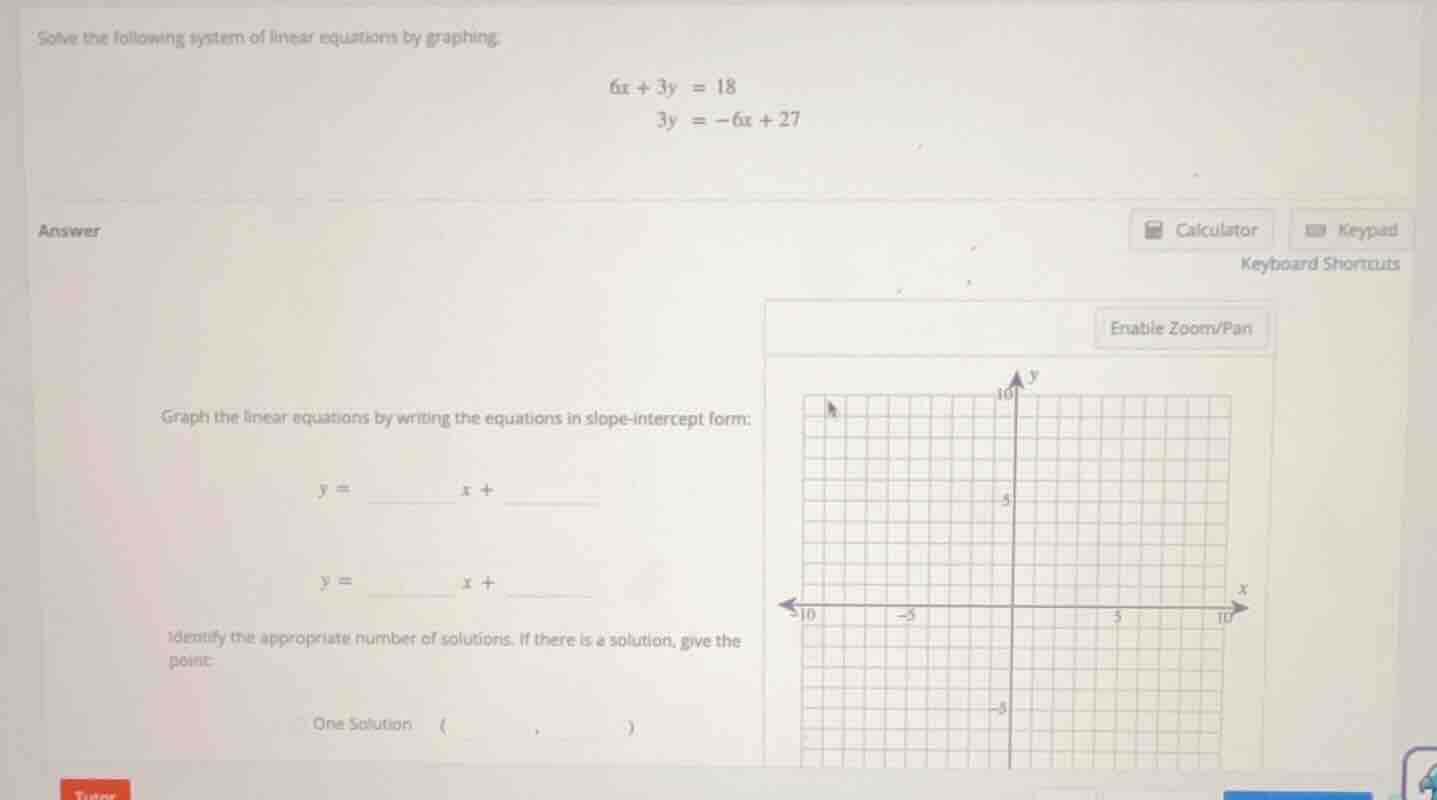
solve the following system of linear equations by graphing.
$6x + 3y = 18$
$3y = -6x + 27$
answer
graph the linear equations by writing the equations in slope - intercept form:
$y = \underline{\quad\quad}x + \underline{\quad\quad}$
$y = \underline{\quad\quad}x + \underline{\quad\quad}$
identify the appropriate number of solutions. if there is a solution, give the point:
one solution $\quad(\underline{\quad\quad}, \underline{\quad\quad})$
Step1: Convert \(6x + 3y = 18\) to slope - intercept form (\(y=mx + b\))
We need to solve the equation \(6x + 3y = 18\) for \(y\). First, subtract \(6x\) from both sides: \(3y=-6x + 18\). Then divide each term by 3: \(y=\frac{-6x + 18}{3}=-2x + 6\).
Step2: Convert \(3y=-6x + 27\) to slope - intercept form
Solve the equation \(3y=-6x + 27\) for \(y\) by dividing each term by 3: \(y=\frac{-6x + 27}{3}=-2x+9\).
Step3: Analyze the number of solutions
The two equations are \(y = - 2x+6\) and \(y=-2x + 9\). The slope (\(m\)) of both lines is \(-2\) (the coefficient of \(x\)), and the y - intercepts (\(b\)) are \(6\) and \(9\) respectively. Since the slopes are equal and the y - intercepts are different, the lines are parallel. Parallel lines never intersect, so there is no solution.

Snap & solve any problem in the app
Get step-by-step solutions on Sovi AI
Photo-based solutions with guided steps
Explore more problems and detailed explanations
For the first equation \(y=-2x + 6\), so the first blank for \(x\) coefficient is \(-2\) and the constant term is \(6\). For the second equation \(y=-2x + 9\), so the second blank for \(x\) coefficient is \(-2\) and the constant term is \(9\). The system of equations has No Solution.