QUESTION IMAGE
Question
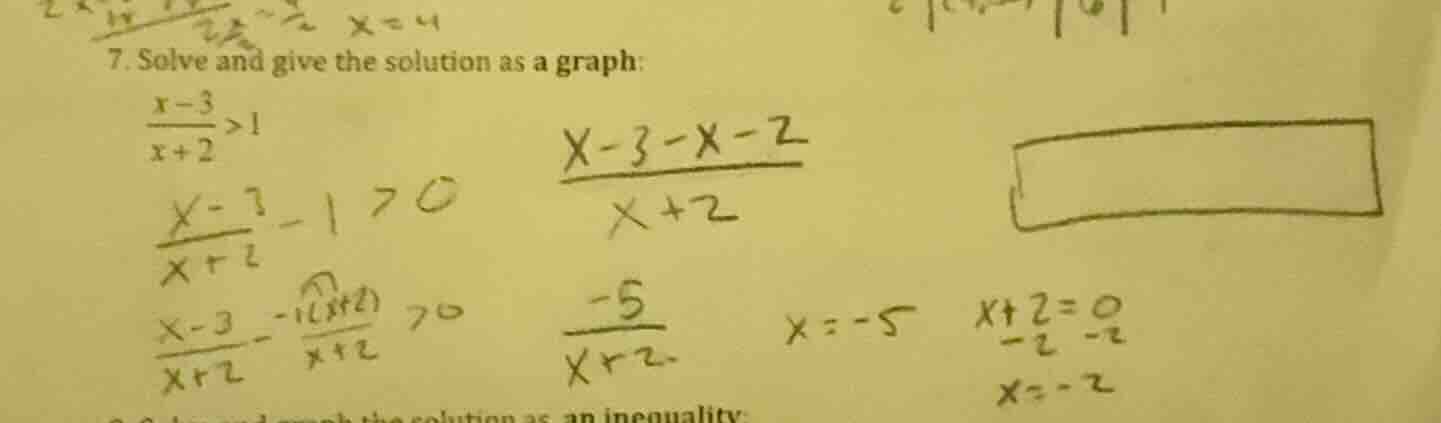
- solve and give the solution as a graph:
\\(\frac{x - 3}{x + 2} > 1\\)
\\(\frac{x - 3}{x + 2} - 1 > 0\\)
\\(\frac{x - 3}{x + 2} - \frac{1(x + 2)}{x + 2} > 0\\)
\\(\frac{x - 3 - x - 2}{x + 2}\\)
\\(\frac{-5}{x + 2}\\) \\(x = -5\\) \\(x + 2 = 0\\) \\(x = -2\\)
Step1: Rewrite the inequality
Start with \(\frac{x - 3}{x + 2}>1\). Subtract 1 from both sides to get \(\frac{x - 3}{x + 2}-1>0\).
Step2: Combine the fractions
Find a common denominator (\(x + 2\)): \(\frac{x - 3-(x + 2)}{x + 2}>0\). Simplify the numerator: \(x - 3 - x - 2=-5\), so the inequality becomes \(\frac{-5}{x + 2}>0\).
Step3: Analyze the sign
A fraction \(\frac{a}{b}\) is positive when \(a\) and \(b\) have the same sign. Here, \(a=-5\) (negative), so \(b = x + 2\) must also be negative for the fraction to be positive. So we solve \(x + 2<0\) (since \(-5\) is negative, denominator must be negative to make the fraction positive).
Step4: Solve for \(x\)
Solve \(x + 2<0\) gives \(x<-2\). Also, we must exclude \(x=-2\) because the original denominator \(x + 2\) cannot be zero. We also check if there are other restrictions. The numerator simplification didn't introduce new roots, and we can verify test points. For example, if \(x=-3\) (which is \(<-2\)), \(\frac{-3 - 3}{-3 + 2}=\frac{-6}{-1}=6>1\), which works. If \(x = 0\) (which is \(>-2\)), \(\frac{0 - 3}{0 + 2}=-\frac{3}{2}<1\), which doesn't work. And \(x=-2\) is undefined.

Snap & solve any problem in the app
Get step-by-step solutions on Sovi AI
Photo-based solutions with guided steps
Explore more problems and detailed explanations
The solution to the inequality \(\frac{x - 3}{x + 2}>1\) is \(x<-2\). To graph this, we draw a number line, put an open circle at \(x=-2\) (since \(x=-2\) is not included), and shade the region to the left of \(x=-2\) (all values less than \(-2\)).