QUESTION IMAGE
Question
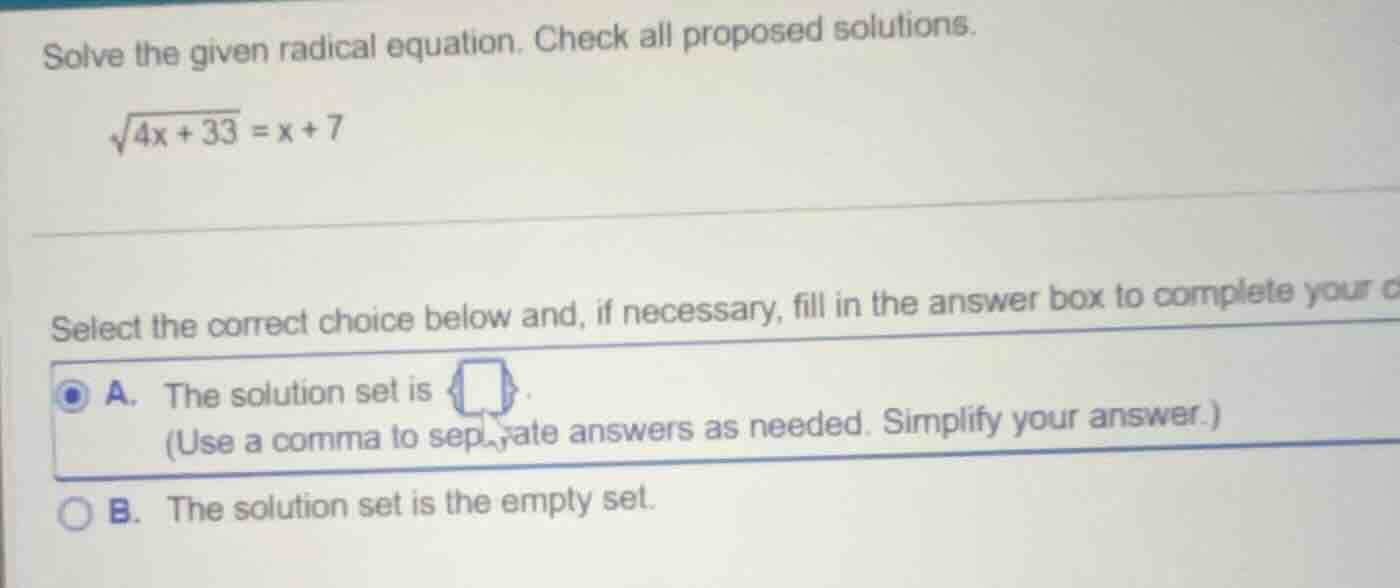
solve the given radical equation. check all proposed solutions.\\(\sqrt{4x + 33}=x + 7\\)\\(\\)select the correct choice below and, if necessary, fill in the answer box to complete your\\(\\)a. the solution set is \\(\square\\).\\(\\)(use a comma to separate answers as needed. simplify your answer.)\\(\\)b. the solution set is the empty set.
Step1: Square both sides to eliminate the square root
To solve the radical equation \(\sqrt{4x + 33}=x + 7\), we first square both sides of the equation. Squaring the left side \(\sqrt{4x + 33}\) gives us \(4x + 33\), and squaring the right side \((x + 7)\) gives us \((x + 7)^2\) by the formula \((a+b)^2=a^2 + 2ab + b^2\) where \(a=x\) and \(b = 7\). So we have the equation:
\[4x+33=(x + 7)^2\]
Step2: Expand the right - hand side
Expand \((x + 7)^2\) using the formula \((a + b)^2=a^{2}+2ab + b^{2}\), where \(a=x\) and \(b = 7\). We get \(x^{2}+14x + 49\). So the equation becomes:
\[4x+33=x^{2}+14x + 49\]
Step3: Rearrange the equation to form a quadratic equation
Subtract \(4x\) and \(33\) from both sides of the equation to set the equation to zero:
\[x^{2}+14x+49-4x - 33=0\]
Simplify the left - hand side:
\[x^{2}+10x + 16=0\]
Step4: Factor the quadratic equation
We need to find two numbers that multiply to \(16\) and add up to \(10\). The numbers are \(2\) and \(8\). So we can factor the quadratic equation as:
\((x + 2)(x+8)=0\)
Step5: Solve for x using the zero - product property
If \((x + 2)(x + 8)=0\), then either \(x+2=0\) or \(x + 8=0\).
- If \(x+2=0\), then \(x=-2\).
- If \(x + 8=0\), then \(x=-8\).
Step6: Check the proposed solutions
Check \(x=-2\):
Substitute \(x = - 2\) into the original equation \(\sqrt{4x+33}=x + 7\).
Left - hand side: \(\sqrt{4\times(-2)+33}=\sqrt{-8 + 33}=\sqrt{25}=5\).
Right - hand side: \(-2 + 7=5\).
Since the left - hand side equals the right - hand side, \(x=-2\) is a valid solution.
Check \(x=-8\):
Substitute \(x=-8\) into the original equation \(\sqrt{4x + 33}=x + 7\).
Left - hand side: \(\sqrt{4\times(-8)+33}=\sqrt{-32 + 33}=\sqrt{1}=1\).
Right - hand side: \(-8 + 7=-1\).
Since \(1
eq - 1\), \(x=-8\) is not a valid solution.

Snap & solve any problem in the app
Get step-by-step solutions on Sovi AI
Photo-based solutions with guided steps
Explore more problems and detailed explanations
\(-2\)