QUESTION IMAGE
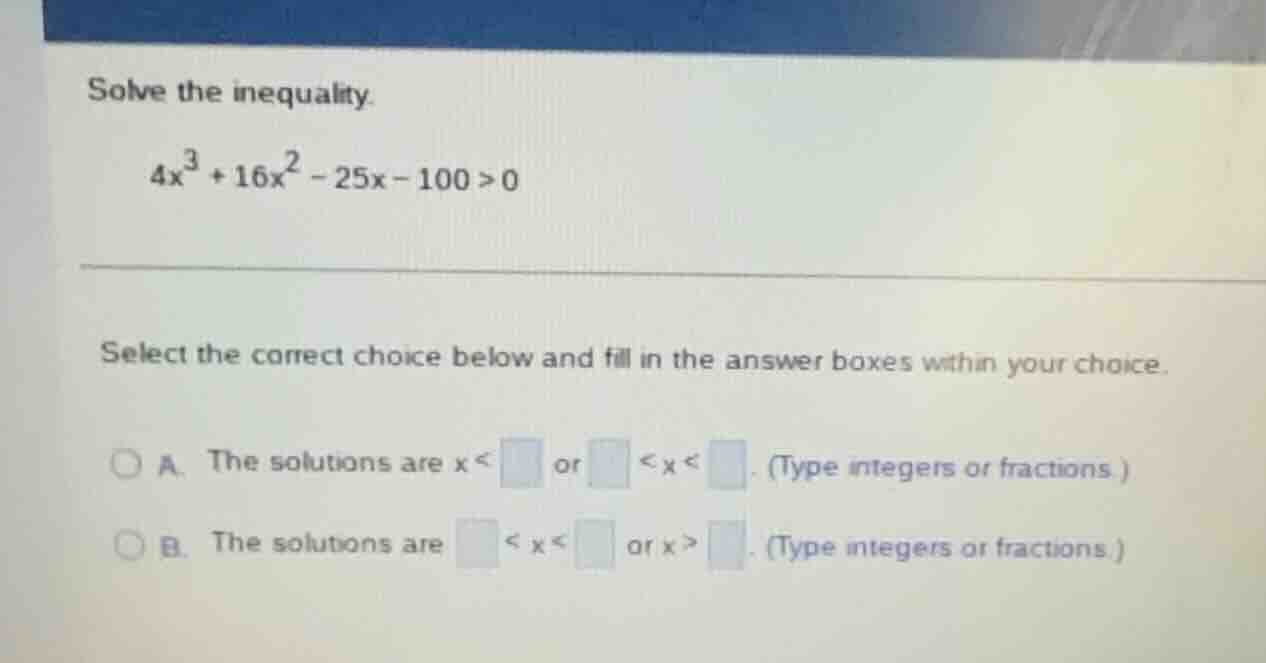
Question
solve the inequality.
$4x^3 + 16x^2 - 25x - 100 > 0$
select the correct choice below and fill in the answer boxes within your choice.
a. the solutions are $x < \square$ or $\square < x < \square$. (type integers or fractions.)
b. the solutions are $\square < x < \square$ or $x > \square$. (type integers or fractions.)
Step1: Factor the polynomial
First, we factor the left - hand side of the inequality \(4x^{3}+16x^{2}-25x - 100>0\) by grouping.
Group the terms as follows: \((4x^{3}+16x^{2})+(-25x - 100)>0\)
Factor out the greatest common factor from each group: \(4x^{2}(x + 4)-25(x + 4)>0\)
Then, factor out the common binomial factor \((x + 4)\): \((x + 4)(4x^{2}-25)>0\)
We know that \(4x^{2}-25\) is a difference of squares, and \(a^{2}-b^{2}=(a + b)(a - b)\), where \(a = 2x\) and \(b = 5\). So \(4x^{2}-25=(2x + 5)(2x - 5)\)
The factored form of the inequality is \((x + 4)(2x+5)(2x - 5)>0\)
Step2: Find the critical points
Set each factor equal to zero and solve for \(x\):
- For \(x + 4=0\), we get \(x=-4\)
- For \(2x + 5=0\), we get \(x=-\frac{5}{2}\)
- For \(2x - 5=0\), we get \(x=\frac{5}{2}\)
These critical points divide the real number line into the intervals: \((-\infty,-4),(-4,-\frac{5}{2}),(-\frac{5}{2},\frac{5}{2}),(\frac{5}{2},\infty)\)
Step3: Test the intervals
- Interval \((-\infty,-4)\): Let's choose a test point, say \(x=-5\).
Substitute \(x = - 5\) into \((x + 4)(2x+5)(2x - 5)\):
\((-5 + 4)(2\times(-5)+5)(2\times(-5)-5)=(-1)(-10 + 5)(-10 - 5)=(-1)(-5)(-15)=-75<0\)
- Interval \((-4,-\frac{5}{2})\): Let's choose a test point, say \(x=-3\).
Substitute \(x=-3\) into \((x + 4)(2x+5)(2x - 5)\):
\((-3 + 4)(2\times(-3)+5)(2\times(-3)-5)=(1)(-6 + 5)(-6 - 5)=(1)(-1)(-11)=11>0\)
- Interval \((-\frac{5}{2},\frac{5}{2})\): Let's choose a test point, say \(x = 0\).
Substitute \(x = 0\) into \((x + 4)(2x+5)(2x - 5)\):
\((0 + 4)(2\times0+5)(2\times0 - 5)=(4)(5)(-5)=-100<0\)
- Interval \((\frac{5}{2},\infty)\): Let's choose a test point, say \(x = 3\).
Substitute \(x = 3\) into \((x + 4)(2x+5)(2x - 5)\):
\((3 + 4)(2\times3+5)(2\times3 - 5)=(7)(6 + 5)(6 - 5)=(7)(11)(1)=77>0\)

Snap & solve any problem in the app
Get step-by-step solutions on Sovi AI
Photo-based solutions with guided steps
Explore more problems and detailed explanations
The solutions are \(-4
So the correct choice is B. The solutions are \(\boldsymbol{-4}