QUESTION IMAGE
Question
solve the number stories. use a different strategy for each one.
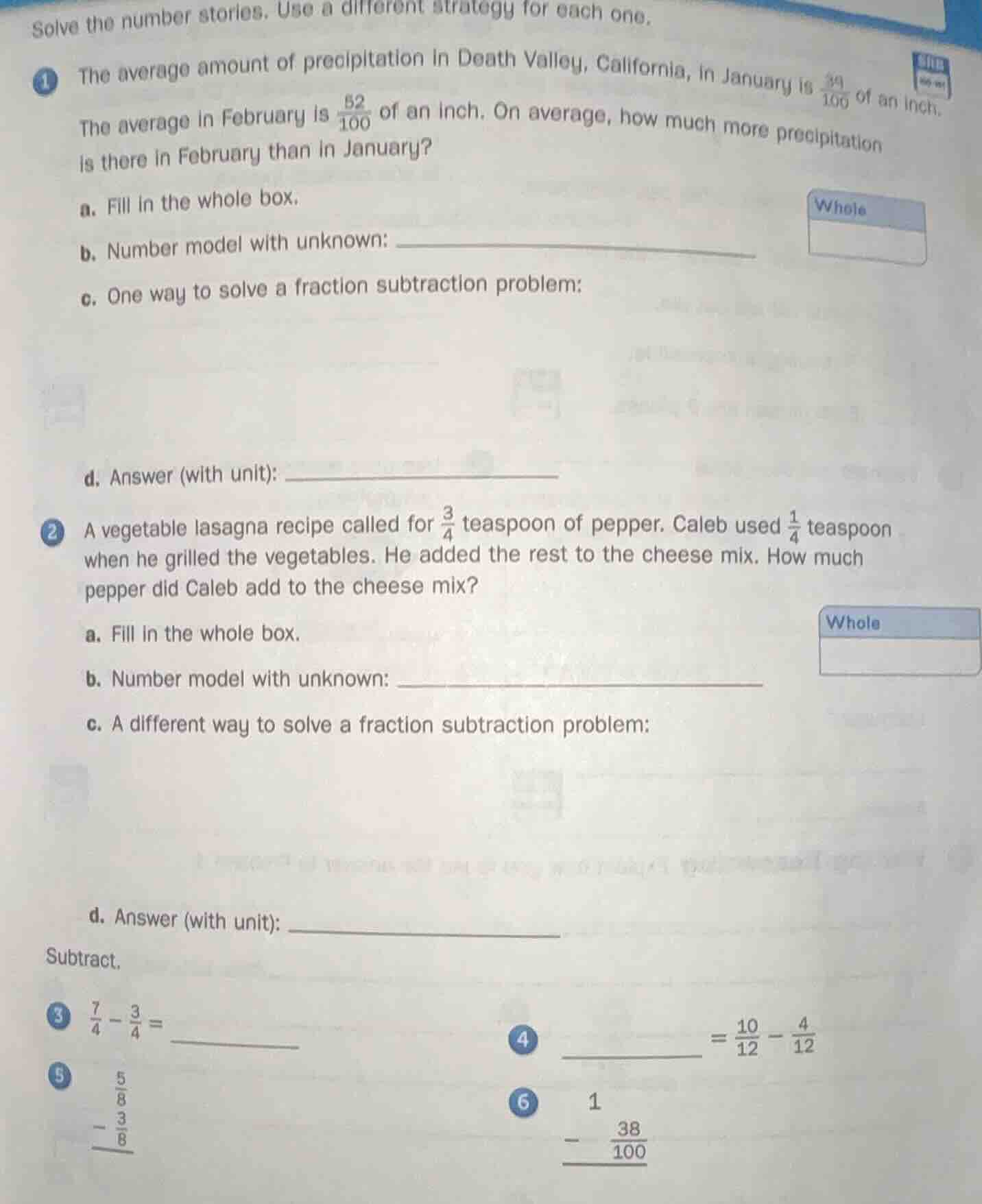
1 the average amount of precipitation in death valley, california, in january is \\(\frac{39}{100}\\) of an inch. the average in february is \\(\frac{52}{100}\\) of an inch. on average, how much more precipitation is there in february than in january?
a. fill in the whole box.
b. number model with unknown:
c. one way to solve a fraction subtraction problem:
d. answer (with unit):
2 a vegetable lasagna recipe called for \\(\frac{3}{4}\\) teaspoon of pepper. caleb used \\(\frac{1}{4}\\) teaspoon when he grilled the vegetables. he added the rest to the cheese mix. how much pepper did caleb add to the cheese mix?
a. fill in the whole box.
b. number model with unknown:
c. a different way to solve a fraction subtraction problem:
d. answer (with unit):
subtract.
3 \\(\frac{7}{4} - \frac{3}{4} = \\)
4 \\(\\_\\_\\_\\_\\_\\_\\_ = \frac{10}{12} - \frac{4}{12}\\)
5 \\(\
\\)
6 \\(\
\\)
Problem 1
a. Fill in the whole box.
The whole represents 1 inch (or $\frac{100}{100}$ of an inch) since we are dealing with hundredths of an inch for precipitation. So the whole box is labeled with 1 (or $\frac{100}{100}$).
b. Number model with unknown:
Let $x$ be the amount more precipitation in February than January. Then the number model is $x+\frac{39}{100}=\frac{52}{100}$ (or $\frac{52}{100}-\frac{39}{100}=x$).
c. One way to solve a fraction subtraction problem:
Since the denominators are the same, we subtract the numerators. For $\frac{52}{100}-\frac{39}{100}$, we do $52 - 39=13$, so the result is $\frac{13}{100}$.
d. Answer (with unit):
$\frac{13}{100}$ of an inch
Problem 2
a. Fill in the whole box.
The whole represents 1 teaspoon (or $\frac{4}{4}$ of a teaspoon) since we are dealing with fourths of a teaspoon for pepper. So the whole box is labeled with 1 (or $\frac{4}{4}$).
b. Number model with unknown:
Let $y$ be the amount of pepper added to the cheese mix. Then the number model is $y+\frac{1}{4}=\frac{3}{4}$ (or $\frac{3}{4}-\frac{1}{4}=y$).
c. A different way to solve a fraction subtraction problem:
We can use a visual model like a fraction bar. The fraction bar for $\frac{3}{4}$ has 3 parts shaded out of 4, and we remove 1 part (for $\frac{1}{4}$), leaving 2 parts shaded, which is $\frac{2}{4}=\frac{1}{2}$.
d. Answer (with unit):
$\frac{1}{2}$ teaspoon
Problem 3
Step 1: Subtract numerators (same denominator)
Since the denominators are the same ($4$), we subtract the numerators: $7 - 3 = 4$.
Step 2: Write result over denominator
The result is $\frac{4}{4}$, which simplifies to $1$.
Step 1: Subtract numerators (same denominator)
We have $\frac{10}{12}-\frac{4}{12}$. Subtract the numerators: $10 - 4 = 6$.
Step 2: Write result over denominator
The result is $\frac{6}{12}$, which simplifies to $\frac{1}{2}$.
Step 1: Subtract numerators (same denominator)
The denominators are the same ($8$), so subtract the numerators: $5 - 3 = 2$.
Step 2: Write result over denominator
The result is $\frac{2}{8}$, which simplifies to $\frac{1}{4}$.

Snap & solve any problem in the app
Get step-by-step solutions on Sovi AI
Photo-based solutions with guided steps
Explore more problems and detailed explanations
$1$ (or $\frac{4}{4}$)