QUESTION IMAGE
Question
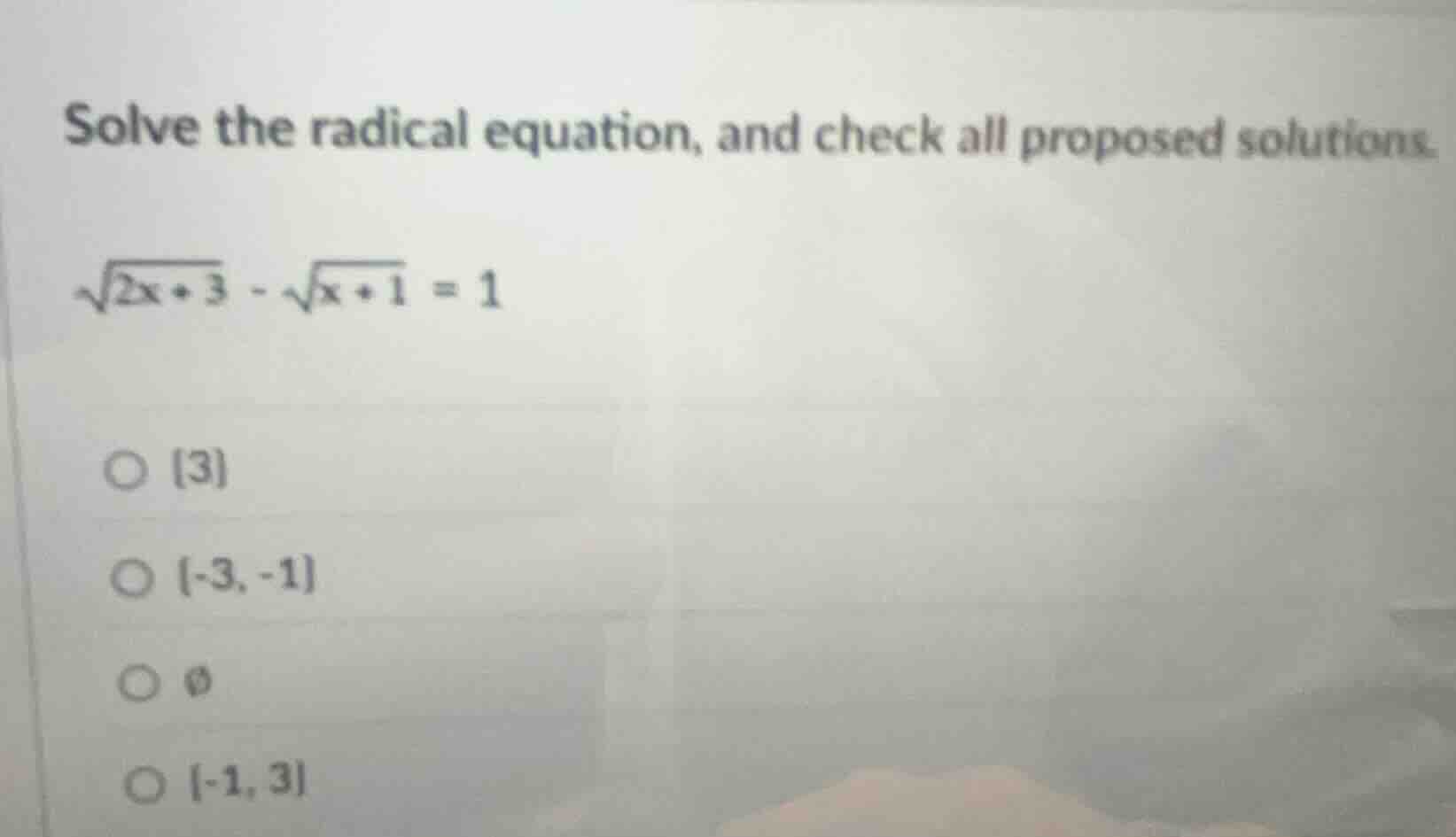
solve the radical equation, and check all proposed solutions.\\(\sqrt{2x + 3} - \sqrt{x + 1} = 1\\)\\(\bigcirc\\{3\\}\\)\\(\bigcirc\\{-3, -1\\}\\)\\(\bigcirc\emptyset\\)\\(\bigcirc\\{-1, 3\\}\\)
Step1: Isolate one radical
Let's isolate $\sqrt{2x + 3}$ by adding $\sqrt{x + 1}$ to both sides of the equation $\sqrt{2x + 3}-\sqrt{x + 1}=1$.
We get $\sqrt{2x + 3}=\sqrt{x + 1}+1$.
Step2: Square both sides
Square both sides of the equation $\sqrt{2x + 3}=\sqrt{x + 1}+1$ to eliminate the square root on the left side.
Using the formula $(a + b)^2=a^2 + 2ab + b^2$, where $a=\sqrt{x + 1}$ and $b = 1$, we have:
$(\sqrt{2x + 3})^2=(\sqrt{x + 1}+1)^2$
$2x+3=(x + 1)+2\sqrt{x + 1}+1$
Simplify the right side: $2x + 3=x + 2+2\sqrt{x + 1}$
Step3: Isolate the remaining radical
Subtract $x + 2$ from both sides to isolate the term with the square root.
$2x+3-(x + 2)=2\sqrt{x + 1}$
$2x+3 - x-2=2\sqrt{x + 1}$
$x + 1=2\sqrt{x + 1}$
Step4: Square both sides again
Square both sides of the equation $x + 1=2\sqrt{x + 1}$ to eliminate the square root.
$(x + 1)^2=(2\sqrt{x + 1})^2$
$x^2+2x + 1 = 4(x + 1)$
Expand the right side: $x^2+2x + 1=4x + 4$
Step5: Solve the quadratic equation
Rearrange the equation to standard quadratic form $ax^2+bx + c = 0$.
$x^2+2x + 1-4x - 4=0$
$x^2-2x - 3=0$
Factor the quadratic equation: $(x - 3)(x + 1)=0$
Set each factor equal to zero:
$x-3 = 0$ or $x + 1=0$
So, $x = 3$ or $x=-1$
Step6: Check the proposed solutions
Check $x = 3$:
Substitute $x = 3$ into the original equation $\sqrt{2x+3}-\sqrt{x + 1}=1$.
Left side: $\sqrt{2(3)+3}-\sqrt{3 + 1}=\sqrt{6 + 3}-\sqrt{4}=\sqrt{9}-2 = 3-2=1$
Right side: $1$
Since left side = right side, $x = 3$ is a valid solution.
Check $x=-1$:
Substitute $x=-1$ into the original equation $\sqrt{2x+3}-\sqrt{x + 1}=1$.
Left side: $\sqrt{2(-1)+3}-\sqrt{-1 + 1}=\sqrt{-2 + 3}-\sqrt{0}=\sqrt{1}-0 = 1-0 = 1$? Wait, no, wait: $\sqrt{2(-1)+3}=\sqrt{1}=1$, $\sqrt{-1 + 1}=\sqrt{0}=0$, so $1-0 = 1$. Wait, but let's check the domain of the original square roots. For $\sqrt{2x+3}$, $2x+3\geq0\Rightarrow x\geq-\frac{3}{2}$. For $\sqrt{x + 1}$, $x + 1\geq0\Rightarrow x\geq - 1$. So $x=-1$ is in the domain. But wait, when we squared the equation twice, we might have introduced extraneous solutions, but in this case, when we check $x=-1$:
Original equation: $\sqrt{2(-1)+3}-\sqrt{-1 + 1}=\sqrt{1}-\sqrt{0}=1 - 0=1$, which equals the right side. Wait, but earlier when we did step 3, we had $x + 1=2\sqrt{x + 1}$. If $x=-1$, left side: $-1 + 1=0$, right side: $2\sqrt{-1 + 1}=2\times0 = 0$. So it works. But wait, let's check again the original equation. Wait, maybe I made a mistake. Wait, original equation: $\sqrt{2x + 3}-\sqrt{x + 1}=1$. For $x=-1$: $\sqrt{2(-1)+3}=\sqrt{1}=1$, $\sqrt{-1 + 1}=\sqrt{0}=0$, so $1-0 = 1$, which is equal to the right side. But wait, when we squared the equation in step 3, $x + 1=2\sqrt{x + 1}$, if $x=-1$, both sides are 0, so that's okay. But wait, let's check the quadratic solution again. Wait, when we had $x^2-2x - 3=0$, solutions $x = 3$ and $x=-1$. But let's check the step where we had $x + 1=2\sqrt{x + 1}$. If we let $y=\sqrt{x + 1}$, then the equation becomes $y^2=2y$ (since $x + 1=y^2$), so $y^2-2y=0\Rightarrow y(y - 2)=0\Rightarrow y = 0$ or $y = 2$. If $y = 0$, then $\sqrt{x + 1}=0\Rightarrow x=-1$. If $y = 2$, then $\sqrt{x + 1}=2\Rightarrow x + 1=4\Rightarrow x = 3$. So both solutions are valid? But wait, the option has $[-1,3]$? Wait, the options are [3], [-3,-1], $\emptyset$, [-1,3]. Wait, when I checked $x=-1$, it seems to work. But wait, let's re - check the original equation with $x=-1$:
$\sqrt{2(-1)+3}-\sqrt{-1 + 1}=\sqrt{1}-\sqrt{0}=1 - 0=1$, which is equal to the right side. So why is the option [3]? Wait, maybe I made a mistake in the che…

Snap & solve any problem in the app
Get step-by-step solutions on Sovi AI
Photo-based solutions with guided steps
Explore more problems and detailed explanations
[-1, 3]