QUESTION IMAGE
Question
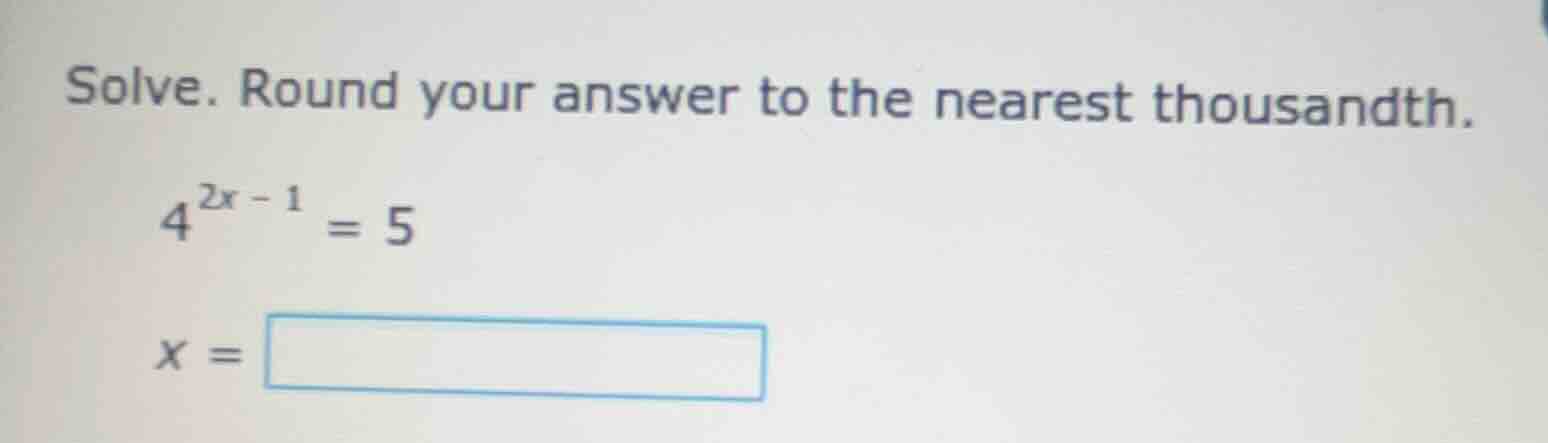
solve. round your answer to the nearest thousandth.\\(4^{2x - 1} = 5\\)\\(x = \square\\)
Step1: Take log of both sides
Take the logarithm (natural log or common log, here we use natural log) of both sides of the equation \(4^{2x - 1}=5\). So we get \(\ln(4^{2x - 1})=\ln(5)\).
Step2: Use logarithm power rule
Using the power rule of logarithms \(\ln(a^b)=b\ln(a)\), the left - hand side becomes \((2x - 1)\ln(4)=\ln(5)\).
Step3: Solve for x
First, expand the left - hand side: \(2x\ln(4)-\ln(4)=\ln(5)\).
Then, isolate the term with \(x\): \(2x\ln(4)=\ln(5)+\ln(4)\).
We know that \(\ln(a)+\ln(b)=\ln(ab)\), so \(\ln(5)+\ln(4)=\ln(20)\).
Then \(x = \frac{\ln(20)}{2\ln(4)}\).
We can also simplify \(\ln(4) = 2\ln(2)\) and \(\ln(20)=\ln(4\times5)=\ln(4)+\ln(5)=2\ln(2)+\ln(5)\), but we can directly calculate the numerical value.
\(\ln(4)\approx1.3863\), \(\ln(5)\approx1.6094\), \(\ln(20)=\ln(4)+\ln(5)\approx1.3863 + 1.6094=2.9957\)
\(2\ln(4)=2\times1.3863 = 2.7726\)
\(x=\frac{2.9957}{2.7726}\approx1.080\) (or we can solve it as follows:
From \((2x - 1)\ln(4)=\ln(5)\), we can also write \(2x-1=\frac{\ln(5)}{\ln(4)}\)
\(\frac{\ln(5)}{\ln(4)}\approx\frac{1.6094}{1.3863}\approx1.161\)
Then \(2x=1 + 1.161=2.161\)
\(x=\frac{2.161}{2}=1.0805\approx1.081\) (using common logarithm: \(\log(4)\approx0.6021\), \(\log(5)\approx0.6990\)
\((2x - 1)\log(4)=\log(5)\)
\(2x-1=\frac{\log(5)}{\log(4)}\approx\frac{0.6990}{0.6021}\approx1.161\)
\(2x=1 + 1.161 = 2.161\)
\(x=\frac{2.161}{2}=1.0805\approx1.081\))

Snap & solve any problem in the app
Get step-by-step solutions on Sovi AI
Photo-based solutions with guided steps
Explore more problems and detailed explanations
\(x\approx1.081\)