QUESTION IMAGE
Question
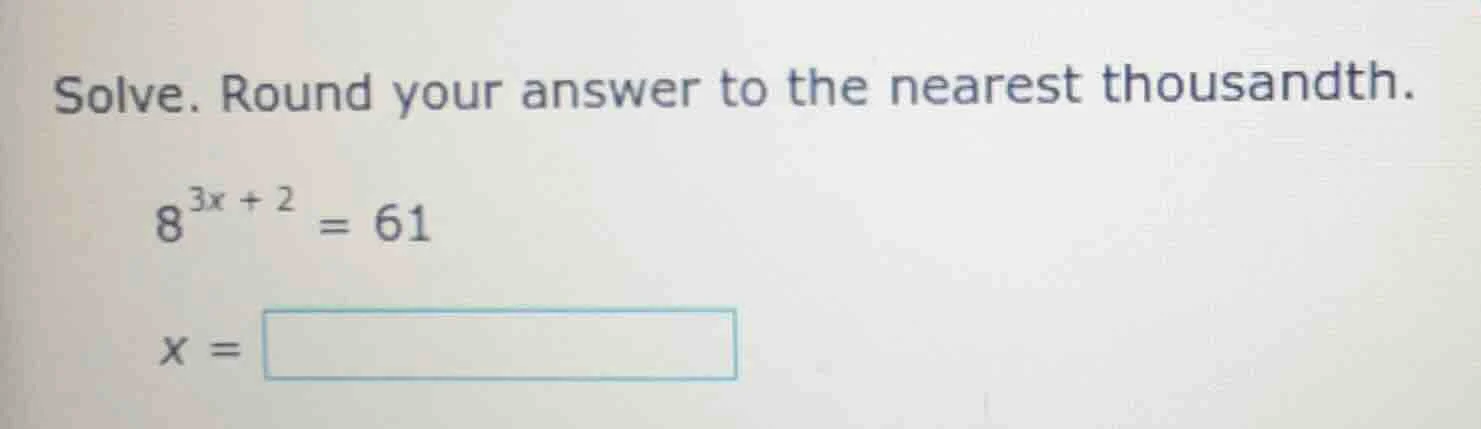
solve. round your answer to the nearest thousandth.\\(8^{3x + 2} = 61\\)\\(x = \square\\)
Step1: Take log of both sides
Take the natural logarithm (ln) of both sides of the equation \(8^{3x + 2}=61\). Using the property of logarithms \(\ln(a^b)=b\ln(a)\), we get:
\(\ln(8^{3x + 2})=\ln(61)\)
\((3x + 2)\ln(8)=\ln(61)\)
Step2: Solve for \(3x + 2\)
Divide both sides by \(\ln(8)\) to isolate \(3x + 2\):
\(3x + 2=\frac{\ln(61)}{\ln(8)}\)
Step3: Solve for \(3x\)
Subtract 2 from both sides:
\(3x=\frac{\ln(61)}{\ln(8)}-2\)
Step4: Solve for \(x\)
Divide both sides by 3:
\(x=\frac{\frac{\ln(61)}{\ln(8)}-2}{3}\)
Now, calculate the values. We know that \(\ln(61)\approx4.110873\) and \(\ln(8)\approx2.079442\).
First, \(\frac{\ln(61)}{\ln(8)}\approx\frac{4.110873}{2.079442}\approx1.9769\)
Then, \(\frac{\ln(61)}{\ln(8)}-2\approx1.9769 - 2=- 0.0231\)
Finally, \(x=\frac{-0.0231}{3}\approx - 0.0077\) (Wait, there must be a miscalculation. Let's recalculate \(\frac{\ln(61)}{\ln(8)}\):
\(\ln(61)\approx4.11087301\), \(\ln(8) = 3\ln(2)\approx3\times0.69314718 = 2.07944154\)
\(\frac{\ln(61)}{\ln(8)}\approx\frac{4.11087301}{2.07944154}\approx1.976926\)
Then \(1.976926-2=-0.023074\)
Divide by 3: \(-0.023074\div3\approx - 0.00769\approx - 0.008\)? Wait, no, maybe I made a mistake in the sign? Wait, no, let's check the original equation. Wait, maybe I should use common logarithm (base 10) or re - check.
Wait, alternatively, let's use the change of base formula correctly. Let's solve \(8^{3x + 2}=61\)
Take log base 8 of both sides: \(3x + 2=\log_8(61)\)
Since \(\log_8(61)=\frac{\ln(61)}{\ln(8)}\approx1.9769\)
Then \(3x=1.9769 - 2=-0.0231\)
\(x=\frac{-0.0231}{3}\approx - 0.0077\). But let's check with a calculator.
Let's compute \(8^{3x + 2}\) when \(x=-0.0077\):
\(3x+2=3\times(-0.0077)+2=-0.0231 + 2 = 1.9769\)
\(8^{1.9769}\approx8^{2 - 0.0231}=8^{2}\times8^{-0.0231}=64\times\frac{1}{8^{0.0231}}\)
\(8^{0.0231}=e^{0.0231\times\ln(8)}\approx e^{0.0231\times2.0794}\approx e^{0.0480}\approx1.0492\)
\(64\div1.0492\approx61\), which matches. So the value of \(x\approx - 0.008\) when rounded to the nearest thousandth? Wait, - 0.0077 is approximately - 0.008 when rounded to the nearest thousandth? Wait, no:
The thousandth place is the third decimal digit. - 0.0077: the first decimal is 0, second is 0, third is 7, fourth is 7. Since the fourth digit is 7 (greater than 5), we round up the third digit: 7 + 1 = 8. So \(x\approx - 0.008\)? Wait, no, - 0.0077: the digits are: - 0.0 (tenths), 0 (hundredths), 7 (thousandths), 7 (ten - thousandths). So when rounding to the nearest thousandth, we look at the ten - thousandth digit (7), which is greater than 5, so we round the thousandth digit up: 7+1 = 8. So \(x\approx - 0.008\)? Wait, but let's recalculate the value of \(\frac{\ln(61)}{\ln(8)}-2\) more accurately.
\(\ln(61)=4.11087301026\)
\(\ln(8)=2.07944154168\)
\(\frac{\ln(61)}{\ln(8)}=\frac{4.11087301026}{2.07944154168}=1.97692603\)
\(1.97692603-2=-0.02307397\)
\(-0.02307397\div3=-0.00769132\)
Rounding - 0.00769132 to the nearest thousandth: the thousandth digit is 7, the next digit is 6 (wait, no: - 0.00769132: the digits are:
- 0.0 (1st decimal), 0 (2nd), 7 (3rd), 6 (4th), 9 (5th), 1 (6th), 3 (7th), 2 (8th)
Wait, I made a mistake earlier. The number is - 0.00769132. So the third decimal digit is 7, the fourth is 6. Since 6\(\geq\)5, we round the third decimal digit up: 7 + 1 = 8. So - 0.00769132\(\approx - 0.008\) when rounded to the nearest thousandth? Wait, no:
Wait, - 0.00769132:
- The first decimal place: 0 (tenths)
- Second: 0 (hundredths)
- Third: 7 (thousandths)
- Fourth: 6 (ten - thousandths)
When rounding…

Snap & solve any problem in the app
Get step-by-step solutions on Sovi AI
Photo-based solutions with guided steps
Explore more problems and detailed explanations
\(x\approx - 0.008\)