QUESTION IMAGE
Question
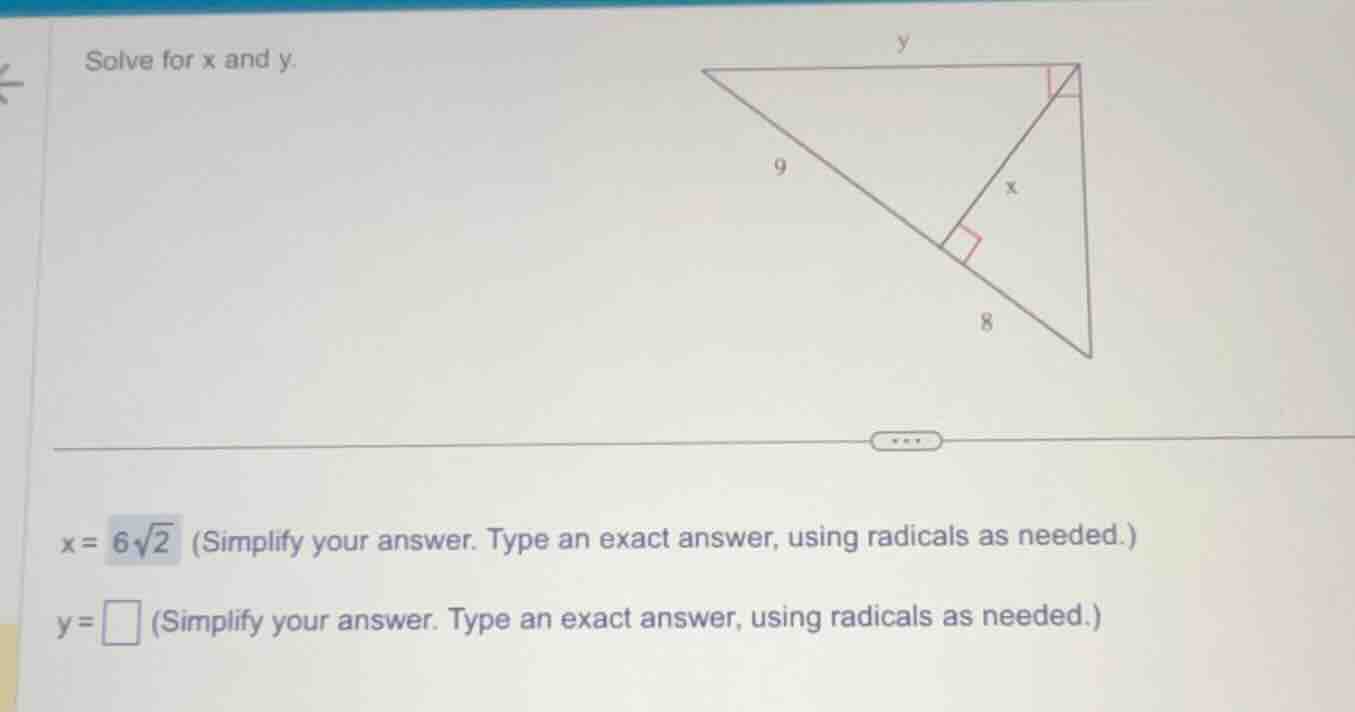
solve for x and y.
x = 6√2 (simplify your answer. type an exact answer, using radicals as needed.)
y = \square (simplify your answer. type an exact answer, using radicals as needed.)
Step1: Identify the geometric theorem
This is a right triangle with an altitude to the hypotenuse, so we can use the geometric mean theorem (or altitude-on-hypotenuse theorem). Also, for the hypotenuse segments and the sides, we can use the Pythagorean theorem or the geometric mean for the hypotenuse. First, let's recall that in a right triangle, if we have a segment of the hypotenuse as \(a = 9\), another as \(b = 8\), then the hypotenuse \(H=9 + 8=17\)? Wait, no, wait. Wait, actually, the two segments of the hypotenuse are \(9\) and \(8\)? Wait, no, looking at the diagram: the large right triangle has a leg divided into \(9\) and \(8\) by the altitude? Wait, no, the altitude is to the hypotenuse, so the two segments of the hypotenuse are \(9\) and \(8\), and the altitude is \(x\), and the other leg is \(y\). Wait, actually, the geometric mean theorem states that in a right triangle, the length of the altitude to the hypotenuse is the geometric mean of the lengths of the two segments of the hypotenuse. Also, each leg is the geometric mean of the hypotenuse and the segment adjacent to that leg.
Wait, let's correct: Let the large right triangle have hypotenuse \(c\), and the two segments of the hypotenuse (divided by the altitude) be \(m = 9\) and \(n = 8\). Then the leg adjacent to segment \(m\) (which is \(y\)) is the geometric mean of \(c\) and \(m\), and the leg adjacent to segment \(n\) (which is \(x\)) is the geometric mean of \(c\) and \(n\). Wait, no, actually, the hypotenuse \(c=m + n=9 + 8 = 17\)? Wait, no, that can't be, because \(x = 6\sqrt{2}\), let's check with the altitude. Wait, the altitude \(x\) is the geometric mean of \(9\) and \(8\)? Wait, \(x=\sqrt{9\times8}=\sqrt{72}=6\sqrt{2}\), which matches the given \(x = 6\sqrt{2}\). Good, so that's correct. Now, for the leg \(y\), which is adjacent to the segment \(9\) of the hypotenuse, the leg \(y\) is the geometric mean of the hypotenuse \(c\) (which is \(9 + 8 = 17\)?) Wait, no, wait, hypotenuse \(c\) is \(m + n=9 + 8 = 17\)? Wait, no, that would mean \(y=\sqrt{c\times m}=\sqrt{17\times9}\), but that doesn't make sense. Wait, no, I think I mixed up the segments. Wait, actually, the two segments of the hypotenuse are \(9\) and \(8\), so the hypotenuse length is \(9 + 8 = 17\)? Wait, no, that can't be, because the altitude is \(6\sqrt{2}\), and the area of the large triangle can be calculated in two ways: \(\frac{1}{2}\times x\times (9 + 8)=\frac{1}{2}\times y\times \sqrt{9^2 + 8^2}\)? No, wait, no, the large triangle is a right triangle, so its legs are \(y\) and \(\sqrt{8^2 + x^2}\)? Wait, no, let's start over.
Wait, the diagram: there is a right triangle, with an altitude drawn to the hypotenuse, creating two smaller right triangles. The two segments of the hypotenuse are \(9\) (adjacent to the leg of length \(y\)) and \(8\) (adjacent to the leg of length \(\sqrt{8^2 + x^2}\)? No, wait, the altitude is \(x\), and the two segments of the hypotenuse are \(9\) and \(8\). So the large right triangle has hypotenuse \(9 + 8 = 17\)? Wait, no, that would mean the legs are \(y\) and \(\sqrt{8^2 + x^2}\), but using the Pythagorean theorem on the large triangle: \(y^2 + (8^2 + x^2)=(9 + 8)^2\). But we know \(x = 6\sqrt{2}\), so \(x^2=(6\sqrt{2})^2 = 72\). Then \(8^2 + x^2=64 + 72 = 136\). Then \(y^2 + 136 = 17^2=289\), so \(y^2=289 - 136 = 153\), so \(y=\sqrt{153}=\sqrt{9\times17}=3\sqrt{17}\)? But that doesn't match. Wait, I must have misidentified the segments.
Wait, maybe the two segments of the hypotenuse are not \(9\) and \(8\), but rather, the length of the segment a…

Snap & solve any problem in the app
Get step-by-step solutions on Sovi AI
Photo-based solutions with guided steps
Explore more problems and detailed explanations
\(y = 3\sqrt{17}\) (Wait, but let's check again. Wait, maybe