QUESTION IMAGE
Question
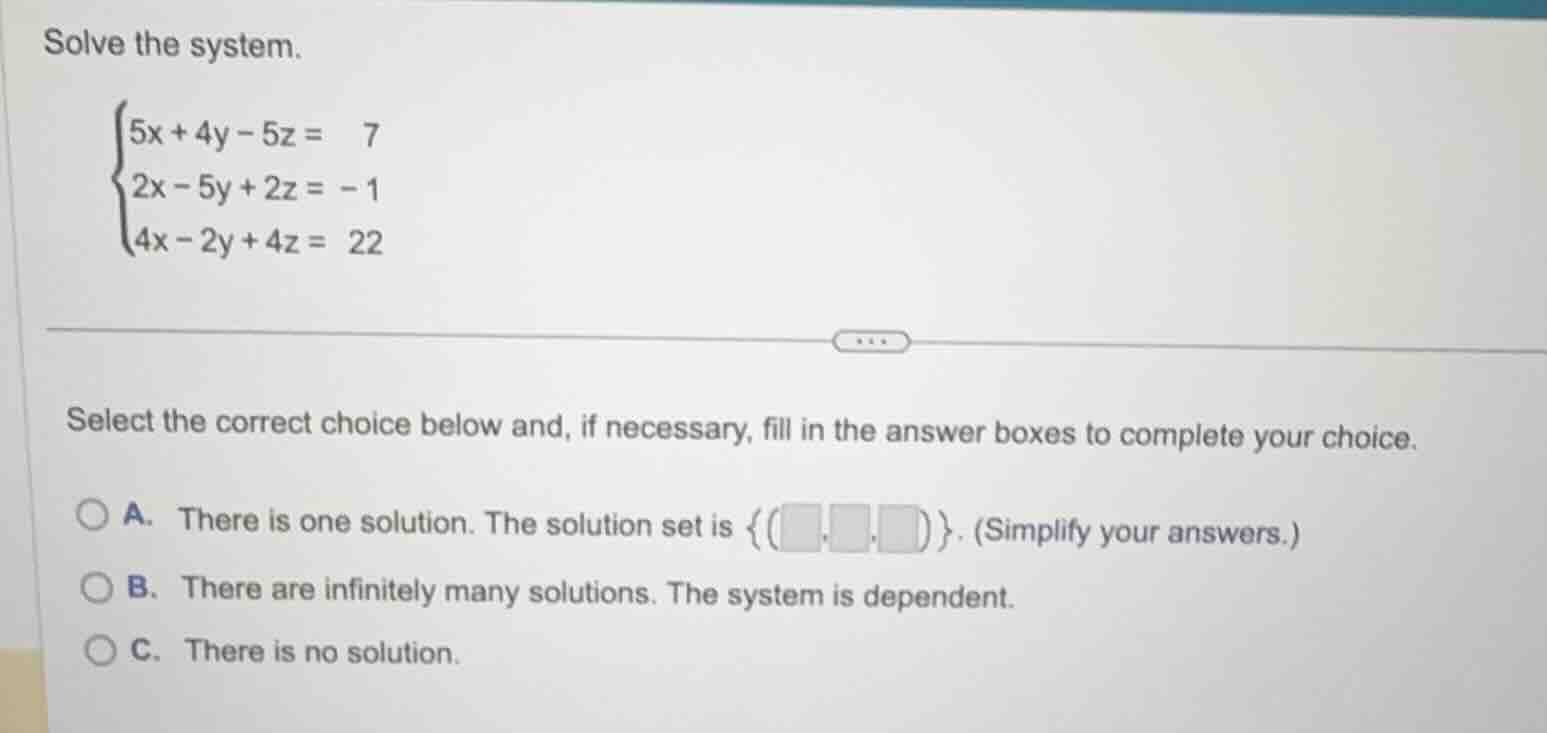
solve the system.\
\select the correct choice below and, if necessary, fill in the answer boxes to complete your choice.\\(\bigcirc\\) a. there is one solution. the solution set is \\(\\{ (\square, \square, \square) \\}\\). (simplify your answers.)\\(\bigcirc\\) b. there are infinitely many solutions. the system is dependent.\\(\bigcirc\\) c. there is no solution.
Step1: Simplify the third equation
Divide the third equation \(4x - 2y + 4z = 22\) by 2, we get \(2x - y + 2z = 11\).
Step2: Subtract the second equation from the new third equation
The second equation is \(2x - 5y + 2z = -1\), subtract it from \(2x - y + 2z = 11\):
\[
\]
Step3: Substitute \(y = 3\) into the second and new third equations
Substitute \(y = 3\) into \(2x - 5y + 2z = -1\), we have \(2x-15 + 2z=-1\), which simplifies to \(2x + 2z=14\), or \(x + z = 7\) (Equation 1).
Substitute \(y = 3\) into \(2x - y + 2z = 11\), we get \(2x-3 + 2z=11\), which simplifies to \(2x + 2z=14\), same as above.
Substitute \(y = 3\) into the first equation \(5x + 4y - 5z = 7\), we get \(5x+12 - 5z=7\), which simplifies to \(5x - 5z=-5\), or \(x - z=-1\) (Equation 2).
Step4: Solve the system of Equation 1 and Equation 2
We have the system \(
\)
Add the two equations:
\[
\]
Substitute \(x = 3\) into \(x + z = 7\), we get \(3+z = 7\), so \(z = 4\).

Snap & solve any problem in the app
Get step-by-step solutions on Sovi AI
Photo-based solutions with guided steps
Explore more problems and detailed explanations
A. There is one solution. The solution set is \(\{(3, 3, 4)\}\)