QUESTION IMAGE
Question
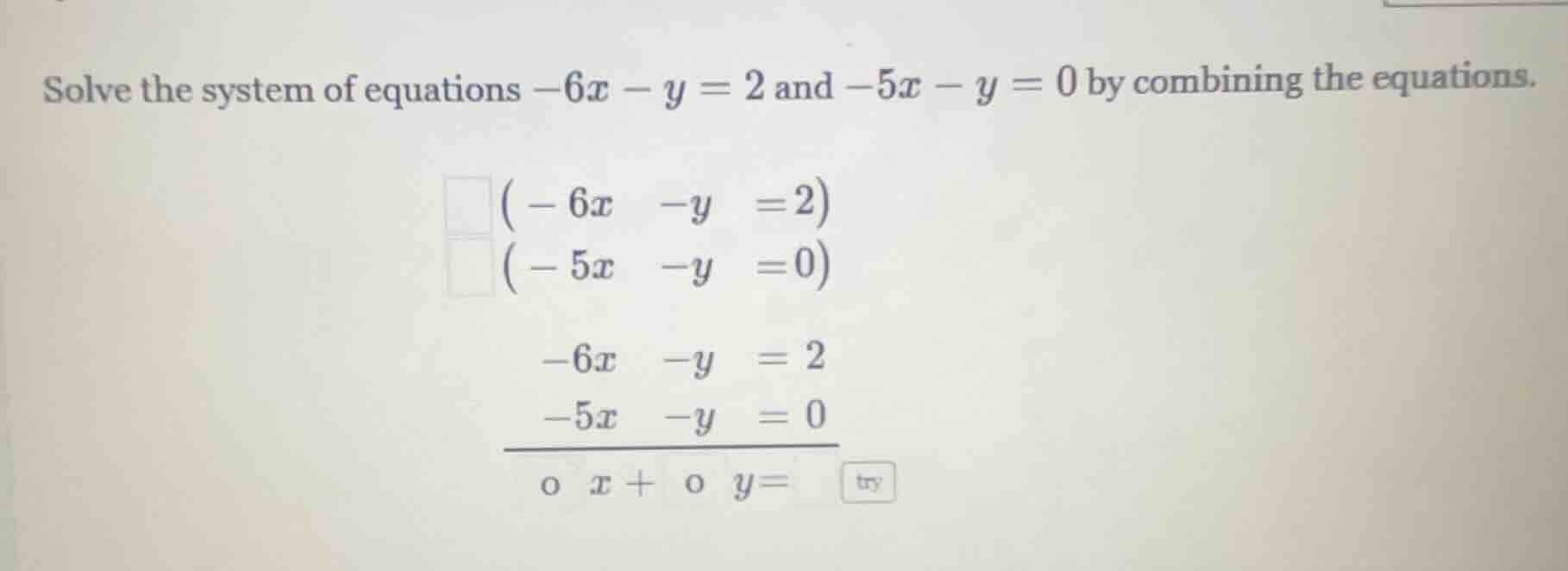
solve the system of equations $-6x - y = 2$ and $-5x - y = 0$ by combining the equations.
$\square\left(\
\
ight)$
$\square\left(\
\
ight)$
$\
$ try
Step1: Multiply the second equation by -1
To eliminate \( y \), we can multiply the second equation \(-5x - y = 0\) by \(-1\). So the first equation remains as \(-6x - y = 2\) (coefficient 1) and the second equation becomes \(5x + y = 0\) (coefficient -1).
Step2: Add the two equations
Now add the two equations: \((-6x - y)+(5x + y)=2 + 0\). Simplifying the left side: \(-6x+5x - y + y=-x\), and the right side is \(2\). So we get \(-x=2\), which means \(x = - 2\).
Step3: Substitute \(x\) into one of the original equations
Substitute \(x=-2\) into the second original equation \(-5x - y = 0\). We have \(-5\times(-2)-y = 0\), which is \(10 - y = 0\). Solving for \(y\), we get \(y = 10\).
But for the combination step shown in the problem (finding the coefficients to multiply the equations and then adding), let's do that:
Let the first equation be multiplied by \(a = 1\) and the second by \(b=-1\) (to make the \(y\) terms cancel when added).
First equation: \(1\times(-6x - y)=-6x - y = 2\)
Second equation: \(-1\times(-5x - y)=5x + y = 0\)
Now add them: \((-6x - y)+(5x + y)=2 + 0\)
Simplify: \(-6x+5x - y + y=-x\) and \(2+0 = 2\), so \(-x=2\) (which is the result of the combination \(0x + 0y\) part? Wait, no, the problem's combination step is probably to subtract or add with appropriate coefficients. Wait, the two equations are:
Equation 1: \(-6x - y = 2\)
Equation 2: \(-5x - y = 0\)
If we subtract Equation 2 from Equation 1: \((-6x - y)-(-5x - y)=2 - 0\)
Simplify left side: \(-6x - y + 5x + y=-x\), right side: \(2\). So \(-x = 2\), so \(x=-2\). Then substitute back to find \(y\).
For the boxes: the first box (coefficient for first equation) is \(1\), the second box (coefficient for second equation) is \(-1\). Then when we combine (subtract Equation 2 from Equation 1, which is same as adding Equation 1 and -1*Equation 2), we get \((-6x - y)-(-5x - y)=2-0\), which simplifies to \(-x=2\), but in the problem's format of \(0x + 0y=\) (wait, maybe the problem's format is a bit off, but the key is to find the coefficients to multiply the equations so that when combined, we can solve for \(x\) or \(y\).
But following the problem's combination step (the bottom part with \(0x + 0y=\)):
Let's do the combination by subtracting the second equation from the first:
\((-6x - y)-(-5x - y)=2 - 0\)
\(-6x - y + 5x + y=2\)
\(-x=2\)
So the coefficients are 1 for the first equation and -1 for the second equation. Then the combination gives \(-x = 2\) (but the problem's format has \(0x + 0y=\), maybe a typo, but the main thing is to find \(x\) and \(y\).

Snap & solve any problem in the app
Get step-by-step solutions on Sovi AI
Photo-based solutions with guided steps
Explore more problems and detailed explanations
The coefficients are \(1\) (for \(-6x - y = 2\)) and \(-1\) (for \(-5x - y = 0\)). Solving the system, we get \(x=-2\) and \(y = 10\).
(If we strictly follow the problem's combination step to get \(0x + 0y=\) part, when we add the two equations with coefficients 1 and -1, we get \(-x=2\), but the problem's format might be expecting the result of the combination as \(-x = 2\) (so \(0x+0y\) is not correct, maybe it's a mistake in the problem's layout). But the solution for the system is \(x=-2\), \(y = 10\).)