QUESTION IMAGE
Question
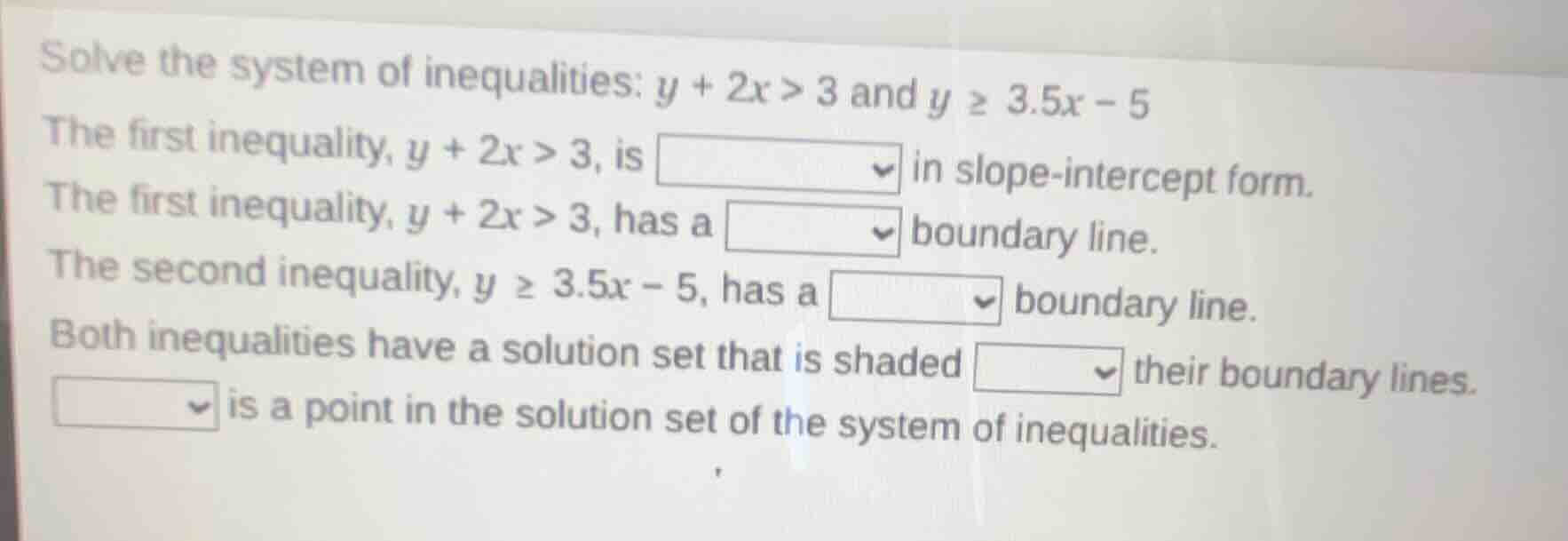
solve the system of inequalities: ( y + 2x > 3 ) and ( y geq 3.5x - 5 ) the first inequality, ( y + 2x > 3 ), is (\boxed{quad}) in slope - intercept form. the first inequality, ( y + 2x > 3 ), has a (\boxed{quad}) boundary line. the second inequality, ( y geq 3.5x - 5 ), has a (\boxed{quad}) boundary line. both inequalities have a solution set that is shaded (\boxed{quad}) their boundary lines. (\boxed{quad}) is a point in the solution set of the system of inequalities.
To solve the system of inequalities, we analyze each part:
1. Slope - Intercept Form Check for \(y + 2x>3\)
The slope - intercept form of a linear equation is \(y=mx + b\), where \(m\) is the slope and \(b\) is the y - intercept.
For the inequality \(y + 2x>3\), we can rewrite it as \(y>- 2x + 3\) by subtracting \(2x\) from both sides. But the original form \(y + 2x>3\) is not in the form \(y=mx + b\) (slope - intercept form) initially. So the first inequality \(y + 2x>3\) is \(\boldsymbol{\text{not}}\) in slope - intercept form.
2. Boundary Line Type for \(y + 2x>3\)
The inequality \(y + 2x>3\) (or \(y>-2x + 3\)) uses the \(>\) symbol. When the inequality symbol is \(>\) or \(<\), the boundary line is dashed (because the points on the line are not included in the solution set). So the first inequality \(y + 2x>3\) has a \(\boldsymbol{\text{dashed}}\) boundary line.
3. Boundary Line Type for \(y\geq3.5x - 5\)
The inequality \(y\geq3.5x - 5\) uses the \(\geq\) symbol. When the inequality symbol is \(\geq\) or \(\leq\), the boundary line is solid (because the points on the line are included in the solution set). So the second inequality \(y\geq3.5x - 5\) has a \(\boldsymbol{\text{solid}}\) boundary line.
4. Shading Direction
For \(y>-2x + 3\) (rewritten from \(y + 2x>3\)), we shade above the line (since \(y\) is greater than \(-2x + 3\)). For \(y\geq3.5x-5\), we shade above the line (since \(y\) is greater than or equal to \(3.5x - 5\)). So both inequalities have a solution set that is shaded \(\boldsymbol{\text{above}}\) their boundary lines.
5. Checking a Point in the Solution Set
Let's take a point, for example, \((0,4)\).
- For \(y + 2x>3\): Substitute \(x = 0\) and \(y = 4\) into \(y+2x\). We get \(4+2(0)=4\), and \(4>3\), so the point satisfies the first inequality.
- For \(y\geq3.5x - 5\): Substitute \(x = 0\) and \(y = 4\) into \(y\) and \(3.5x-5\). We get \(4\geq3.5(0)-5\), which simplifies to \(4\geq - 5\), and this is true. So \((0,4)\) is a point in the solution set (other valid points can also be chosen, but \((0,4)\) works).
Final Answers:
- The first inequality, \(y + 2x>3\), is \(\boldsymbol{\text{not}}\) in slope - intercept form.
- The first inequality, \(y + 2x>3\), has a \(\boldsymbol{\text{dashed}}\) boundary line.
- The second inequality, \(y\geq3.5x - 5\), has a \(\boldsymbol{\text{solid}}\) boundary line.
- Both inequalities have a solution set that is shaded \(\boldsymbol{\text{above}}\) their boundary lines.
- A point like \(\boldsymbol{(0,4)}\) is in the solution set of the system of inequalities.

Snap & solve any problem in the app
Get step-by-step solutions on Sovi AI
Photo-based solutions with guided steps
Explore more problems and detailed explanations
To solve the system of inequalities, we analyze each part:
1. Slope - Intercept Form Check for \(y + 2x>3\)
The slope - intercept form of a linear equation is \(y=mx + b\), where \(m\) is the slope and \(b\) is the y - intercept.
For the inequality \(y + 2x>3\), we can rewrite it as \(y>- 2x + 3\) by subtracting \(2x\) from both sides. But the original form \(y + 2x>3\) is not in the form \(y=mx + b\) (slope - intercept form) initially. So the first inequality \(y + 2x>3\) is \(\boldsymbol{\text{not}}\) in slope - intercept form.
2. Boundary Line Type for \(y + 2x>3\)
The inequality \(y + 2x>3\) (or \(y>-2x + 3\)) uses the \(>\) symbol. When the inequality symbol is \(>\) or \(<\), the boundary line is dashed (because the points on the line are not included in the solution set). So the first inequality \(y + 2x>3\) has a \(\boldsymbol{\text{dashed}}\) boundary line.
3. Boundary Line Type for \(y\geq3.5x - 5\)
The inequality \(y\geq3.5x - 5\) uses the \(\geq\) symbol. When the inequality symbol is \(\geq\) or \(\leq\), the boundary line is solid (because the points on the line are included in the solution set). So the second inequality \(y\geq3.5x - 5\) has a \(\boldsymbol{\text{solid}}\) boundary line.
4. Shading Direction
For \(y>-2x + 3\) (rewritten from \(y + 2x>3\)), we shade above the line (since \(y\) is greater than \(-2x + 3\)). For \(y\geq3.5x-5\), we shade above the line (since \(y\) is greater than or equal to \(3.5x - 5\)). So both inequalities have a solution set that is shaded \(\boldsymbol{\text{above}}\) their boundary lines.
5. Checking a Point in the Solution Set
Let's take a point, for example, \((0,4)\).
- For \(y + 2x>3\): Substitute \(x = 0\) and \(y = 4\) into \(y+2x\). We get \(4+2(0)=4\), and \(4>3\), so the point satisfies the first inequality.
- For \(y\geq3.5x - 5\): Substitute \(x = 0\) and \(y = 4\) into \(y\) and \(3.5x-5\). We get \(4\geq3.5(0)-5\), which simplifies to \(4\geq - 5\), and this is true. So \((0,4)\) is a point in the solution set (other valid points can also be chosen, but \((0,4)\) works).
Final Answers:
- The first inequality, \(y + 2x>3\), is \(\boldsymbol{\text{not}}\) in slope - intercept form.
- The first inequality, \(y + 2x>3\), has a \(\boldsymbol{\text{dashed}}\) boundary line.
- The second inequality, \(y\geq3.5x - 5\), has a \(\boldsymbol{\text{solid}}\) boundary line.
- Both inequalities have a solution set that is shaded \(\boldsymbol{\text{above}}\) their boundary lines.
- A point like \(\boldsymbol{(0,4)}\) is in the solution set of the system of inequalities.