QUESTION IMAGE
Question
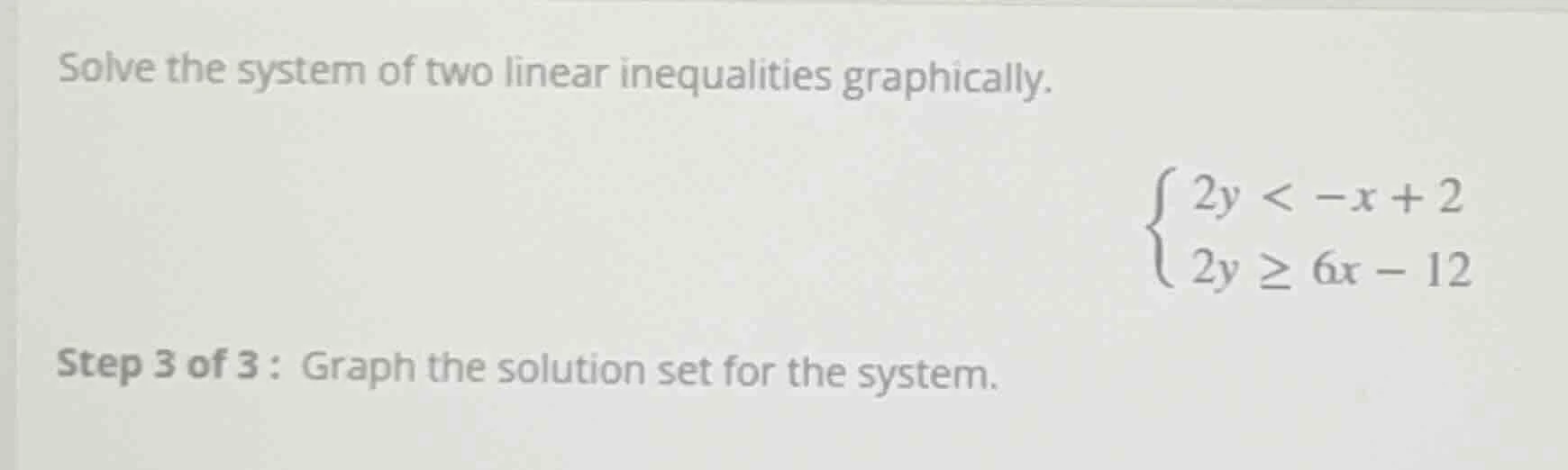
solve the system of two linear inequalities graphically.\
\
step 3 of 3 : graph the solution set for the system.
Step1: Rewrite inequalities to slope-intercept form
First inequality: $2y < -x + 2$ → $y < -\frac{1}{2}x + 1$
Second inequality: $2y \geq 6x - 12$ → $y \geq 3x - 6$
Step2: Graph boundary lines
For $y = -\frac{1}{2}x + 1$: use a dashed line (since inequality is $<$), y-intercept at $(0,1)$, slope $-\frac{1}{2}$.
For $y = 3x - 6$: use a solid line (since inequality is $\geq$), y-intercept at $(0,-6)$, slope $3$.
Step3: Shade solution regions
For $y < -\frac{1}{2}x + 1$: shade below the dashed line.
For $y \geq 3x - 6$: shade above the solid line.
Step4: Identify overlapping shaded area
The solution set is the intersection of the two shaded regions.

Snap & solve any problem in the app
Get step-by-step solutions on Sovi AI
Photo-based solutions with guided steps
Explore more problems and detailed explanations
The solution is the overlapping shaded area where:
- Below the dashed line $y = -\frac{1}{2}x + 1$
- Above the solid line $y = 3x - 6$
The intersection point of the two boundaries is found by solving $-\frac{1}{2}x + 1 = 3x - 6$:
$-\frac{1}{2}x - 3x = -6 - 1$
$-\frac{7}{2}x = -7$
$x = 2$, substitute back to get $y = 0$. So the lines intersect at $(2, 0)$, and the solution set is the region bounded by this point, the dashed line, and the solid line.