QUESTION IMAGE
Question
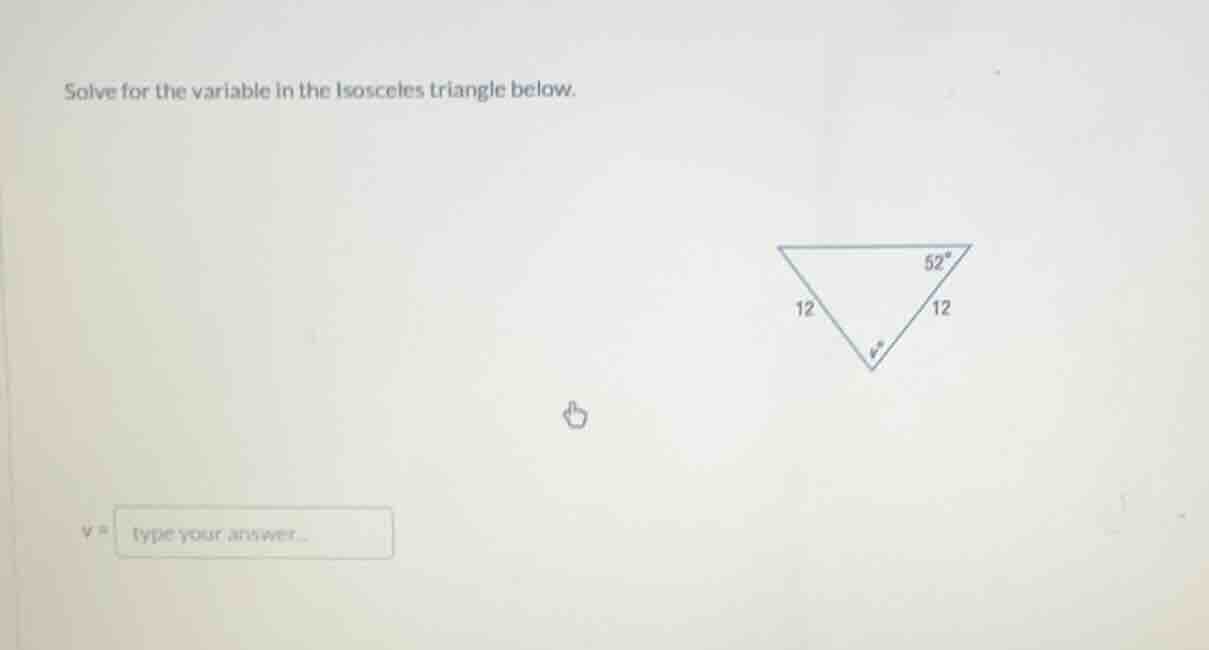
solve for the variable in the isosceles triangle below.
12, 12, 52°, v°
v = type your answer...
Step1: Recall triangle angle sum
The sum of angles in a triangle is \(180^\circ\).
Step2: Identify equal angles
In an isosceles triangle, the angles opposite equal sides are equal. Here, the two sides of length 12 are equal, so the angles opposite them (the \(52^\circ\) angle and its corresponding angle) are equal? Wait, no—wait, the two equal sides are the legs, so the base angles? Wait, no, the triangle has two sides of 12, so the angles opposite those sides are equal. Wait, the given angle is \(52^\circ\), and the two sides of 12 are adjacent to the angle \(v\). Wait, actually, in an isosceles triangle with two equal sides (the legs), the base angles are equal. Wait, let's clarify: the triangle has two sides of length 12, so the angles opposite those sides are equal. Wait, the angle given is \(52^\circ\), and the other angle (not \(v\)) is also \(52^\circ\) because they are opposite the equal sides? Wait, no—wait, the two sides of 12 are the legs, so the base is the other side. So the two base angles? Wait, no, the vertex angle is \(v\), and the two base angles are \(52^\circ\) each? Wait, no, let's think again. The sum of angles in a triangle is \(180^\circ\). So if two angles are equal (because two sides are equal), let's say the two base angles are \(52^\circ\) each, then the vertex angle \(v\) is \(180 - 2\times52\).
Step3: Calculate \(v\)
\[
v = 180 - 2\times52 = 180 - 104 = 76
\]

Snap & solve any problem in the app
Get step-by-step solutions on Sovi AI
Photo-based solutions with guided steps
Explore more problems and detailed explanations
\(76\)