QUESTION IMAGE
Question
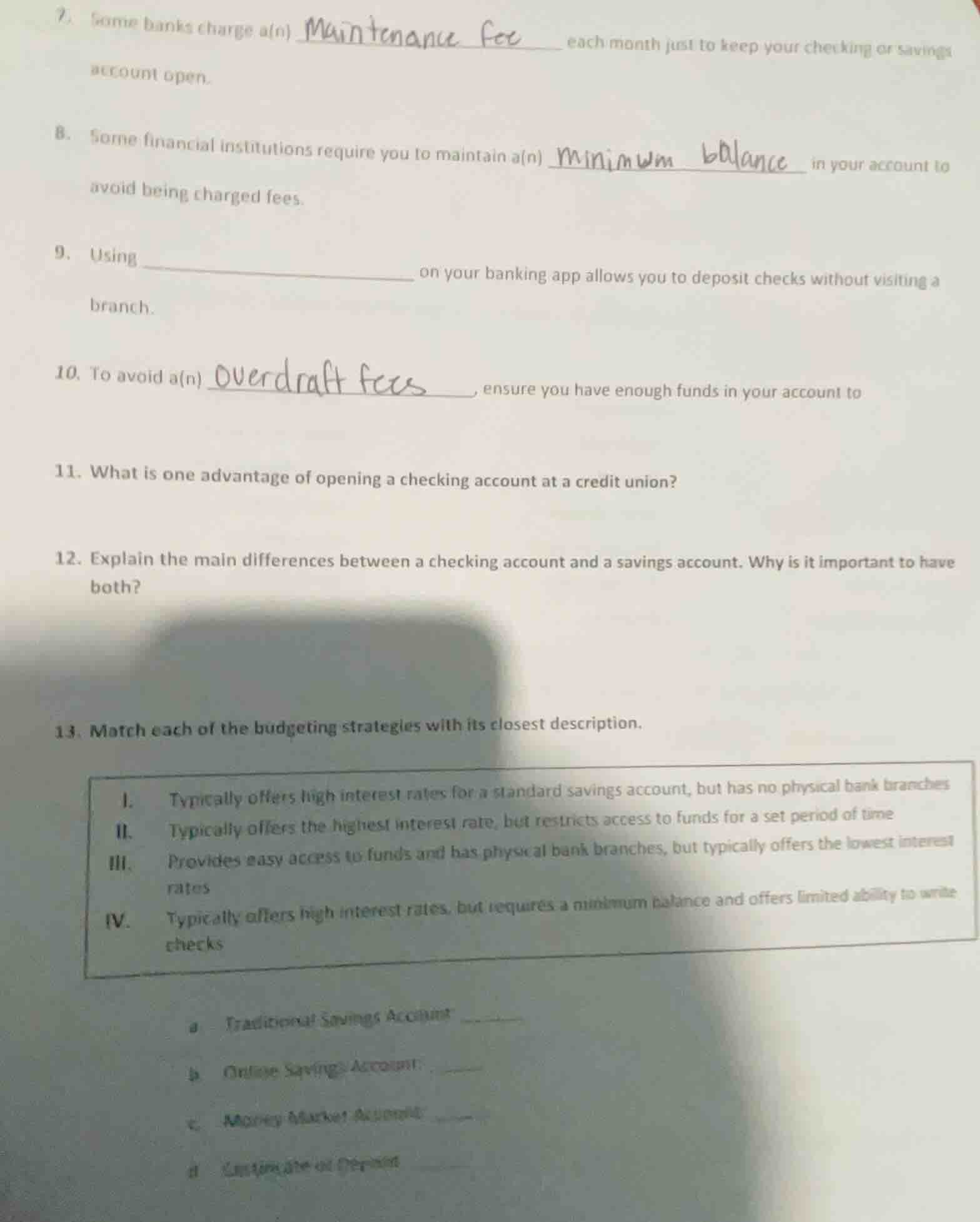
- some banks charge a(n) maintenance fee each month just to keep your checking or savings account open.
- some financial institutions require you to maintain a(n) minimum balance in your account to avoid being charged fees.
- using ____________ on your banking app allows you to deposit checks without visiting a branch.
- to avoid a(n) overdraft fees, ensure you have enough funds in your account to
- what is one advantage of opening a checking account at a credit union?
- explain the main differences between a checking account and a savings account. why is it important to have both?
- match each of the budgeting strategies with its closest description.
i. typically offers high interest rates for a standard savings account, but has no physical bank branches
ii. typically offers the highest interest rate, but restricts access to funds for a set period of time
iii. provides easy access to funds and has physical bank branches, but typically offers the lowest interest rates
iv. typically offers high interest rates, but requires a minimum balance and offers limited ability to write checks
a traditional savings account ______
b online savings account: ______
c money market account ______
d certificate of deposit ______
Question 9
The blank in question 9 is about a feature in a banking app for check deposit without visiting a branch. The term for this is "mobile check deposit" as it's a common functionality in banking apps allowing users to deposit checks via their mobile devices.
One advantage of a credit union checking account is typically lower fees (like monthly maintenance fees) and better interest rates on deposits compared to traditional banks. Credit unions are member - owned, so they often pass on savings to members in the form of favorable terms.
- Differences:
- Checking accounts are for daily transactions (like paying bills, making purchases). They offer easy access (e.g., debit cards, checks) but usually have low or no interest.
- Savings accounts are for saving money, earn interest, but have restrictions on the number of withdrawals (due to federal regulations) and are not for frequent transactions.
- Importance of both: Checking accounts facilitate day - to - day spending and bill - paying. Savings accounts help in accumulating money for future goals (emergencies, large purchases, retirement) by earning interest, so having both helps manage daily finances and save for the long - term.

Snap & solve any problem in the app
Get step-by-step solutions on Sovi AI
Photo-based solutions with guided steps
Explore more problems and detailed explanations
Mobile Check Deposit