QUESTION IMAGE
Question
source d
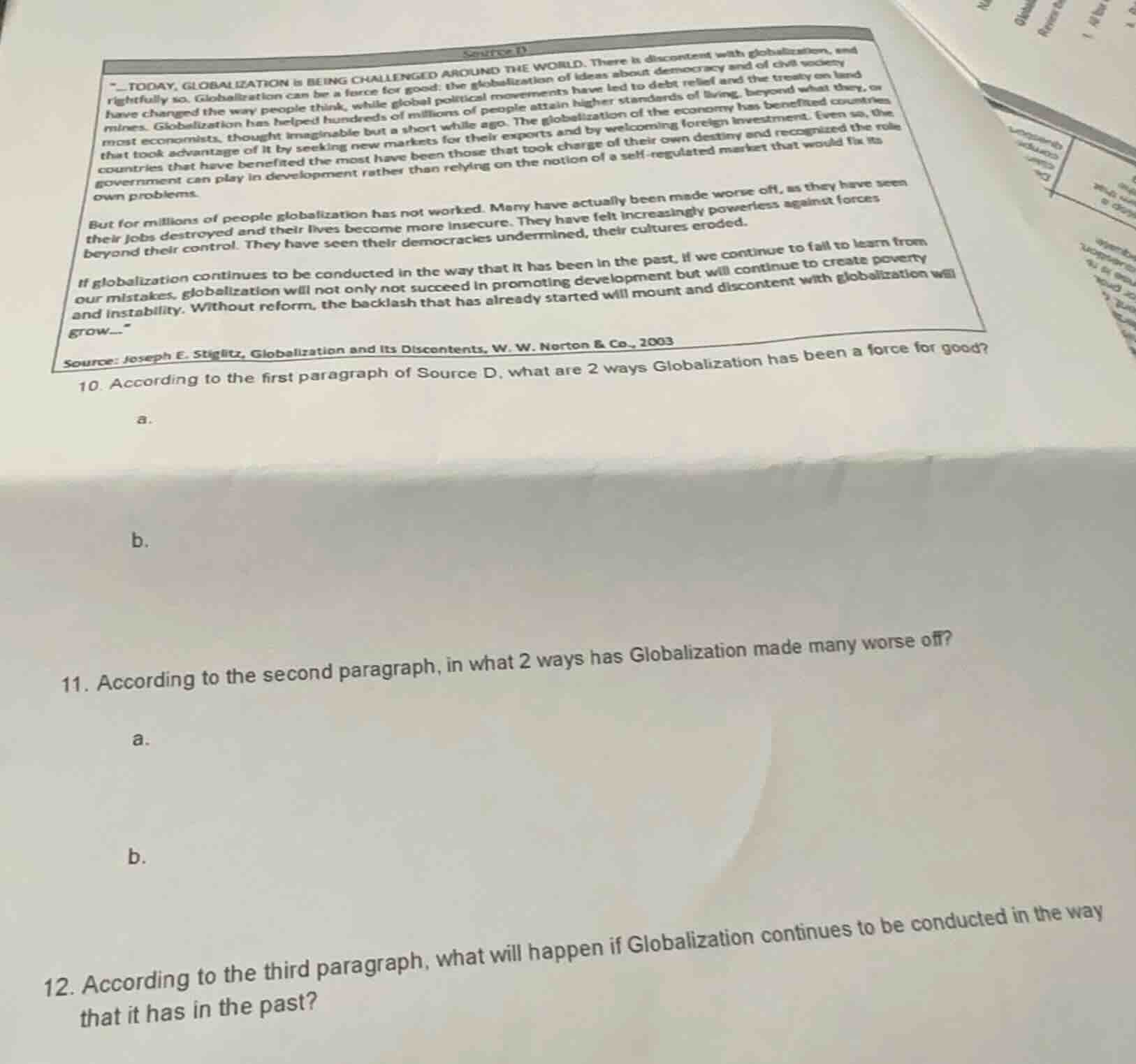
\...today, globalization is being challenged around the world. there is discontent with globalization, and rightfully so. globalization can be a force for good: the globalization of ideas about democracy and of civil society have changed the way people think, while global political movements have led to debt relief and the treaty on land mines. globalization has helped hundreds of millions of people attain higher standards of living, beyond what they, or most economists, thought imaginable but a short while ago. the globalization of the economy has benefited countries that took advantage of it by seeking new markets for their exports and by welcoming foreign investment. even so, the countries that have benefited the most have been those that took charge of their own destiny and recognized the role government can play in development rather than relying on the notion of a self - regulated market that would fix its own problems.
but for millions of people globalization has not worked. many have actually been made worse off, as they have seen their jobs destroyed and their lives become more insecure. they have felt increasingly powerless against forces beyond their control. they have seen their democracies undermined, their cultures eroded.
if globalization continues to be conducted in the way that it has been in the past, if we continue to fail to learn from our mistakes, globalization will not only not succeed in promoting development but will continue to create poverty and instability. without reform, the backlash that has already started will mount and discontent with globalization will grow...\
source: joseph e. stiglitz, globalization and its discontents, w. w. norton & co., 2003
- according to the first paragraph of source d, what are 2 ways globalization has been a force for good?
a.
b.
- according to the second paragraph, in what 2 ways has globalization made many worse off?
a.
b.
- according to the third paragraph, what will happen if globalization continues to be conducted in the way that it has in the past?
Question 10
To answer this, we analyze the first paragraph of Source D.
- For part a: The text says "the globalization of ideas about democracy and of civil society have changed the way people think".
- For part b: It also states "globalization has helped hundreds of millions of people attain higher standards of living, beyond what they, or most economists, thought imaginable but a short while ago" or "global political movements have led to debt relief and the treaty on land mines" or "the globalization of the economy has benefited countries that took advantage of it by seeking new markets for their exports and by welcoming foreign investment" (any two valid points from the first paragraph).
We look at the second paragraph.
- For part a: The text mentions "they have seen their jobs destroyed and their lives become more insecure".
- For part b: It also says "They have felt increasingly powerless against forces beyond their control" or "They have seen their democracies undermined, their cultures eroded" (any two valid points from the second paragraph).
From the third paragraph, the relevant sentence is "If globalization continues to be conducted in the way that it has been in the past, if we continue to fail to learn from our mistakes, globalization will not only not succeed in promoting development but will continue to create poverty and instability. Without reform, the backlash that has already started will mount and discontent with globalization will grow..." We summarize this.

Snap & solve any problem in the app
Get step-by-step solutions on Sovi AI
Photo-based solutions with guided steps
Explore more problems and detailed explanations
a. The globalization of ideas about democracy and civil society has changed the way people think.
b. Globalization has helped hundreds of millions of people attain higher standards of living. (or other valid points from the first paragraph like "global political movements have led to debt relief and the treaty on land mines" or "the globalization of the economy has benefited countries that took advantage of it by seeking new markets for their exports and by welcoming foreign investment")