QUESTION IMAGE
Question
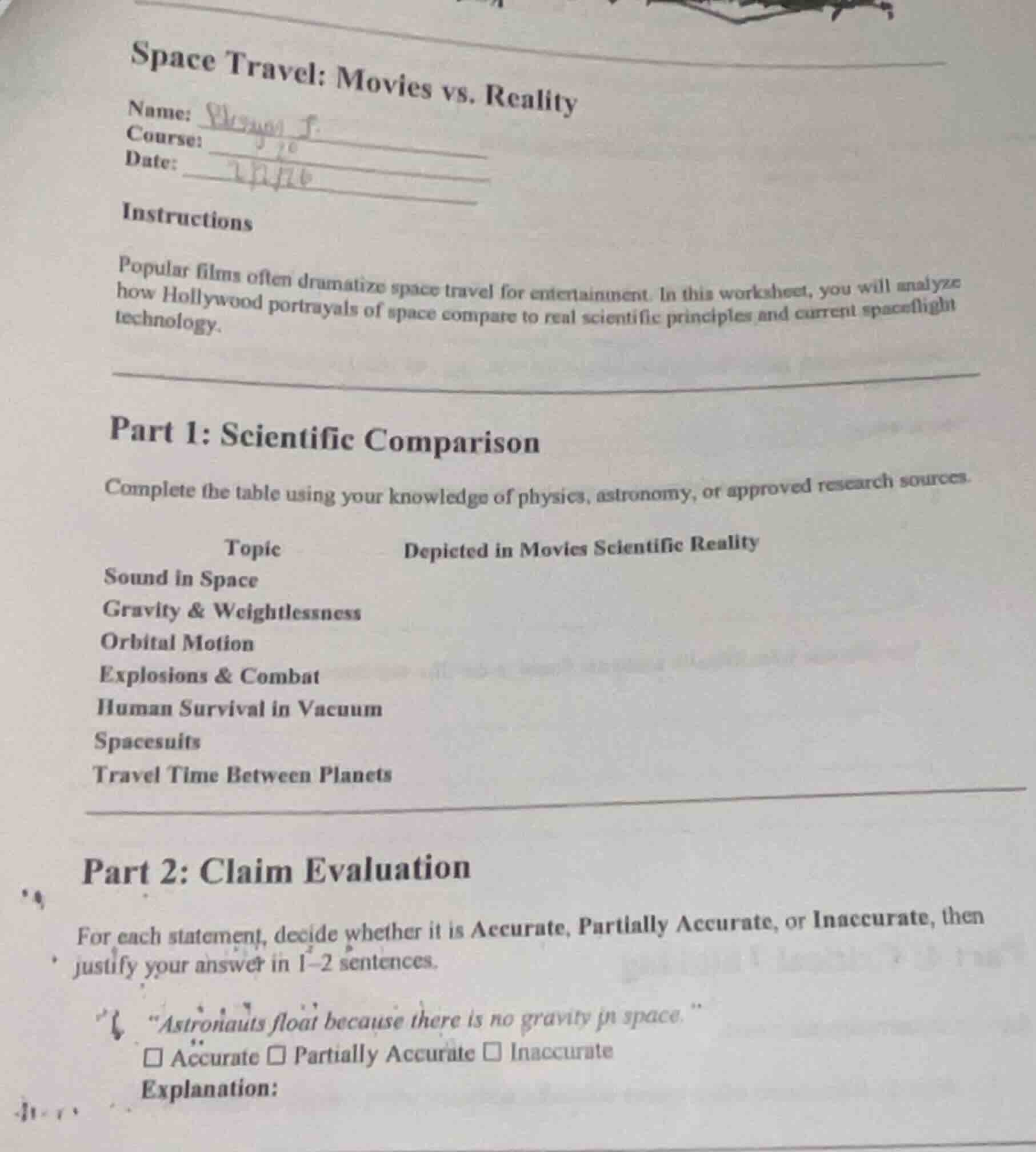
space travel: movies vs. reality
name:
course:
date:
instructions
popular films often dramatize space travel for entertainment. in this worksheet, you will analyze how hollywood portrayals of space compare to real scientific principles and current spaceflight technology.
part 1: scientific comparison
complete the table using your knowledge of physics, astronomy, or approved research sources.
topic | depicted in movies | scientific reality
sound in space | |
gravity & weightlessness | |
orbital motion | |
explosions & combat | |
human survival in vacuum | |
spacesuits | |
travel time between planets | |
part 2: claim evaluation
for each statement, decide whether it is accurate, partially accurate, or inaccurate, then justify your answer in 1–2 sentences.
“astronauts float because there is no gravity in space.”
□ accurate □ partially accurate □ inaccurate
explanation:
Part 1: Scientific Comparison (Example for "Sound in Space")
Depicted in Movies:
Movies often show loud explosions, spaceship engines making noise, and characters talking or hearing sounds clearly as if in an atmosphere (e.g., in Star Wars, spaceships make roaring sounds during battles in space).
Scientific Reality:
Space is a vacuum, and sound waves require a medium (like air, water, or solid matter) to travel. Since there is no air or other medium in the vacuum of space, sound cannot propagate, so there would be no audible sounds from explosions, engines, or conversations as depicted in movies.
Part 2: Claim Evaluation for "Astronauts float because there is no gravity in space."
Step 1: Analyze the Claim
The claim states astronauts float due to a lack of gravity in space.
Step 2: Recall Scientific Principles
Gravity is a universal force; in orbit (where astronauts in the ISS are), they are in free - fall around the Earth. The gravitational force from the Earth is still acting on them (providing the centripetal force for their orbital motion). The "floating" or weightlessness is due to the spacecraft and the astronauts falling at the same rate (free - fall), not a lack of gravity. In deep space, far from large masses, gravity is very weak but not zero.
Step 3: Evaluate the Claim
The claim is inaccurate because astronauts float (experience weightlessness) due to being in free - fall (orbiting the Earth, for example), not because there is no gravity in space. Gravity still exists in space (e.g., the Earth’s gravity keeps the ISS in orbit, and the Sun’s gravity keeps planets in orbit).

Snap & solve any problem in the app
Get step-by-step solutions on Sovi AI
Photo-based solutions with guided steps
Explore more problems and detailed explanations
Part 1 (Example for Sound in Space)
- Depicted in Movies: Sounds like explosions, engine noises, and conversations are clearly audible in space.
- Scientific Reality: Space is a vacuum, so sound (which needs a medium to travel) cannot be heard as depicted; there would be silence.
Part 2
- The correct option is: $\boldsymbol{\square}$ Inaccurate (with the box for Inaccurate filled)
- Explanation: Astronauts float due to free - fall (e.g., orbiting Earth, where gravity still acts as centripetal force), not no gravity in space (gravity exists in space, e.g., Earth’s gravity for ISS orbit).