QUESTION IMAGE
Question
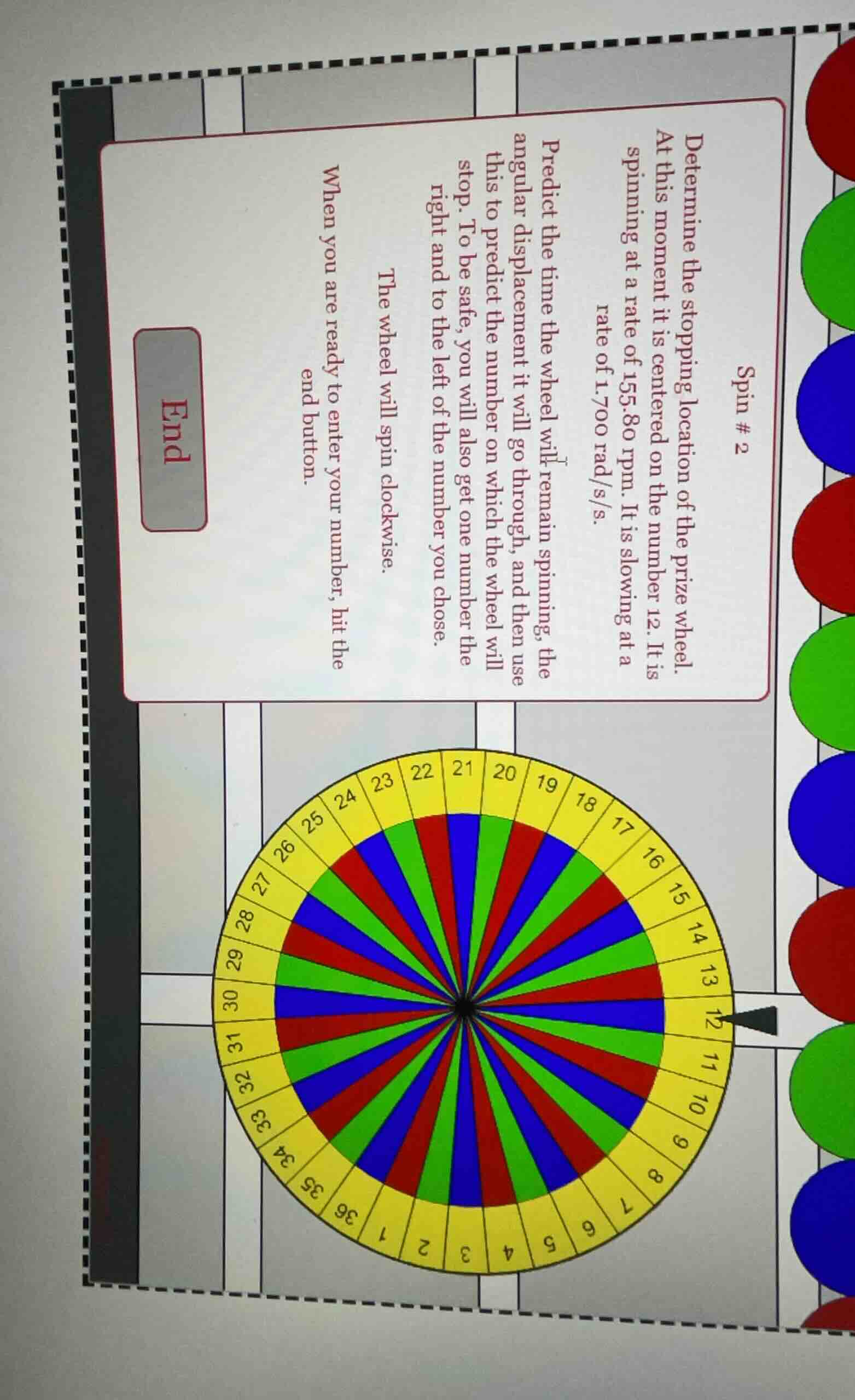
spin # 2
determine the stopping location of the prize wheel.
at this moment it is centered on the number 12. it is spinning at a rate of 155.80 rpm. it is slowing at a rate of 1.700 rad/s/s.
predict the time the wheel will remain spinning, the angular displacement it will go through, and then use this to predict the number on which the wheel will stop. to be safe, you will also get one number the right and to the left of the number you chose.
the wheel will spin clockwise.
when you are ready to enter your number, hit the end button.
end
Step1: Convert rpm to rad/s
The initial angular velocity \(\omega_0\) is given as \(155.80\) rpm. To convert this to rad/s, we use the conversion factor: \(1\) rpm \(=\frac{2\pi}{60}\) rad/s. So, \(\omega_0 = 155.80\times\frac{2\pi}{60}\) rad/s. Calculating this, \(\omega_0\approx155.80\times0.10472\approx16.31\) rad/s. The angular acceleration \(\alpha=- 1.700\) rad/s² (negative because it's slowing down). We need to find the time \(t\) when the wheel stops, so the final angular velocity \(\omega = 0\) rad/s.
Step2: Use the angular motion equation
The equation for angular motion is \(\omega=\omega_0+\alpha t\). We need to solve for \(t\). Rearranging the formula gives \(t=\frac{\omega - \omega_0}{\alpha}\). Substituting the values: \(\omega = 0\), \(\omega_0 = 16.31\) rad/s, \(\alpha=-1.700\) rad/s². So, \(t=\frac{0 - 16.31}{-1.700}\approx9.59\) s.
Step3: Find angular displacement
Now, we use the equation for angular displacement \(\theta=\omega_0t+\frac{1}{2}\alpha t^{2}\). Substituting \(\omega_0 = 16.31\) rad/s, \(t = 9.59\) s, \(\alpha=-1.700\) rad/s². \(\theta=16.31\times9.59+\frac{1}{2}\times(-1.700)\times(9.59)^{2}\). First, calculate \(16.31\times9.59\approx156.4\), and \(\frac{1}{2}\times(-1.700)\times(9.59)^{2}\approx\frac{- 1.700\times91.96}{2}\approx - 78.17\). Then, \(\theta\approx156.4-78.17 = 78.23\) rad.
Step4: Convert angular displacement to number of intervals
The wheel has 36 numbers (from 1 to 36), so the angle between each number is \(\Delta\theta=\frac{2\pi}{36}=\frac{\pi}{18}\approx0.1745\) rad per number. Now, we find how many numbers \(n\) are covered in \(\theta = 78.23\) rad. \(n=\frac{\theta}{\Delta\theta}=\frac{78.23}{0.1745}\approx448.3\). But since the wheel is spinning clockwise, we start from 12 and move clockwise. Wait, actually, the initial position is 12. Let's think again. The angular displacement is \(\theta = 78.23\) rad. The number of full rotations: each rotation is \(2\pi\approx6.283\) rad. Number of full rotations \(N=\frac{78.23}{6.283}\approx12.45\) rotations. The remaining angle after full rotations: \(\theta_{remaining}=78.23-12\times6.283=78.23 - 75.396 = 2.834\) rad. Now, convert this remaining angle to number of steps: each step is \(\frac{2\pi}{36}\) rad, so number of steps \(n=\frac{2.834}{\frac{2\pi}{36}}=\frac{2.834\times36}{2\pi}\approx\frac{102.024}{6.283}\approx16.24\). Since we start at 12 (clockwise), moving 16.24 steps clockwise. 12 + 16.24 = 28.24. But we also have the "safe" number (left of the chosen number). Wait, maybe I made a mistake in the direction. Wait, the wheel spins clockwise, so angular displacement is clockwise. The initial position is 12. Let's recast the angular displacement. Alternatively, maybe the wheel has 36 segments, each corresponding to a number from 1 to 36, so each segment is \(\frac{2\pi}{36}=\frac{\pi}{18}\) rad. The angular displacement \(\theta = 78.23\) rad. Let's find how many segments this is: \(n=\frac{\theta}{\frac{\pi}{18}}=\frac{78.23\times18}{\pi}\approx\frac{1408.14}{3.1416}\approx448.2\) segments. But since it's a wheel with 36 numbers, the number of full cycles of 36 is \(448.2\div36\approx12.45\) cycles. So, the remaining segments: \(448.2-12\times36=448.2 - 432 = 16.2\) segments. So, starting at 12, moving 16.2 segments clockwise: 12 + 16.2 = 28.2. So the wheel stops near 28, and the safe number (left) would be 27. Wait, maybe my initial angular velocity conversion was wrong. Let's re - check the rpm to rad/s conversion. \(155.80\) rpm: \(1\) rpm is \(\frac{2\pi}{60}\) rad/s, so \(155.80\times\frac{2\pi}{60}=155.80…

Snap & solve any problem in the app
Get step-by-step solutions on Sovi AI
Photo-based solutions with guided steps
Explore more problems and detailed explanations
The wheel stops near number 28, and the safe number (left of 28) is 27. (If we consider the angular displacement calculation, the final number the wheel stops on is approximately 28, and the number to the left is 27)