QUESTION IMAGE
Question
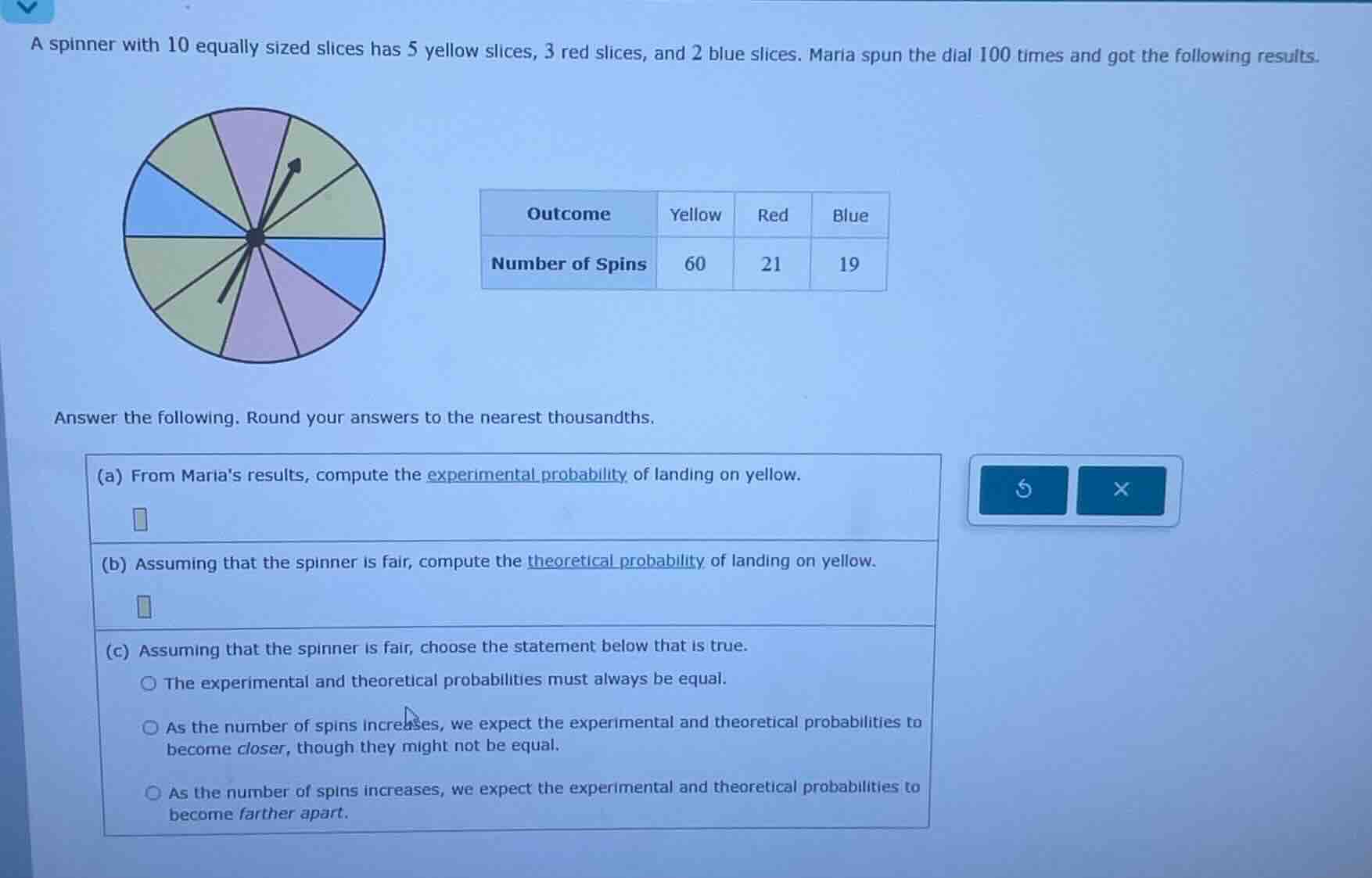
a spinner with 10 equally sized slices has 5 yellow slices, 3 red slices, and 2 blue slices. maria spun the dial 100 times and got the following results.
| outcome | yellow | red | blue |
|---|
answer the following. round your answers to the nearest thousandths.
(a) from marias results, compute the experimental probability of landing on yellow.
(b) assuming that the spinner is fair, compute the theoretical probability of landing on yellow.
(c) assuming that the spinner is fair, choose the statement below that is true.
- the experimental and theoretical probabilities must always be equal.
- as the number of spins increases, we expect the experimental and theoretical probabilities to become closer, though they might not be equal.
- as the number of spins increases, we expect the experimental and theoretical probabilities to become farther apart.
Step1: Calculate experimental yellow probability
$\text{Experimental Probability} = \frac{\text{Yellow Spins}}{\text{Total Spins}} = \frac{60}{100} = 0.600$
Step2: Calculate theoretical yellow probability
$\text{Theoretical Probability} = \frac{\text{Yellow Slices}}{\text{Total Slices}} = \frac{5}{10} = 0.500$
Step3: Identify true probability statement
Match to the law of large numbers principle.

Snap & solve any problem in the app
Get step-by-step solutions on Sovi AI
Photo-based solutions with guided steps
Explore more problems and detailed explanations
(a) $0.600$
(b) $0.500$
(c) As the number of spins increases, we expect the experimental and theoretical probabilities to become closer, though they might not be equal.