QUESTION IMAGE
Question
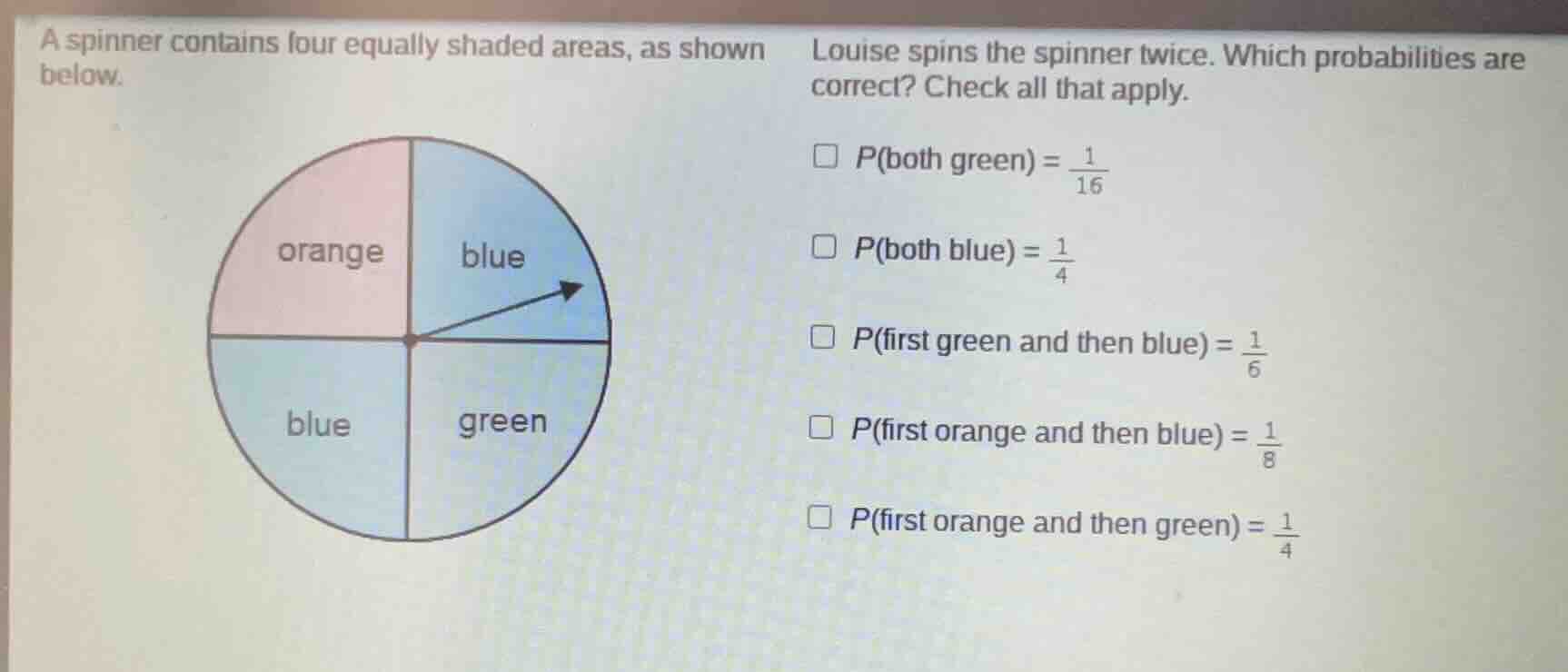
a spinner contains four equally shaded areas, as shown below. louise spins the spinner twice. which probabilities are correct? check all that apply. \\(\square\\) \\(p(\text{both green}) = \frac{1}{16}\\) \\(\square\\) \\(p(\text{both blue}) = \frac{1}{4}\\) \\(\square\\) \\(p(\text{first green and then blue}) = \frac{1}{6}\\) \\(\square\\) \\(p(\text{first orange and then blue}) = \frac{1}{8}\\) \\(\square\\) \\(p(\text{first orange and then green}) = \frac{1}{4}\\)
First, let's determine the probability of landing on each color. The spinner has 4 equal areas: orange, blue, blue, green. So the probabilities for each color are:
- \( P(\text{orange}) = \frac{1}{4} \)
- \( P(\text{blue}) = \frac{2}{4} = \frac{1}{2} \)
- \( P(\text{green}) = \frac{1}{4} \)
Since the spins are independent, we use the multiplication rule for independent events: \( P(A \text{ and } B) = P(A) \times P(B) \)
Step 1: Check \( P(\text{both green}) \)
\( P(\text{green}) = \frac{1}{4} \), so \( P(\text{both green}) = \frac{1}{4} \times \frac{1}{4} = \frac{1}{16} \). This is correct.
Step 2: Check \( P(\text{both blue}) \)
\( P(\text{blue}) = \frac{1}{2} \), so \( P(\text{both blue}) = \frac{1}{2} \times \frac{1}{2} = \frac{1}{4} \). This is correct.
Step 3: Check \( P(\text{first green and then blue}) \)
\( P(\text{green}) = \frac{1}{4} \), \( P(\text{blue}) = \frac{1}{2} \), so \( P(\text{first green and then blue}) = \frac{1}{4} \times \frac{1}{2} = \frac{1}{8} \). The given value is \( \frac{1}{6} \), which is incorrect.
Step 4: Check \( P(\text{first orange and then blue}) \)
\( P(\text{orange}) = \frac{1}{4} \), \( P(\text{blue}) = \frac{1}{2} \), so \( P(\text{first orange and then blue}) = \frac{1}{4} \times \frac{1}{2} = \frac{1}{8} \). This is correct.
Step 5: Check \( P(\text{first orange and then green}) \)
\( P(\text{orange}) = \frac{1}{4} \), \( P(\text{green}) = \frac{1}{4} \), so \( P(\text{first orange and then green}) = \frac{1}{4} \times \frac{1}{4} = \frac{1}{16} \). The given value is \( \frac{1}{4} \), which is incorrect.

Snap & solve any problem in the app
Get step-by-step solutions on Sovi AI
Photo-based solutions with guided steps
Explore more problems and detailed explanations
The correct probabilities are:
- \( P(\text{both green}) = \frac{1}{16} \)
- \( P(\text{both blue}) = \frac{1}{4} \)
- \( P(\text{first orange and then blue}) = \frac{1}{8} \)
So the correct options are:
- \( P(\text{both green}) = \frac{1}{16} \)
- \( P(\text{both blue}) = \frac{1}{4} \)
- \( P(\text{first orange and then blue}) = \frac{1}{8} \)