QUESTION IMAGE
Question
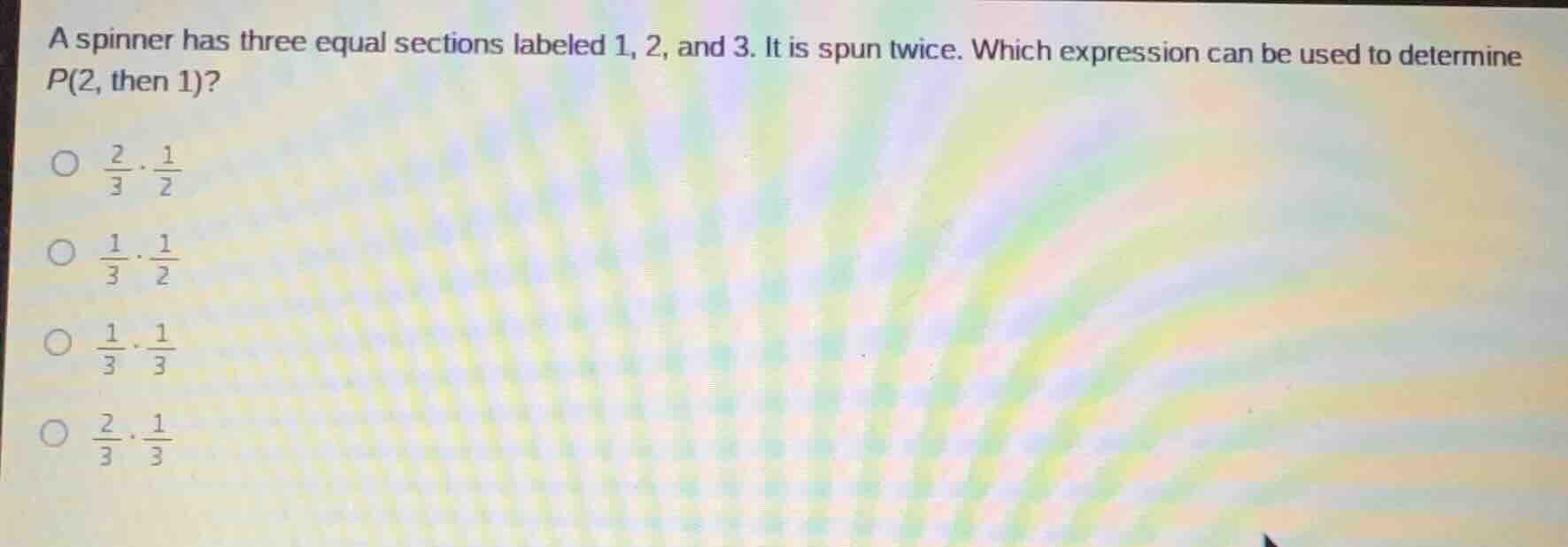
a spinner has three equal sections labeled 1, 2, and 3. it is spun twice. which expression can be used to determine p(2, then 1)?
$\frac{2}{3}\cdot\frac{1}{2}$
$\frac{1}{3}\cdot\frac{1}{2}$
$\frac{1}{3}\cdot\frac{1}{3}$
$\frac{2}{3}\cdot\frac{1}{3}$
Step1: Probability of first spin (landing on 2)
The spinner has 3 equal sections (1, 2, 3). The probability of landing on 2 in the first spin is the number of favorable outcomes (1, since only one section is labeled 2) divided by the total number of outcomes (3). So, \( P(2) = \frac{1}{3} \).
Step2: Probability of second spin (landing on 1)
After the first spin, the spinner still has 3 equal sections (since spinning doesn't change the sections, assuming it's a fair spinner and we're dealing with independent events? Wait, no—wait, actually, when spinning twice, are the events independent? Wait, the spinner has 3 sections, so each spin is independent. So the probability of landing on 1 in the second spin is also the number of favorable outcomes (1, for section 1) divided by total outcomes (3). So \( P(1) = \frac{1}{3} \). Wait, but wait—maybe I made a mistake. Wait, no, the options have \( \frac{1}{3} \cdot \frac{1}{3} \) as one of them. Wait, let's re-examine.
Wait, the spinner has three equal sections. So for the first spin, probability of 2 is \( \frac{1}{3} \). For the second spin, probability of 1 is \( \frac{1}{3} \), because the spinner is spun again, so the sections are still 1,2,3. So the two events are independent, so we multiply the probabilities: \( P(2 \text{ then } 1) = P(2) \times P(1) = \frac{1}{3} \times \frac{1}{3} \). Wait, but let's check the options. The third option is \( \frac{1}{3} \cdot \frac{1}{3} \)? Wait, no, the third option is \( \frac{1}{3} \cdot \frac{1}{3} \)? Wait, the options are:
- \( \frac{2}{3} \cdot \frac{1}{2} \)
- \( \frac{1}{3} \cdot \frac{1}{2} \)
- \( \frac{1}{3} \cdot \frac{1}{3} \)
- \( \frac{2}{3} \cdot \frac{1}{3} \)
Wait, maybe I misread. Wait, the problem is "spun twice". So first spin: probability of 2 is \( \frac{1}{3} \). Second spin: probability of 1 is \( \frac{1}{3} \), because after spinning once, the spinner is reset? Or is it without replacement? Wait, the spinner has three sections, so it's with replacement (since it's spun twice, so each spin is independent, same as original). So the probability of 2 then 1 is \( \frac{1}{3} \times \frac{1}{3} \), which is the third option. Wait, but let's check again.
Wait, maybe the question is about dependent events? But the spinner has three sections, labeled 1,2,3. If we spin it once and get 2, then spin it again—wait, no, the spinner is spun twice, so each spin is independent. So the probability of 2 on first spin is \( \frac{1}{3} \), probability of 1 on second spin is \( \frac{1}{3} \), so the expression is \( \frac{1}{3} \times \frac{1}{3} \), which is the third option. Wait, but the third option is \( \frac{1}{3} \cdot \frac{1}{3} \)? Wait, the third option is written as \( \frac{1}{3} \cdot \frac{1}{3} \)? Let me check the options again:
The options are:
- \( \frac{2}{3} \cdot \frac{1}{2} \)
- \( \frac{1}{3} \cdot \frac{1}{2} \)
- \( \frac{1}{3} \cdot \frac{1}{3} \)
- \( \frac{2}{3} \cdot \frac{1}{3} \)
Yes, the third option is \( \frac{1}{3} \cdot \frac{1}{3} \). Wait, but maybe I made a mistake. Wait, let's think again. The spinner has three sections: 1,2,3. So first spin: probability of 2 is 1/3. Second spin: probability of 1 is 1/3. So the expression is 1/3 * 1/3, which is the third option.

Snap & solve any problem in the app
Get step-by-step solutions on Sovi AI
Photo-based solutions with guided steps
Explore more problems and detailed explanations
\(\boldsymbol{\frac{1}{3} \cdot \frac{1}{3}}\) (the third option, i.e., the option with \(\frac{1}{3} \cdot \frac{1}{3}\))