QUESTION IMAGE
Question
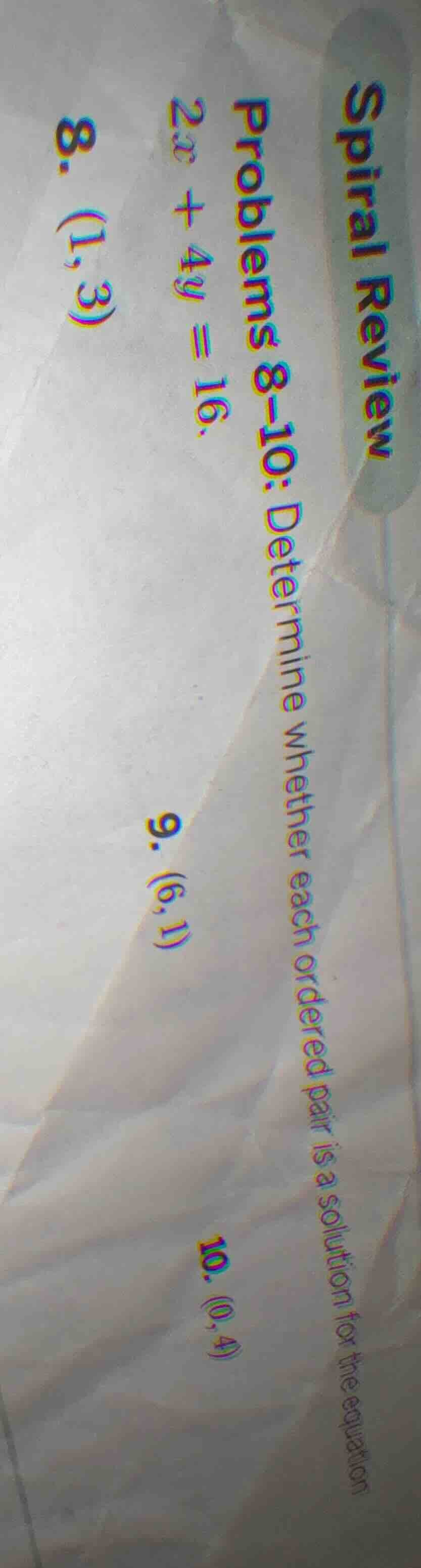
spiral review
problems 8–10: determine whether each ordered pair is a solution for the equation
2x + 4y = 16.
- (1, 3)
- (6, 1)
- (0, 4)
To determine if an ordered pair \((x, y)\) is a solution to the equation \(2^x + 4^y = 16\), we substitute the values of \(x\) and \(y\) from the ordered pair into the equation and check if the left - hand side equals the right - hand side (which is 16).
Problem 8: Check the ordered pair \((1, 3)\)
Step 1: Substitute \(x = 1\) and \(y=3\) into the left - hand side of the equation
We know that for the equation \(2^x+4^y\), when \(x = 1\) and \(y = 3\), we calculate \(2^x\) and \(4^y\) separately.
For \(2^x\) with \(x = 1\), we have \(2^1=2\).
For \(4^y\) with \(y = 3\), we know that \(4=2^2\), so \(4^y=(2^2)^y = 2^{2y}\). When \(y = 3\), \(4^3=(2^2)^3=2^{6} = 64\).
Then the left - hand side of the equation \(2^x + 4^y\) is \(2^1+4^3=2 + 64=66\).
Step 2: Compare with the right - hand side
The right - hand side of the equation is 16. Since \(66
eq16\), the ordered pair \((1, 3)\) is not a solution to the equation \(2^x + 4^y=16\).
Problem 9: Check the ordered pair \((6, 1)\)
Step 1: Substitute \(x = 6\) and \(y = 1\) into the left - hand side of the equation
For \(2^x\) with \(x = 6\), we have \(2^6=64\).
For \(4^y\) with \(y = 1\), we have \(4^1 = 4\).
Then the left - hand side of the equation \(2^x+4^y\) is \(2^6 + 4^1=64 + 4=68\).
Step 2: Compare with the right - hand side
The right - hand side of the equation is 16. Since \(68
eq16\), the ordered pair \((6, 1)\) is not a solution to the equation \(2^x + 4^y = 16\).
Problem 10: Check the ordered pair \((0, 4)\)
Step 1: Substitute \(x = 0\) and \(y = 4\) into the left - hand side of the equation
For \(2^x\) with \(x = 0\), we know that any non - zero number to the power of 0 is 1, so \(2^0 = 1\).
For \(4^y\) with \(y = 4\), we have \(4^4=(2^2)^4=2^{8}=256\).
Then the left - hand side of the equation \(2^x + 4^y\) is \(2^0+4^4=1 + 256 = 257\).
Step 2: Compare with the right - hand side
The right - hand side of the equation is 16. Since \(257
eq16\), the ordered pair \((0, 4)\) is not a solution to the equation \(2^x+4^y = 16\).
Final Answers
- The ordered pair \((1, 3)\) is not a solution.
- The ordered pair \((6, 1)\) is not a solution.
- The ordered pair \((0, 4)\) is not a solution.

Snap & solve any problem in the app
Get step-by-step solutions on Sovi AI
Photo-based solutions with guided steps
Explore more problems and detailed explanations
To determine if an ordered pair \((x, y)\) is a solution to the equation \(2^x + 4^y = 16\), we substitute the values of \(x\) and \(y\) from the ordered pair into the equation and check if the left - hand side equals the right - hand side (which is 16).
Problem 8: Check the ordered pair \((1, 3)\)
Step 1: Substitute \(x = 1\) and \(y=3\) into the left - hand side of the equation
We know that for the equation \(2^x+4^y\), when \(x = 1\) and \(y = 3\), we calculate \(2^x\) and \(4^y\) separately.
For \(2^x\) with \(x = 1\), we have \(2^1=2\).
For \(4^y\) with \(y = 3\), we know that \(4=2^2\), so \(4^y=(2^2)^y = 2^{2y}\). When \(y = 3\), \(4^3=(2^2)^3=2^{6} = 64\).
Then the left - hand side of the equation \(2^x + 4^y\) is \(2^1+4^3=2 + 64=66\).
Step 2: Compare with the right - hand side
The right - hand side of the equation is 16. Since \(66
eq16\), the ordered pair \((1, 3)\) is not a solution to the equation \(2^x + 4^y=16\).
Problem 9: Check the ordered pair \((6, 1)\)
Step 1: Substitute \(x = 6\) and \(y = 1\) into the left - hand side of the equation
For \(2^x\) with \(x = 6\), we have \(2^6=64\).
For \(4^y\) with \(y = 1\), we have \(4^1 = 4\).
Then the left - hand side of the equation \(2^x+4^y\) is \(2^6 + 4^1=64 + 4=68\).
Step 2: Compare with the right - hand side
The right - hand side of the equation is 16. Since \(68
eq16\), the ordered pair \((6, 1)\) is not a solution to the equation \(2^x + 4^y = 16\).
Problem 10: Check the ordered pair \((0, 4)\)
Step 1: Substitute \(x = 0\) and \(y = 4\) into the left - hand side of the equation
For \(2^x\) with \(x = 0\), we know that any non - zero number to the power of 0 is 1, so \(2^0 = 1\).
For \(4^y\) with \(y = 4\), we have \(4^4=(2^2)^4=2^{8}=256\).
Then the left - hand side of the equation \(2^x + 4^y\) is \(2^0+4^4=1 + 256 = 257\).
Step 2: Compare with the right - hand side
The right - hand side of the equation is 16. Since \(257
eq16\), the ordered pair \((0, 4)\) is not a solution to the equation \(2^x+4^y = 16\).
Final Answers
- The ordered pair \((1, 3)\) is not a solution.
- The ordered pair \((6, 1)\) is not a solution.
- The ordered pair \((0, 4)\) is not a solution.