QUESTION IMAGE
Question
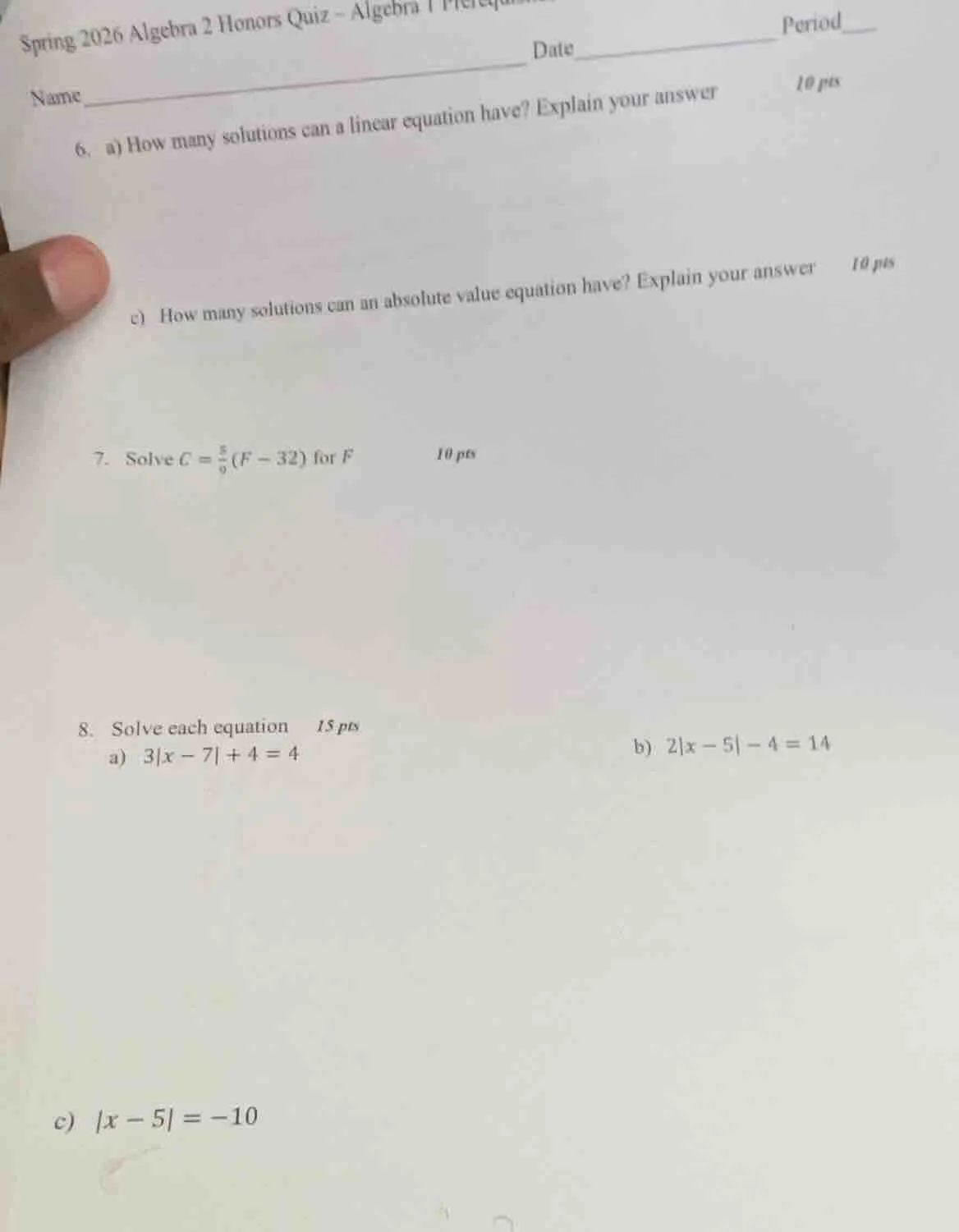
spring 2026 algebra 2 honors quiz - algebra 1 prerequisites
name ____________________________ date ___________ period_
- a) how many solutions can a linear equation have? explain your answer 10 pts
c) how many solutions can an absolute value equation have? explain your answer 10 pts
- solve ( c = \frac{5}{9}(f - 32) ) for ( f ) 10 pts
- solve each equation 15 pts
a) ( 3|x - 7| + 4 = 4 )
b) ( 2|x - 5| - 4 = 14 )
c) ( |x - 5| = -10 )
Question 6a
A linear equation in one variable can have 1 unique solution when the coefficient of the variable is non-zero (e.g., $2x=4$ has solution $x=2$). It can have infinitely many solutions if it simplifies to a true statement with no variable (e.g., $2x+3=2x+3$, which is true for all $x$). It can have no solutions if it simplifies to a false statement (e.g., $2x+1=2x+3$, which is never true).
An absolute value represents a non-negative distance, so $|A|\geq0$ for all real numbers $A$. If the equation sets the absolute value equal to a positive number, there are 2 solutions (e.g., $|x|=5$ has $x=5$ and $x=-5$). If it equals 0, there is 1 solution (e.g., $|x-2|=0$ has $x=2$). If it equals a negative number, there are 0 solutions, since absolute value cannot be negative.
Step1: Multiply both sides by 9
$9C = 5(F-32)$
Step2: Divide both sides by 5
$\frac{9C}{5} = F - 32$
Step3: Add 32 to both sides
$F = \frac{9C}{5} + 32$

Snap & solve any problem in the app
Get step-by-step solutions on Sovi AI
Photo-based solutions with guided steps
Explore more problems and detailed explanations
A linear equation can have 0, 1, or infinitely many solutions:
- 1 solution: When the equation simplifies to a single value for the variable.
- 0 solutions: When the equation simplifies to a false contradiction.
- Infinitely many solutions: When the equation simplifies to a true identity valid for all values of the variable.
---