QUESTION IMAGE
Question
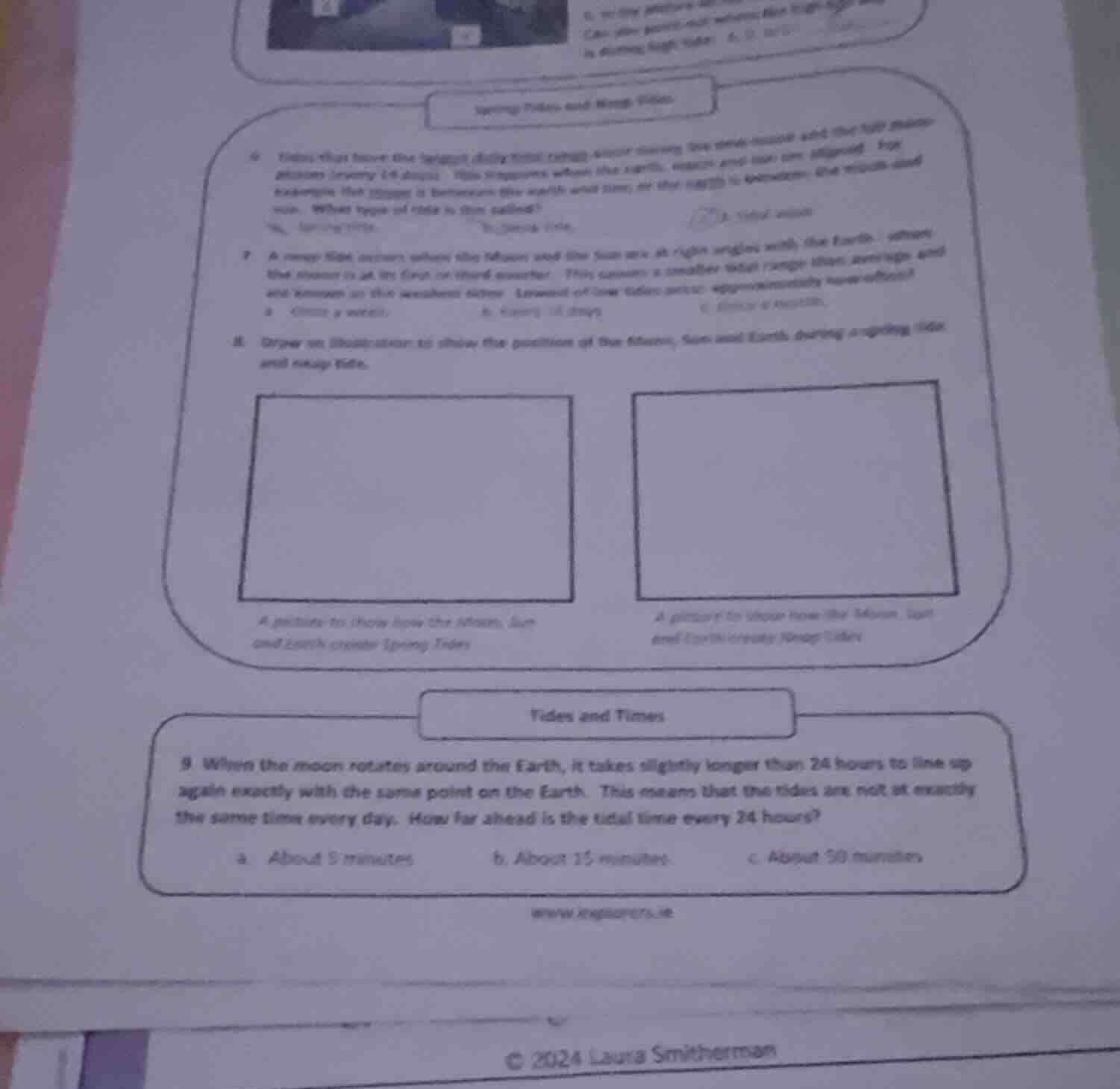
spring tides and neap tides6. tides that have the highest high tide and lowest low tide occur and the full moon phases every 14 days. this happens when the earth, moon and sun are aligned. for example that happens is between the earth and sun, or the earth is between the moon and sun. what type of tide is this called?a. spring tide. b. neap tide. c. tidal wave7. a neap tide occurs when the moon and the sun are at right angles with the earth, when the moon is at its first or third quarter. this causes a smaller tidal range than average and are known as the weakest tides. how often do low tides occur approximately twice often?a. once a week. b. every 14 days. c. once a month.8. draw an illustration to show the position of the moon, sun and earth during a spring tide and neap tide.a picture to show how the moon, sun and earth create spring tidesa picture to show how the moon, sun and earth create neap tidestides and times9. when the moon rotates around the earth, it takes slightly longer than 24 hours to line up again exactly with the same point on the earth. this means that the tides are not at exactly the same time every day. how far ahead is the tidal time every 24 hours?a. about 5 minutes b. about 15 minutes c. about 50 minutes
Step1: Identify tide type for Q6
Spring tides occur when Earth, Moon, Sun are aligned, creating the largest tidal range every 14 days.
Step2: Determine neap tide frequency (Q7)
Neap tides occur when Moon/Sun are at right angles to Earth, happening every ~14 days.
Step3: Calculate tidal time shift (Q9)
The Moon's orbital period causes tides to shift ~50 minutes daily.
Step4: Sketch spring tide alignment
Draw Earth between Sun and Moon (or Moon between Earth and Sun), with tidal bulges on opposite sides of Earth, labeled: Sun, Earth, Moon, Tidal Bulges.
Step5: Sketch neap tide alignment
Draw Earth with Moon at a 90° angle to the Sun, with smaller tidal bulges, labeled: Sun, Earth, Moon, Small Tidal Bulges.

Snap & solve any problem in the app
Get step-by-step solutions on Sovi AI
Photo-based solutions with guided steps
Explore more problems and detailed explanations
- Spring Tide
- b. Every 14 days
8.
- Spring Tide Diagram: A central Earth, with the Sun on one side and the Moon directly on the opposite side (or Moon between Earth and Sun), with two large, equal bulges on Earth's opposite ends (toward/away from the Moon).
- Neap Tide Diagram: A central Earth, with the Sun on one side and the Moon at a right angle to the Sun relative to Earth, with two smaller, equal bulges on Earth.
- c. About 50 minutes