QUESTION IMAGE
Question
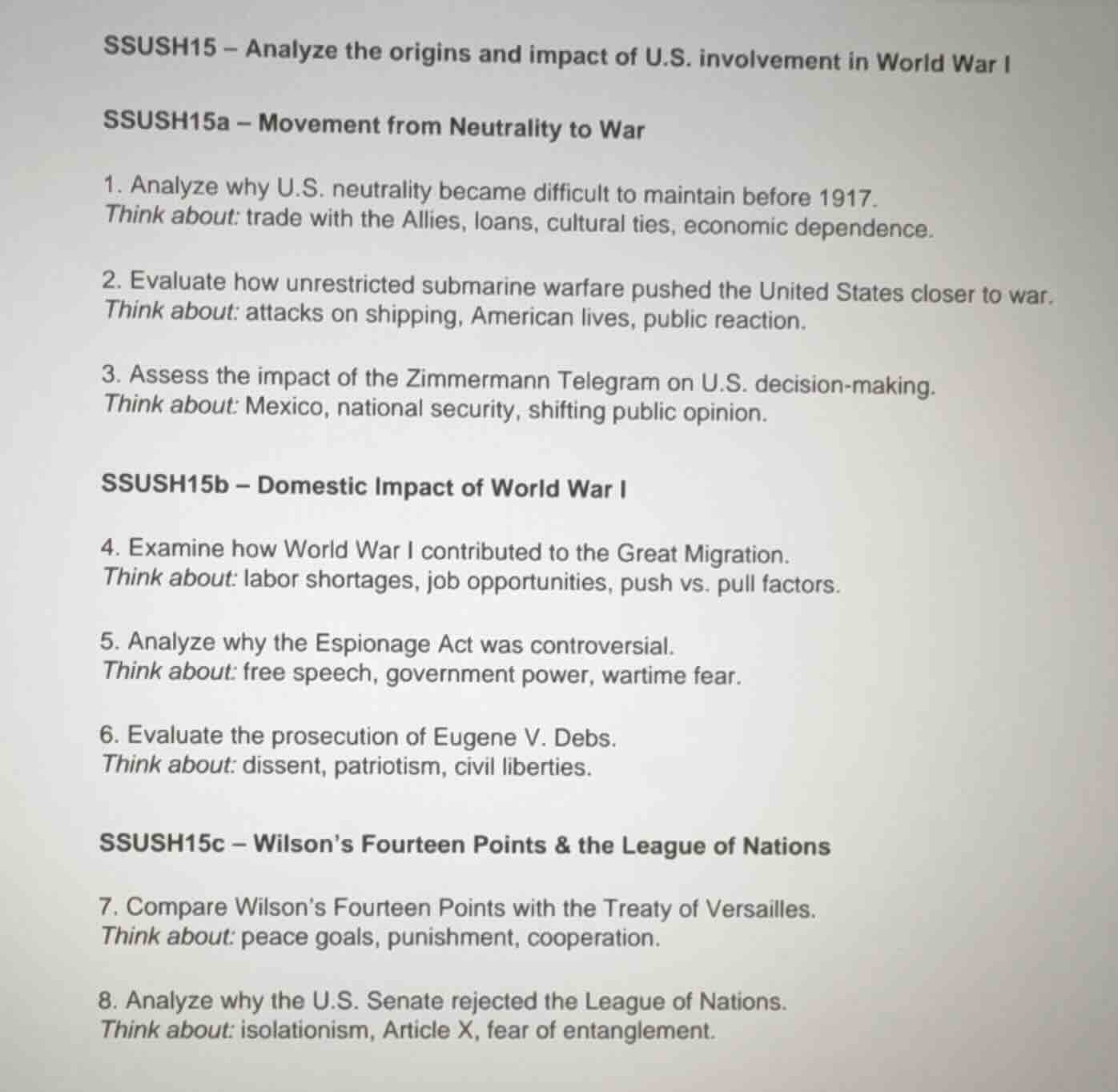
ssush15 – analyze the origins and impact of u.s. involvement in world war i
ssush15a – movement from neutrality to war
- analyze why u.s. neutrality became difficult to maintain before 1917.
think about: trade with the allies, loans, cultural ties, economic dependence.
- evaluate how unrestricted submarine warfare pushed the united states closer to war.
think about: attacks on shipping, american lives, public reaction.
- assess the impact of the zimmermann telegram on u.s. decision - making.
think about: mexico, national security, shifting public opinion.
ssush15b – domestic impact of world war i
- examine how world war i contributed to the great migration.
think about: labor shortages, job opportunities, push vs. pull factors.
- analyze why the espionage act was controversial.
think about: free speech, government power, wartime fear.
- evaluate the prosecution of eugene v. debs.
think about: dissent, patriotism, civil liberties.
ssush15c – wilson’s fourteen points & the league of nations
- compare wilson’s fourteen points with the treaty of versailles.
think about: peace goals, punishment, cooperation.
- analyze why the u.s. senate rejected the league of nations.
think about: isolationism, article x, fear of entanglement.
This appears to be a set of questions related to the history of the United States' involvement in World War I, including its origins, domestic impact, and post - war developments. Since no specific question is asked (e.g., to answer one of these sub - questions, or to identify the discipline), if you want to answer a particular sub - question (for example, question 1: "Analyze why U.S. neutrality became difficult to maintain before 1917"), here is the answer - explanation format:
- Trade with the Allies: The U.S. had significant trade with the Allied powers (Britain, France, etc.). As the war continued, the U.S. economy became more intertwined with the Allies' war effort. The British naval blockade also made it harder for the U.S. to trade with the Central Powers, pushing the U.S. towards the Allied side in terms of economic interests.
- Loans: The U.S. provided large - scale loans to the Allies. If the Allies were to lose the war, the U.S. would likely face significant losses on these loans. This financial stake made neutrality harder to sustain as the U.S. had an economic incentive for the Allies to win.
- Cultural Ties: There were strong cultural ties between the U.S. and the Allied countries, especially Britain. Shared language, history, and cultural values created a sense of affinity with the Allies, which influenced public opinion and made neutrality in spirit difficult, even if the government tried to be neutral.
- Economic Dependence: The U.S. economy became dependent on the war - related trade and loans to the Allies. A loss by the Allies would disrupt this economic relationship, affecting American businesses and the overall economy. So, maintaining neutrality became a challenge as the U.S. economy was increasingly tied to the Allied war effort.

Snap & solve any problem in the app
Get step-by-step solutions on Sovi AI
Photo-based solutions with guided steps
Explore more problems and detailed explanations
U.S. neutrality before 1917 became difficult to maintain due to trade with the Allies (intertwined economy, British blockade limiting Central Powers trade), loans to the Allies (financial stake in their victory), cultural ties with the Allies (shared values/history), and economic dependence on the Allied - centered war - related economic activities.
If you have a different sub - question or a different request (e.g., identifying the discipline, which would be Social Science - History), please clarify.